AI & Predictive Analytics in Freight Forwarding
Streamline operations, improve efficiency, and reduce costs
What if a machine could perform tasks that usually require human intelligence; for example, a machine that could recognize patterns, build on experience, and take decisions? Certainly, this would relieve human workers from important but routine tasks, allowing them to dedicate their time and skills to more important, value-adding tasks. To do this, the machine would need artificial intelligence (AI) – the ability for computers to learn and think.
Why Predictive Analytics is Changing Freight Forwarding
Predictive analytics is described as a range of sophisticated techniques and tools to analyze and interpret data to extract insights and foresights and provide actionable intelligence beyond what is offered by traditional business intelligence (BI) methods. Together, AI and predictive analytics are transforming freight forwarding and the supply chain in many ways. Some key examples include helping to streamline operations, improve efficiency, and reduce costs.
For example, AI and predictive analytics can help optimize routes, forecast delivery times, and manage risks like traffic congestion and weather disruption. They can also help anticipate demand fluctuation, enabling better resource allocation and inventory management. They enable better decision making by providing real-time insights and allowing proactive adjustments to processes and schedules across the supply chain. And for shippers, AI and predictive analytics can ensure faster and more reliable shipping services.
How Exactly is This Done?

Large volumes of logistics data must be analyzed. To do this, AI relies on algorithms that can learn from patterns in the data. Equipped with AI algorithms, the machine can now apply the learned knowledge to undertake tasks that would normally require human intelligence. In addition, the algorithms can utilize experience to improve over time; the more data an algorithm processes, the more accurate its predictions and decisions become.
Predictive analytics leverages a range of methodologies, such as statistical analysis, predictive modeling, machine learning (ML), and data mining. Today, rather than merely having access to large volumes of data in the supply chain, logistics professionals can intelligently use and analyze this data for strategic advantage, which is essential to answer the increasingly complex and specific questions asked by businesses today.
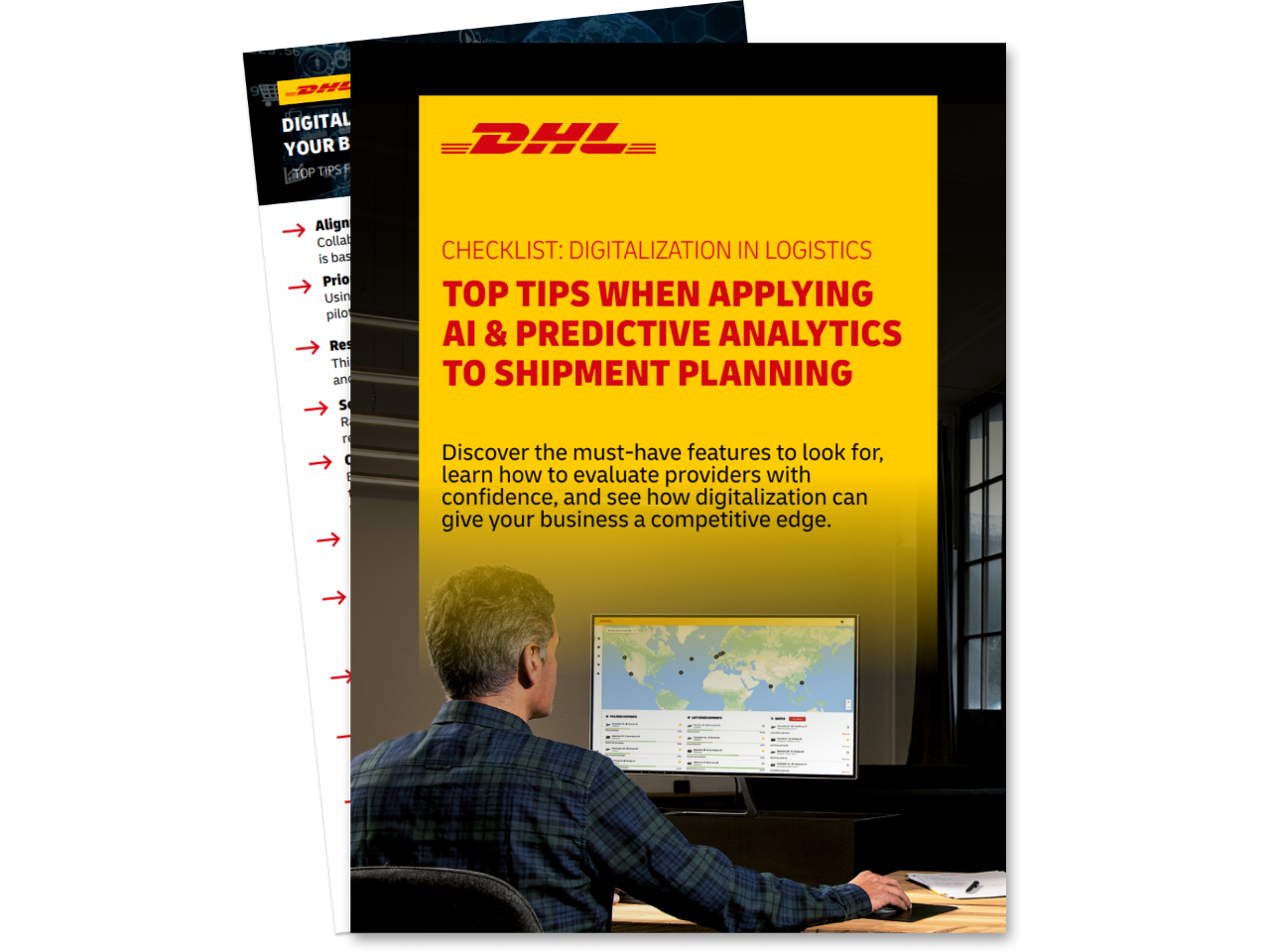
Checklist: Top Tips When Applying AI & Predictive Analytics to Shipment Planning
Discover how predictive analytics can boost reliability, optimize routes, and reduce manual work—while improving agility and sustainability in your supply chain.
Reliability of AI and Predictive Analytics
For shippers to rely on AI and predictive analytics for freight forwarding, it’s essential to have clean, high-quality data. The accuracy of insights and the efficacy of predictive models are directly contingent on the integrity of the underlying data. This requires robust data management practices, emphasizing not just the cleaning but also the integration of predictive analytics into the existing IT infrastructure, which can present significant technical challenges, requiring careful planning and substantial investment in technology upgrades.
Good governance of data is also essential. There needs to be a well-built data governance framework in place to ensure data quality and compliance across departments and functions. To achieve data privacy and security, data from various sources must be protected against breaches and unauthorized access.
Most Useful Applications for Shippers Today
One thing has historically caused great difficulty for shippers: Inaccuracy of the estimated time of arrival (ETA) of ocean freight shipments. Typically, the carrier will provide an ETA but, in general terms, the quality and reliability of ocean schedules have deteriorated in recent years, making it difficult for shippers to plan port pickups and production-related processes. This uncertainty limits the shipper’s proactive exception management and customer communication during freight forwarding.
With an accurate ETA, shippers can improve planning and supply chain efficiency. By knowing when goods will arrive, you can ensure timely unloading, storage, and distribution, preventing congestion and downtime. You can also optimize resource allocation, making sure the right people and equipment are in the right place at the right time, and you can manage your customers’ delivery expectations by keeping them fully informed of any delays. This boosts end-to-end supply chain productivity.

Get Logistics Insights by Email
Subscribe to our monthly market updates and get invited to exclusive webinars where our Freight Forwarding Experts answer all your questions on global trade.
DHL's Smart ETA Approach for Consistent Ocean Shipment Visibility
DHL provides ETA visibility for ocean freight shipments through its Smart ETA approach, available to customers through the myDHLi platform.
Smart ETA is designed to improve consistency and transparency in ocean freight arrival information by aligning ETA data across shipments travelling on the same vessel voyage. Rather than relying on a single ETA source, Smart ETA evaluates available carrier-provided arrival estimates and applies harmonization logic to provide a consistent ETA view for shipments associated with the same sailing.
This approach helps reduce situations where multiple shipments on the same vessel display conflicting arrival dates, improving visibility and simplifying customer planning and communication.
ETA information is continuously refreshed as new carrier updates become available, helping customers maintain visibility of their shipments throughout the transportation lifecycle. Today's Smart ETA solution focuses on delivering a reliable and consistent ETA experience while DHL continues to evaluate future enhancements in ETA prediction capabilities.
Benefits include:
- Improved consistency of ETA information across shipments on the same voyage
- Reduced confusion caused by conflicting carrier estimates
- Better visibility for shipment planning and exception management
- A common ETA reference point across customer reporting and visibility solutions.

Future Development of ETA Intelligence
DHL continues to invest in improving shipment visibility and ETA accuracy across its Ocean Freight products.
Current development activities focus on improving voyage grouping, data quality, ETA consistency, vessel identification, and the overall customer experience for shipment tracking. DHL is also evaluating new data sources and external visibility providers to determine how additional maritime intelligence can further enhance ETA quality and reliability.
As supply chains become increasingly dynamic, DHL's long-term vision remains the delivery of more accurate, proactive and actionable shipment visibility information across the entire transportation journey. This includes continued exploration of advanced analytics, AI-enabled decision support, and enhanced disruption visibility to help customers anticipate and manage changes in their supply chains more effectively.

Try myDHLi Out Now
Interested to learn more about myDHLi by watching a demo?
Want to Read More Freight Forwarding Stories?
Get the latest on Air, Ocean and Rail Freight Forwarding in your inbox every month, along with regular invitations to our webinars.