Traditional methods of B2B operations – from sales to customer interactions; from fulfillment to delivery – are changing rapidly. The industry is digitalizing, driven by the expansion of digital networks and a new influx of millennials in decision-making roles.
In Latin America's largest digital economy, corporate purchasers now expect flexible, convenient, and digitally-focused services more aligned with their everyday B2C experiences. Brazilian B2B businesses that want to make the most of cross-border e-commerce opportunities will need to adapt their traditional sales models – and fast.
This exclusive White Paper explores how your business can move with the trend, including:
The changing B2B customer – who they are and what they expect from your business
How to optimize your B2B e-commerce sales channel(s) to maximize new opportunities
The features that will enhance your e-commerce growth – from digital infrastructure to personalization to synchronization of logistics
Your B2B e-commerce revolution starts here. Download the White Paper to begin your journey towards meeting the new customer demands and help your business grow into a more profitable operation.
What is B2B e-commerce?
B2B e-commerce (business-to-business electronic commerce) is simply the online sale of goods or services between businesses. Instead of placing orders through phone calls, emails or sales reps, buyers log into a digital portal or marketplace to browse products, view contract pricing, and place orders directly.
It brings the convenience of B2C-style shopping into the B2B world – but with added layers such as bulk ordering, negotiated pricing, and account-based purchasing.
You’ll see B2B e-commerce in action on global marketplaces like Alibaba, where wholesalers connect with buyers worldwide, or Amazon (through its B2B offering), which enables businesses to purchase everything from office supplies to industrial equipment online.
At its core, B2B e-commerce makes buying and selling faster and easier to scale – especially for businesses looking to grow across borders.
According to e-commerce data from ABCOMM and global trade indicators, the global B2B e-commerce market was valued at U.S.$30.1 trillion in 2025, and is expected to reach U.S.$44.5 trillion by 2029. For Brazilian manufacturers and distributors, this growth represents a massive opportunity to capture international corporate market share.
The global B2B e-commerce market was valued at U.S.$30.1 trillion in 2025, and is expected to reach U.S.$44.5 trillion by 20291
Key insights from our ultimate B2B e-commerce guide
It’s a global opportunity
B2B e-commerce is thriving worldwide. Asia-Pacific leads the market in overall value, with China at the forefront and rapid digital growth across India and Southeast Asia. North America remains a powerhouse, while Europe continues to expand through strong intra-regional trade.
For B2B businesses, this signals real cross-border potential. Buyers are increasingly comfortable sourcing internationally, and digital platforms make it easier than ever to reach them. With the right logistics strategy in place, businesses can tap into new markets and compete on a global stage.
B2B buyers want to shop like B2C customers
Today’s B2B decision-makers don’t separate their professional expectations from their personal buying experiences. They want intuitive websites, clear product information, fast search, mobile-friendly design and easy self-service tools for tracking and reordering.
Personalization also matters – from tailored pricing to relevant product recommendations based on purchasing history or industry. In short, frictionless digital experiences are no longer a “nice-to-have.” They’re becoming the standard.
Relationship building can still be done – just online
B2B sales have always been built on relationships carefully nurtured over time. As the sector moves online, the foundations remain the same – but the tools for building trust evolve.
Transparent policies, reliable delivery and proactive communication all help build trust in a digital environment. Dedicated account management, responsive support channels and meaningful post-sale follow-up remain essential, too. When done well, digital engagement can actually strengthen loyalty.
Challenges of B2B e-commerce
Adopting and scaling B2B e‑commerce brings big opportunities – but it also comes with real challenges that businesses need to understand and plan for.

Upskilling and cultural change
Moving to digital channels often means rethinking how teams work. Employees need new skills, a digital‑first mindset, and openness to innovation to support changing customer expectations and evolving supply chain processes.

Cross‑border complexity
Selling internationally introduces added layers of complexity, including volatile exchange rates, varying customs requirements, duties and taxes, and differences in infrastructure quality across markets. Understanding these factors and building agile logistics networks is critical for success.
Competitive pressure
Large, established players with legacy systems can struggle to keep up with nimbler, digitally-native competitors. Without rapid adaptation, incumbents risk losing market share or being outpaced by more agile rivals.

Pricing and online negotiation
B2B buyers are accustomed to negotiated pricing and bespoke deals through sales teams. Translating these complex pricing structures into an online environment – such as tiered discounts or bulk pricing – requires thoughtful digital strategy to avoid losing buyers or margin.
How do Receita Federal tax regulations impact Brazilian B2B e-commerce exports?
Receita Federal tax regulations impact Brazilian B2B e-commerce exports because every bulk international transaction must be synchronized with the Siscomex system and validated under a formal Declaração Única de Exportação (DU-E) to ensure compliance.
Unlike standard B2C international sales that can often utilize simplified shipping regimes, high-volume wholesale orders require strict corporate tax verification, including matching the seller's Cadastro Nacional da Pessoa Jurídica (CNPJ) and accurate Nomenclatura Comum do Mercosul (NCM) tariff codes.
Data from SEBRAE indicates that incorrect product classification on fiscal invoices is one of the leading causes of customs delays for small and medium-sized Brazilian exporters.
To maintain operational continuity and avoid tax penalties during high-volume global sales events, follow these three compliance practices:
Automate Invoice Integrations: Connect your e-commerce engine (such as VTEX or Nuvemshop) directly with a localized ERP tool like Bling, Tiny, or Omie to generate international Notas Fiscais de Exportação automatically.
Utilize Electronic Data Interchange (EDI): Transmit package weights, descriptions, and tax data to your transport carrier digitally to bypass manual border delays.
Establish an Inbound Compliance Library: Pre-verify all required commercial certificates—such as health or phytosanitary documents—to accelerate outbound customs verification.
Five strategies to engage your customers with B2B e-commerce

Invest in digital infrastructure
A strong digital backbone is the foundation of successful B2B e-commerce. From user-friendly portals to integrated inventory and ERP systems, investing in robust technology ensures your customers can browse, order, and track purchases seamlessly.

Prioritize the customer experience
B2B buyers expect the same smooth experience they get as B2C consumers. Things like clear product information, easy navigation, fast search, and mobile-friendly interfaces all help reduce friction and encourage repeat orders.

Offer personalized solutions
Personalization goes beyond using a customer’s name. Tailor pricing, product recommendations, and promotions to individual businesses or account tiers. When buyers feel a platform understands their unique needs, they’re more likely to stay loyal.

Adopt an omni-channel approach
B2B customers interact with businesses in multiple ways – online, offline, via email, or through sales reps. Providing a consistent experience across all channels ensures buyers can engage how they want, without gaps or confusion, creating stronger relationships and higher conversion rates.

Synchronize your logistics
Efficient logistics is key to keeping customers happy, especially in cross-border trade. By integrating fulfillment, inventory, and shipping systems, you can provide accurate stock updates, reliable delivery, and transparent tracking – turning timely, hassle-free delivery into a competitive advantage.
Choosing a B2B e-commerce fulfillment partner
Once you have laid the foundations for your B2B e-commerce venture – your website, purchasing, marketing, putting a CRM in place – you will need to optimize your supply chain across all areas including warehousing and last-mile delivery.
Operational Parameter | B2B Fulfillment Requirement |
Order and Item Volume | Fewer individual orders but larger item quantities; requires substantial space. |
Picking & Packing | Focuses heavily on carton picks, master box configurations, and pallet assembly. |
Shipping Methods | Requires cargo networks accustomed to cross-border logistics and customs brokerage. |
Delivery Speed | Planned bulk shipments; demands absolute date-certain reliability from the carrier. |
Returns Pipeline | Structured workflows for reverse logistics, bulk sorting, and corporate restocking. |
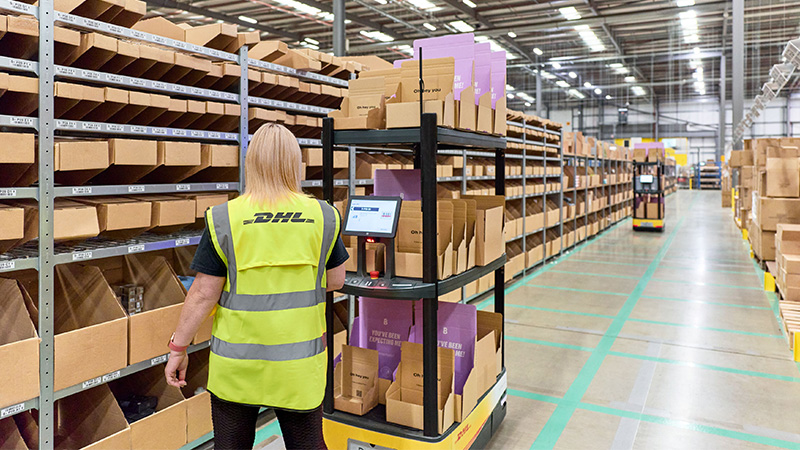
Your logistics provider must be equipped to handle these specialized wholesale requirements without causing data gaps in your customer pipeline. DHL Express’s global network supports both B2C and B2B e-commerce businesses in the efficient storage, commissioning, and delivery of their products.
Their flexible, scalable service integrates seamlessly with all major international webshops and marketplaces, giving your brand end-to-end visibility.
For fast, international B2B shipping, open a DHL Express Business Account.


 Share
Share