Is your business ready for international growth? To sell to the world, you need to understand the world – specifically, which markets promise the most prosperous opportunities. And that’s why the all-new DHL Trade Atlas 2025 is an invaluable tool…
Is your business ready to transition from a domestic leader into a high-performing international brand? To sell to the world successfully, you need to understand the world—specifically, which foreign markets promise the most stable and prosperous growth opportunities for your enterprise.
For Brazilian small and medium enterprises (SMEs) and e-commerce brands looking to scale beyond the local marketplace ecosystem, the newly updated DHL Trade Atlas 2026 serves as an invaluable strategic map.
Produced in partnership with the New York University Stern School of Business, the Atlas analyzes a wealth of data from around the world to map the shifting landscape of global trade.
To help your executive team pinpoint high-yield business opportunities, the report features data-backed insights covering nearly 200 countries and territories. This edition arrives at a critical transition point for Latin America's largest economy, as shifting export regulations, new trade agreements, and changing supply chains dominate international corporate agendas.
Yet, despite macroeconomic turbulence, the Atlas highlights resilient, highly positive signals on the global logistics horizon.
How is global trade expanding in a turbulent business environment?
Global trade is structurally forecast to grow at a modestly faster pace over the next five years than during the preceding decade, driven by the expansion of digital sales channels and resilient cross-border demand.
While changes in trade frameworks and shifting tariff parameters by major world economies create operational uncertainty, predictive models indicate these adjustments are highly unlikely to reverse the baseline growth of international commerce.
Even if all proposed international tariff increases enter into force and major trading blocs implement retaliatory measures, global trade volume is still projected to maintain a forward trajectory through 2031, though at a more measured pace.
Decision-makers running growing businesses must prepare to seize opportunities and manage risks in an increasingly complex global trade environment. While the superpowers of China, the U.S., and India are set to retain their leading absolute trade growth positions, trade flows continue to stretch out over longer average distances.
This structural shift is uncovering dynamic new hotspots of opportunity—with Viet Nam, Indonesia, and the Philippines expected to rank exceptionally highly for both the speed and physical scale of their trade expansion over the next five years. Using data visualizations, charts, and interactive maps to bring these macroeconomic facts to life, the report serves as a unique resource to help your business focus its cross-border growth strategy on the most promising and prosperous markets.
How do global trade shifts affect export opportunities for Brazilian SMEs?
Global trade shifts directly redefine export opportunities for Brazilian SMEs by exposing new alternative routing channels and uncaptured consumer demand across emerging trade corridors.
According to small business data from SEBRAE, structural hurdles at home—such as navigating complex tax rules or managing currency fluctuations through the Banco Central do Brasil—frequently discourage local entrepreneurs from scaling their operations globally.
However, data from ABCOMM (Brazilian Electronic Commerce Association) proves that local brands utilizing integrated e-commerce platforms like VTEX or Nuvemshop to automate international tax compliance see a significant decrease in border friction and a rise in international sales volume.
To protect your profit margins and bypass regional bottlenecks, your development team must understand how these global realignments impact your local trade workflows:
The DU-E Platform (Declaração Única de Exportação): Your compliance desk must automatically unify export records via the Portal Siscomex to verify all outgoing cargo is processed under valid corporate tax registrations (CNPJ).
NCM to HS Code Mapping: You must translate your domestic 8-digit Nomenclatura Comum do Mercosul tax classifications into globally recognized 6-digit Harmonized System codes to prevent foreign border software from flagging your shipments for manual review.
Leveraging Mercosul Pacts: Analyze how regional free trade agreements can lower or eliminate import tariffs when distributing products to neighboring Latin American markets, maximizing your geographic advantages.
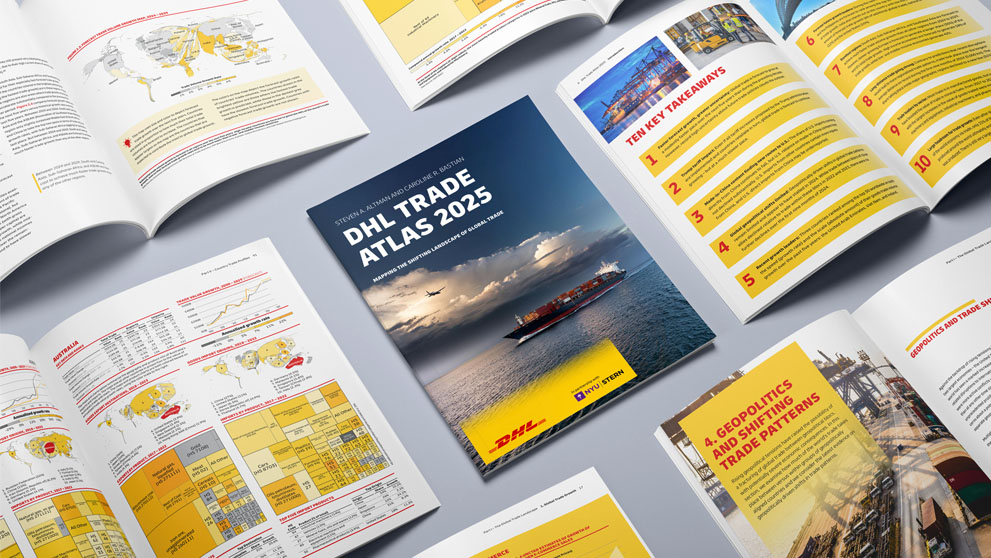
Plan your cross-border growth strategy with the DHL Trade Atlas 2025.
If you’re looking to – or already do – ship internationally, this report is essential reading. Brought to you by the world’s most international company, it reflects DHL's position at the heart of global trade and their commitment to help customers identify the most prosperous markets for expansion.
Download the report nowDHL Trade Atlas 2025: 10 Key Takeaways

1. Faster forecast growth, greater uncertainty
Global trade is forecast to grow at a modestly faster pace over the next five years than during the preceding decade. However, record high uncertainty about future trade policies clouds the outlook.

2. Trump tariff impact
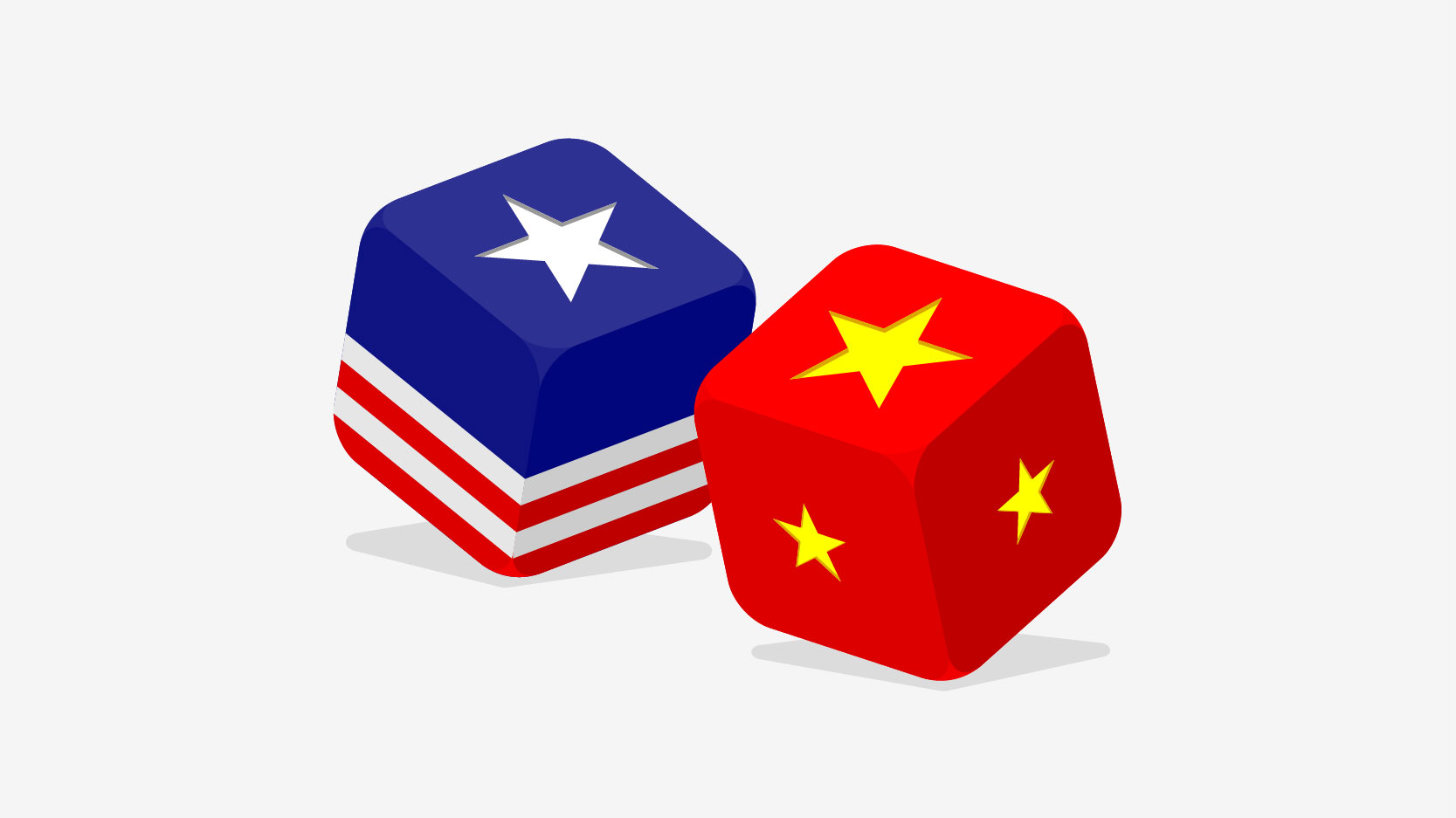
Even if all tariff increases proposed by the Trump administration are implemented and countries retaliate in turn, global trade is forecast to continue growing – but at a much slower pace.
3. Made-in-China content finding new routes to U.S.
The share of U.S. imports coming directly from China continues to fall, but U.S. reliance on made-in-China content has not declined substantially. U.S. imports from other countries contain more inputs from China, and U.S. direct imports from China may be underreported.

4. Global geopolitical shifts limited
Geopolitically driven shifts in global trade patterns remain limited and appear to have stalled in 2024. While trade between blocs of close allies declined relative to trade within these blocs in 2022 and 2023, there were no further declines over the first nine months of 2024.

5. Recent growth leaders
Three countries ranked among the top 30 worldwide on both the speed (growth rate) and the scale (absolute amount) of their goods trade volume growth over the past five years: the United Arab Emirates, Viet Nam, and Ireland.

6. Forecast future growth leaders
During the next five years, India, Viet Nam, Indonesia, and the Philippines are forecast to rank among the top 30 for both speed and scale of trade growth. India also stands out as the country with the third largest absolute amount of forecast trade growth (6% of additional global trade), behind only China (12%) and the United States (10%).

7. Standout regions
South Asia, Sub-Saharan Africa, and Southeast Asia are forecast to achieve much faster trade volume growth than all other regions from 2024 to 2029. However, slower-growing Europe is forecast to generate a larger share (30%) of the world’s total trade growth. High income economies are forecast to generate 58% of trade growth, while low- and middle-income economies generate 42%.

8. Long distance trade going strong
Contrary to predictions that recent disruptions would lead to more regionalized trade patterns, trade took place over the longest average distance on record during the first nine months of 2024 (5,000 km). The share taking place inside major geographic regions declined to a new low (51%).

9. Trade leaders by sector
Most trade is in manufactured goods, but price increases have boosted the value of trade in mineral fuels. From 2017 to 2022, the categories with the largest increases in the value of goods traded were mineral fuels, electrical machinery and equipment, industrial machinery, and pharmaceuticals.

10. Large headroom for trade growth
Even after decades of increases in the integration of the world economy via trade, only 21% of the value of all goods and services produced around the world ultimately ends up in a different country from where it was produced. There is still very large potential for future trade growth.
How can you align your corporate supply chain with global market shifts?
To build an efficient international supply chain, your company must shift from a passive domestic approach to an active, data-driven cross-border strategy. Relying on generic transport routes without mapping out regional regulations leads to customs holds and delivery failures.
By analyzing the maps, charts, and visualizations in the full report, your strategy team can prioritize markets that feature fewer trade restrictions and strong consumer demand. Utilizing advanced compliance tools like MyGTS (My Global Trade Services) allows you to pre-calculate total landed costs and verify tariff codes before booking a courier collection.
Partnering with an express logistics specialist provides your business with the real-time visibility and private air network reliability needed to scale securely across borders.
Plan your cross-border growth strategy with the DHL Trade Atlas 2026. If you are looking to—or already do—export products globally, this report is essential reading to identify the most prosperous markets for expansion.
Plan your cross-border growth strategy with the DHL Trade Atlas 2025.
If you’re looking to – or already do – ship internationally, this report is essential reading. Brought to you by the world’s most international company, it reflects DHL's position at the heart of global trade and their commitment to help customers identify the most prosperous markets for expansion.
Download the report now


 Share
Share