

Looking to start shipping internationally? Great! It’s one of the best ways to grow your business but knowing where to start can seem overwhelming.
Whether you are dispatching your very first overseas order from a local warehouse or scaling an established e-commerce operation on platforms like VTEX or Nuvemshop, mastering the foundational rules of global trade is essential.
This step-by-step guide breaks down the critical information your team needs—clearly and simply—so you can manage international shipping channels with complete confidence and avoid common compliance pitfalls from day one.
How to ship internationally: 7 key steps to remember

1. Prepare the documentation
When managing international shipping workflows, you must provide explicit, error-free transaction data to move your cargo through global border controls. For growing Brazilian small businesses and start-ups—already juggling intense daily priorities—the administrative workload required by customs can feel daunting.
However, taking the operational time to ensure your electronic transport documentation matches perfectly is non-negotiable if you want to eliminate unexpected processing holds, severe administrative fines, or cargo rejections at the border.
MANDATORY DOCUMENTATION FOR EXPORTS FROM BRAZIL
Nota Fiscal Eletrônica (NF-e): The legal domestic invoice with standard state tax (ICMS) classification numbers.
Commercial Invoice: The global bill of sale itemizing descriptions, currency, and structural Incoterms.
Air Waybill (AWB): The contract of carriage containing routing and tracking data.
Your outbound shipments will generally require these primary cross-border documents before departure:
Commercial Invoice: This provides information about the international transaction and goods being shipped, including a detailed line-item description with the respective Tariff Classification Code, the verified commercial value, the operating currency, weight, and terms of sale (Incoterms). Customs brokers rely strictly on this invoice data to compile the official customs declaration submitted to authorities during clearance. Ensuring your Commercial Invoice metrics are complete and accurate is essential to avoid lengthy border inspections or structural penalties enforced by foreign customs agents.
Air Waybill (AWB): This functions as the legal contract of carriage detailing your shipment's routing. The AWB is attached directly to the exterior of the transport package so that anyone handling the cargo has immediate access to tracking codes and destination parameters.
Certificate of Origin (Certificado de Origem): This official document indicates where your commercial goods were manufactured or produced. While not every international lane demands a Certificate of Origin, it is crucial to verify your destination market’s exact requirements before booking freight. For Brazilian exporters, providing this file is often necessary to claim preferential, reduced tariff treatments under active regional trade agreements, such as Mercosul pacts.

2. Classify your commodity
Every single product distributed through international shipping lanes must be mapped to a specific numerical commodity classification that describes its raw materials and design. This is officially known as a Tariff Classification Code—a universally standardized system utilized by global customs agencies to index trade volumes.
Inside Brazil and across adjacent trade blocs, businesses utilize the 8-digit Nomenclatura Comum do Mercosul (NCM) code on domestic corporate invoicing. However, when entering international shipping channels heading to North America, Europe, or Asia, you must convert these numbers into the standard 6-digit Harmonized System (HS) code directory.
These specific classification digits dictate three structural shipping outcomes:
Duties and taxes: The exact financial amount you or your customer must settle at the foreign border.
Import and export restrictions: Determining whether your specific commodities require special health, industrial, or security licenses.
Statistical trade records: Crucial data patterns harvested by governments to monitor cross-border macroeconomics.
You must print your precise commodity code directly onto the Commercial Invoice for every distinct item inside the parcel. Getting this code wrong can lead to severe border delays, miscalculated duty liabilities, cargo abandonment, or retroactive corporate audits by tax regulators.

3. Package your goods correctly
Securing your physical cargo with appropriate packaging materials is a cornerstone of reliable international shipping. Substandard or fragile boxes can lead to transit delays, physical product damage, or outright delivery rejections by carriers.
Remember that specialized commodities—such as consumer electronics housing lithium batteries or beauty products containing aerosols—face rigid packing restrictions under international transport safety codes.
Follow these four mandatory steps to secure your global shipments:
Utilize high-density boxes: Always pack heavier or delicate items inside double-walled corrugated cardboard boxes. Match the volume of the box to the layout of the product; underfilled boxes are vulnerable to crushing under weight, while overstuffed containers can burst during air transit.
Eliminate empty interior space: Use protective cushioning materials like bubble wrap, foam peanuts, or air pillows to immobilize your goods. Ensure there is zero movement inside the package when your team seals the box. Minimizing empty box volume directly reduces your volumetric weight expenses.
Apply transit labels flat and visible: Affix your main transport labels flat onto the top surface of the box. Avoid placing heavy packing tape directly over tracking barcodes or address fields, as plastic reflections can disrupt laser scanning systems.
Manage multi-piece consignments clearly: When shipping multiple packages under a single Air Waybill, attach the original, primary AWB label to the lead box and place copies on the secondary containers. Explicitly number every exterior box to show the total scope of the shipment, using a clear sequence like "1 of 3", "2 of 3", or "3 of 3".
4. Choose your DHL import or export service
How do you ensure rapid transit times and automatic customs processing for your overseas shipments? While the domestic postal service (Correios) can process international packages, public networks frequently encounter heavy backlogs and hand over fulfillment duties to uncoordinated foreign postal agencies once the cargo leaves Brazil.
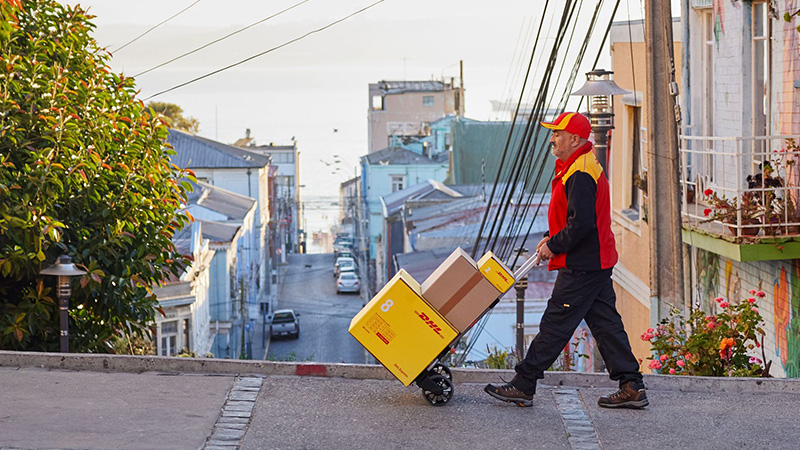
For commercial e-commerce operations, shifting to an express time-definite door-to-door courier network provides distinct logistics advantages. Utilizing a dedicated international air fleet means your packages travel via private, closed-loop transport hubs that feature integrated customs brokers.
This setup allows your small business to offer reliable, time-definite deliveries across more than 220 countries and territories, backed by complete real-time tracking visibility from your domestic facility to the buyer's doorstep.

5. Research denied parties
An essential element of international shipping is ensuring your business remains fully compliant with global trade laws that restrict commercial transactions with specific individuals, entities, or embargoed destinations. Express carriers do not accept controlled military cargo or shipments bound to restricted individuals listed by the UN Security Council, the European Union, or the United States government.
If your company is new to global trade, screening your customer database might not be a step you have integrated into your daily fulfillment workflow—but ignoring it can lead to severe legal penalties, asset freezes, and carrier blacklisting. Your enterprise must conduct its own due diligence and monitor evolving international sanctions to ensure your buyers are fully verified before dispatching inventory.

6. Understand restricted and prohibited commodities
Certain everyday retail items are restricted or completely banned from international shipping due to safety regulations, aviation laws, or strict domestic import blocks. Navigating these product boundaries before packing your boxes prevents costly border seizures.
Know your specific category rules: Common consumer products like cosmetics, health supplements, perfumes, and electronics containing batteries are flagged as restricted commodities and require specialized handling.
Secure necessary documentation upfront: For restricted inventory, confirm you have gathered all mandatory approvals, laboratory certifications, or regional permits from local oversight bodies like ANVISA or INMETRO prior to scheduling a courier collection.
Audit dual-use classifications carefully: Be aware of dual-use regulations governing industrial products or software components that can be applied to both civilian and military tasks, as these items require specific export authorization.

7. Calculate costs
7. Calculate your total landed costs upfront
Understanding the complete financial investment required to move a product across international lines is key to protecting your corporate profit margins. Focusing solely on basic freight rates while ignoring border fees can quickly erase your earnings or lead to unexpected bills for your buyers.
TOTAL LANDED COST COMPONENT BREAKDOWN
Product Price: The actual manufacturing or wholesale value of the commodity.
Shipping Rate: The carrier charge based on origin, destination, and dimensions.
Customs Duties: The import tax calculated from the item's tariff classification.
Local Sales Taxes: Destination-specific consumption taxes (e.g., VAT, GST, Sales Tax).
Handling Fees: Ancillary entry processing fees, fuel surcharges, or insurance.
Always structure your logistics around these three primary cost categories:
Base shipping rates: The underlying carrier fee determined by the physical volume, deadweight, origin, destination, and selected speed level of the parcel.
Customs duties and import taxes: Levied by destination customs authorities based on the item's tariff classification, declared transactional value, and material composition. You must select your billing terms upfront: choose Duties & Taxes Paid (DTP/DDP) to bill all entry fees directly to your corporate account, or Duties & Taxes Unpaid (DTU/DAP) to have the courier collect those fees from your customer before final delivery.
Ancillary charges: Account for potential localized surcharges, including remote area delivery fees, emergency fuel surcharges, or specialized customs bond handling.
MyGTS: Your digital gateway to international shipping
To simplify cross-border trade and streamline your customs documentation workflows, DHL Express created MyGTS (My Global Trade Services)—an intuitive, free cloud portal.
Brazilian SMEs can log in seamlessly using their existing DHL Express Business Account to access advanced trade tools designed to automate compliance checks:
Pre-Shipment Planner: Research country-specific import restrictions, mandatory document checklists, and restricted commodities before scheduling a courier collection.
AI-Guided Tariff Classification: Search for correct 6-digit HS codes using direct keywords or interactive directories, helping your team map local NCM codes to global standards accurately.
Landed Cost Calculator: Calculate an accurate, line-item estimate of all duties, destination taxes, and freight fees upfront. This tool allows you to build a transparent global pricing strategy that establishes deep consumer trust.
Digital Product Catalog: Securely store your standard corporate SKUs, past searches, and verified product specifications within the platform to accelerate repeat shipping dispatches.
Fulfillment precision is the most effective tool for expanding your brand globally. To unlock preferential corporate shipping rates and capture international market share, open a DHL Express Business Account.


 Share
Share