
1 - Statista, published May 2022
2 - BankMyCell, March 2023
3 - Klarna, 2021
4 - Drip, May 2022
5 - Business of Apps, March 2021
6 & 7 - Oberlo, September 2022

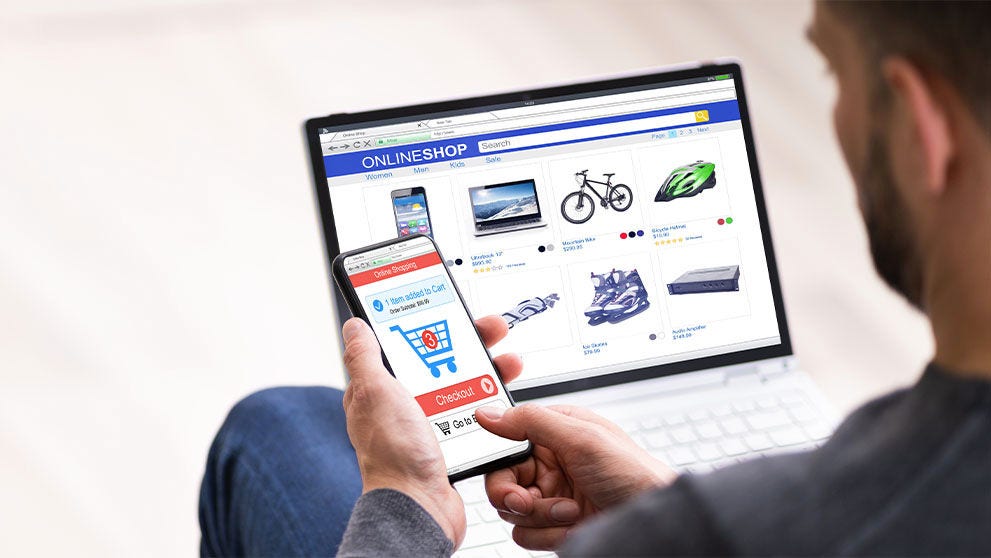
M-commerce is booming. According to Statista’s Digital Market Insights, in 2023, revenue from mobile e-commerce reached an estimated US $1.7 trillion and made up over half of all retail e-commerce sales1. So, whatever your business is, if you’re looking for new customers, chances are you’ll find them through their phones. Read on as we dive into exactly what mobile commerce is, how it stacks up vs e-commerce, the benefits of m-commerce, and how you can optimise your website for the small screen.
Mobile commerce is the buying and selling of goods and services using wireless handheld devices, such as smartphones and tablets. By this definition, m-commerce encompasses online shopping, mobile banking, and contactless payments.
It’s estimated that 60% of people in the world currently own a smartphone2, whilst the amount of time they spend online is increasing all the time, too. So, it’s not surprising that m-commerce is growing rapidly, meaning that more and more people are choosing the convenience and ease of shopping on mobile versus desktop.
There are three basic types of m-commerce: mobile shopping, mobile banking and mobile payments.
Mobile shopping allows customers to buy goods or services using a web app. This can either be via a retail app, for example from UK-based fashion brand ASOS, or a virtual marketplace app such as Amazon.
Mobile shopping can also take place on social media platforms, such as TikTok or Instagram, with companies like Gymshark tapping on Instagram Shopping to sell their fitness apparel.
Mobile banking is online banking designed for mobile technology. Banking transactions, such as paying bills, are usually carried out through a secure app provided by the bank. Major banks which provide seamless mobile banking include Barclays, HSBC, and NatWest.
Mobile payments are an alternative to traditional payments. They include digital wallets such as Apple Pay and UK-based Revolut, mobile payment apps such as PayPal, or using QR codes to pay for items using a mobile device.
By definition, M-commerce is a form of e-commerce. E-commerce covers all commercial transactions that take place digitally, so it adds computers into the mix. Buying from a laptop or desktop computer counts as e-commerce but not m-commerce.
Where e-commerce is simply the buying and selling of goods and services over the internet, m-commerce is a more specific part of that. Here are some of the major differences between m-commerce vs e-commerce.
The most obvious difference between the two is mobility. M-commerce uses only handheld mobile devices, such as smartphones and tablets – so customers can buy whilst “on the go”, so long as there is a wireless internet connection available.
Customers using a desktop computer can only be tracked using their IP address, while those using their mobile device can be tracked using Wi-Fi and GPS-based technologies, which are more precise. That means brands can target mobile users more precisely with location-related advertising, such as sending coupons or discounts for nearby stores.
Security is another difference. Most fixed-device e-commerce is carried out using credit cards, which carry an element of risk. M-commerce is more secure, thanks to biometric authentication, mobile wallets, and QR codes.
These mobile-first security features, such as fingerprint scanning and facial recognition, offer increased protection against fraud and data breaches, boosting consumer trust in mobile commerce transactions.
Finally, mobile apps are more convenient, making the buying experience easier and quicker. Mobile interfaces are often designed for streamlined navigation and one-handed use, with technologies like saved payment information and personalised recommendations. This optimisation for efficiency enhances customer satisfaction in mobile commerce.
Who is leading the m-commerce boom? As you might expect, the answer is Gen Z and Millennials, who have grown up with mobile technology. According to research conducted by Pew Research Center in 2022, 92% of adults aged between 30-49 have reported buying things online using their smartphone while those aged 18-29 are not far behind at 87%3.
Although Millennials are, at the moment, considerably more likely than older shoppers to buy using their smartphones, over time this e-commerce trend will no doubt become the norm for all.
Here are some key user behaviours and technologies currently powering the surge in mobile commerce transactions:
You may wish to go all in and invest in a dedicated mobile app for your business. Conversion rates for mobile commerce through mobile apps are 130% higher compared to mobile-first websites4, so it will be worth it!
Apps generally offer a more streamlined and user-friendly experience on small screen phones. They can also leverage device features like push notifications to re-engage users and offer exclusive deals.
Useful tools for m-commerce development
Bootstrap will automatically scale your web pages for any device.
Google’s Mobile-Friendly Test will measure your m-commerce site’s quality.
Google’s Page Speed Insights and Google Lighthouse will show you if anything is slowing your site down.
AMP (Accelerated Mobile Pages) Validator will enable you to speed up your mobile pages.
me is an emulating tool that replicates how your site will look on a range of devices.
As a final tip, continually test your site and gather user feedback so you can optimise the mobile commerce experience. Remember, happy customers equals more sales!
91% of all social media users access social channels via mobile devices5. So, social media is a key place to attract and convert m-commerce consumers. Here are some tips:
75% of internet users use social media to research brands6, so post plenty of details about your products and take the time to answer questions from followers.
Consider Instagram Shopping for your business. You can link to your product catalogue and create shoppable posts so customers can purchase from your brand with minimal effort.
Share positive customer reviews across your social channels.
Voice assistants are changing how we shop. Voice commerce is booming, with more than 49% of consumers in the UK using voice search to purchase a product for pickup or delivery in 20227.
To capitalise on this trend, businesses must optimise their online presence for voice search. This includes using natural language, targeting long-tail keywords, and implementing schema markup. By embracing voice shopping, businesses can fine tune the m-commerce experience and reach a wider audience.
Here's a m-commerce checklist on how to give your customers the best experience on small screen phones:
Fast loading speed
Important information and Calls To Action at the top
Concise copy but enough product details for a purchase decision
User-friendly navigation
Mobile accordions (like drop-down menus) to conserve space
No excess plug-ins and pop-ups
Responsive web design, so dimensions adjust to the mobile device
Larger font and button sizes
Auto-fill form fields like address entry
Unfortunately, the cart abandonment rate for mobile commerce is 77%, according to AI-powered optimisation platform, Dynamic Yield8. Ouch. But offering one-click checkout is your secret weapon.
By integrating a dedicated payment provider with your online store, customers only need to enter their details (name, email address and shipping location) once, to be stored within the payment processor for future use. When they return to your online store, they can checkout with one click.
Some of the leading providers to consider are:
Facebook Pay
Instant Checkout
Paypal One Touch
Transparency when purchasing
Be transparent about all costs early in the purchasing journey so customers don't have any nasty surprises in the end.
Delivery options
Offer fast and flexible delivery options including DHL Express. Free shipping is always a huge sales driver (if your business can afford it!)
1 - Statista, published May 2022
2 - BankMyCell, March 2023
3 - Klarna, 2021
4 - Drip, May 2022
5 - Business of Apps, March 2021
6 & 7 - Oberlo, September 2022


 Share
Share