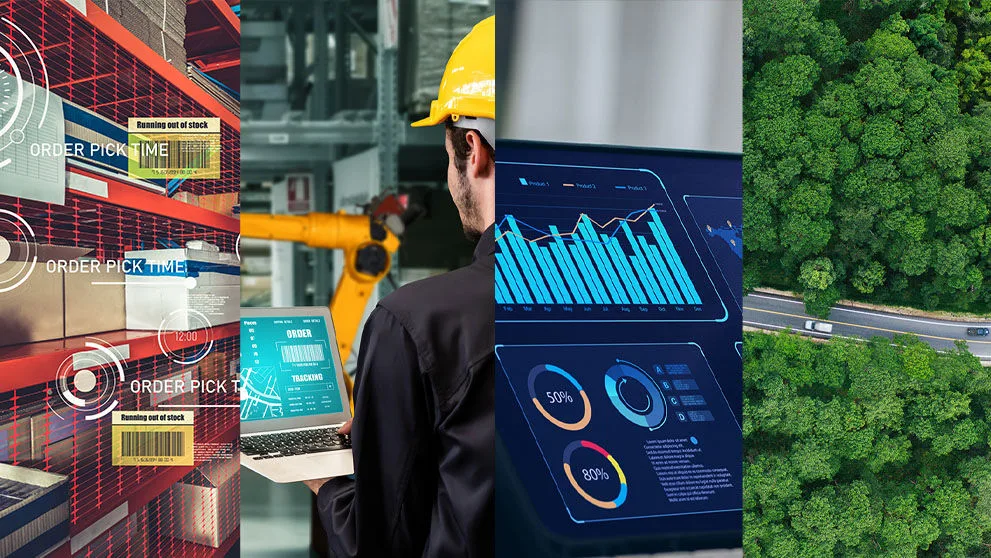




The speed at which businesses adapt and apply artificial intelligence (AI) is increasing, and the logistics industry is driving sweeping changes that offer numerous opportunities. It is one of the most advanced applicators of AI, driving innovation and improving key business functions, which leads to tangible benefits for customers.
In this article, Oliver Facey, Senior Vice President of Global Network Operations Programs at DHL Express, shares his unique view of the role of artificial intelligence in logistics. He explores the current applications of AI and what the future holds for AI in the logistics industry.
What is artificial intelligence in logistics?
In logistics today, artificial intelligence is quickly reshaping how the industry operates. Adopting AI-driven solutions is all about using clever tech to make things more efficient and responsive. Think of AI in logistics as the brain behind smarter operations, from automating tasks in warehouses to predicting delivery times and managing inventory.
The role of artificial intelligence in the logistics industry
Artificial intelligence in today's complex logistics industry is truly transformative. We're seeing AI being used for everything from super-accurate predictive analytics to boost efficiency, to automating tasks in warehouses with robots, and even optimising delivery routes.
This means faster operations, fewer errors, and a smarter way to handle complex supply chains, ultimately making the entire industry more agile and cost-effective.
Key applications of artificial intelligence in logistics
There are so many fantastic ways to see the use of AI in logistics. Some of the most impactful include:
AI in Warehouse Management
AI is completely changing how warehouses are managed. We’re talking about AI-powered automation that makes operations much smoother, eliminates human error, reduces turnaround times, and allows space to be used more efficiently.
One exciting example of this innovation is with“smart glasses.” Rather than relying on hand-held scanners, humans can save time with wearable glasses that read barcodes and react to voice commands.
As a Group, we’re currently exploring this and similar technology. Imagine 100 couriers lined up on either side of a conveyor belt of parcels. They have to look at each one’s label to check the address and find the right one for them.
But if we could automatically read the barcodes to indicate that a specific parcel needs to be allocated to a specific vehicle, using glasses and some sort of visual reading or showing guidance, we would save time and reduce errors.
However, I would flag that whilst goggles are good with static, they have some trouble with moving parts, so this technology is very much a “work in progress.” And other options are also being considered.
AI in Route Optimization
Route optimisation is another key area where AI makes a real difference in the logistics industry. Amid fluctuating fuel costs, analytics could make a significant difference too — such as identifying when vans are idling for too long, or when loading and unloading processes are being done inefficiently.
As part of the daily route optimisation, AI systems can take into consideration traffic levels and road conditions to help vehicles avoid delays and get to where they need to be as quickly as possible.
The rise of electric vehicles is, of course, significant too — reducing fuel costs whilst also contributing greatly to sustainable logistics by cutting down on emissions.
AI in Demand Forecasting
AI is a powerful tool for businesses to accurately predict demand and optimise inventory. It helps businesses of all sizes predict what customers will want and when, with incredible accuracy.
By analysing vast amounts of data, AI can spot trends and anticipate spikes or dips in demand, allowing you to optimise your inventory levels perfectly. This means fewer stockouts, less excess inventory sitting around, and a much more efficient supply chain overall.
Benefits of AI in logistics
So, how exactly is AI transforming logistics? It’s a question I’m asked a lot, and something which DHL is constantly exploring and trialling in order to deliver the best service to our customers. Some of its advantages include:
Improved Operational Efficiency
An agile supply chain is a must to help businesses adapt to market fluctuations and changing customer demands. AI can help — for example, by analysing large amounts of customer data to identify trends and predict future demand, and then relaying requirements to suppliers so that inventory levels are always optimal.
AI can also monitor orders’ fulfilment status and update customers immediately when anything is delayed. And it can identify market trends for pricing and adapt business's prices accordingly, so they stay competitive.
Overall, artificial intelligence is automating many key steps of supply chains to save businesses time and money, and ensure operational efficiency throughout every stage.
Cost Savings and Resource Optimization
Adopting AI solutions could reduce logistics costs by 5-20%1 thanks to more accurate forecasting, clever route optimisation, and improved operational efficiency. Plus, with predictive maintenance, AI can flag potential equipment issues before they become expensive breakdowns, minimising downtime.
For instance, an AI system might analyse data from a delivery truck's engine and predict a component failure days or weeks in advance, allowing for a planned repair instead of an emergency roadside breakdown.
Better Customer Experience
Our customers increasingly want to know when their deliveries will arrive, but we manage many international shipments, and with flights going all around the world, there’s a lot to track.
So, we've done extensive work with forecasting and prediction models. We can use that data to know, for example, with 90%-95% certainty, that specific volumes of shipments are going to arrive in a certain facility for this day. We then use that information to start planning the couriers’ routes, matching volumes, service, and other important variables.
Once the packages are in the delivery vehicle, we then further optimise the route using AI-powered software from Wise Systems. In just a few seconds, it can take a route with 120 stops and order the sequence based on parameters such as an urgent medical express delivery, or a delivery that must be with a customer before 9am, or generally taking into account distance per stop to get the best possible route sequence.
We then send the customer a predicted time of delivery through a capability called Follow My Parcel. As the courier gets closer to the customer, they will be given a more specific time window, with a notification saying, “We're 20 minutes away from you.”
And in that moment, the customer can still make some changes — they may choose to defer the delivery to a later time, or to a neighbour. This helps to improve the Customer experience and DHL’s first attempt delivery rate.
So, in short, AI is enabling possibilities for smarter route planning, which means we can deliver faster — with less fuel wasted. Meanwhile, our customers receive a more accurate time window for their delivery — and the flexibility to manage the delivery of the package.
Another way AI is transforming customer experience in the logistics industry is through chatbots. AI is enabling chatbots to have a better understanding of customer intent during interactions.
Some of our teams use an AI-based virtual assistant that profiles responses from customers and gathers sentiment on their reactions — which of course means we can help them find a more accurate solution to their query, and more quickly.
Advanced AI-powered chatbots can even help businesses upsell and cross-sell to customers, which is, of course, an extremely attractive proposition.
AI is also beneficial to customer service because it can learn customers’ preferences. As an example, when we work with customers shipping internationally on a regular basis, we could leverage machine learning to know their preferences regarding customs clearance, so we don’t have to contact them for the information each time.
Furthermore, for our smaller customers who aren’t familiar with Customs Tariff HS codes, machine learning can quickly guide them to the correct classification for their goods, so that they have a faster clearance rate. The nature of machine learning means it is constantly improving, so the service customers receive gets more and more accurate.
Scalability and Adaptability
All these uses of AI ultimately make operations in the logistics industry far more scalable and adaptable to changing market conditions. By automating key processes and providing real-time insights, AI ensures that logistics operations can expand or contract efficiently, keeping businesses nimble and responsive no matter what challenges come their way.
Challenges of AI in Logistics
While the application of artificial intelligence in logistics offers huge advantages, it's fair to say there are also a few hurdles to jump over, namely:
High Initial Investment
There's no denying that adopting AI in logistics often means a significant upfront cost. We're talking about investing in new hardware, complex software, and even training your team to use these advanced systems.
For some businesses, especially smaller ones, these initial expenses can be a pretty big barrier, making it tough to jump straight into the AI revolution despite the long-term benefits.
Integration with Existing Systems
One of the trickiest parts of introducing AI in the logistics industry is getting it to play nicely with older, legacy systems. Many established logistics companies rely on infrastructure that wasn't built for AI, so integrating new tech could be a real headache.
This often means extensive modifications, which can lead to operational disruptions during the implementation phase. It could also require significant retraining for staff, adding another layer of complexity and cost to the transition.
Data Security and Privacy Concerns
When you're dealing with vast amounts of sensitive information, data security and privacy are massive concerns. That's why protecting customer data and proprietary business processes from cyber threats is paramount.
However, ensuring AI systems are robustly secure and comply with all privacy regulations is an ongoing challenge that demands constant vigilance and investment.
The future of AI in Logistics
The role of artificial intelligence in logistics is only going to grow, with some fascinating emerging trends on the horizon, such as autonomous vehicles and delivery drones, machine learning-powered supply chain optimisation, and advanced predictive analytics for risk management and real-time decision-making.
Ultimately, AI is poised to make logistics smarter, faster, and more responsive than ever, truly transforming the way goods move globally.
How DHL is Leveraging AI in Logistics
As for the future role of AI in last-mile delivery, really, the possibilities are endless. Automation and machine learning have the potential to optimise every step of logistics — and the technology is ever-changing, adapting and improving.
I hope you’ve been inspired by this article. I encourage you to check out DHL’s Logistics Trend Radar, too, which explores some of the other technologies set to transform the industry in the coming years, including interactive AI, drones, big data analytics, and indoor mobile robots — to name just a few examples!
DHL has always been at the forefront of logistics innovations. With a DHL Express Business Account, you’ll have access to a range of industry-leading solutions to help you overcome challenges and meet customer demand.


 Share
Share