

1- European Commission, July 2025
2- ASEAN, July 2025
3- Official Journal of the European Union, European Commission, July 2025
4- World Customs Organization, July 2025

The sheer diversity of goods traded globally has grown increasingly complex over time, leading to a need for a uniform and standardised classification system. This system needed to be recognised by governing bodies and businesses across the world.
Consequently, the Harmonised System code was designed to label all existing goods in elaborate detail, making it significantly easier to identify products internationally and streamline global trade.
This article covers
Harmonized System (HS) codes are a unique identifier to classify the exact type of goods you’re shipping.
Created by the World Customs Organization, these identifiers are internationally recognised in almost every country. This global standardisation provides customs and government bodies with a common point of reference, enabling them to implement regulations consistently across different HS classes. In turn, this fosters a more organised importing and exporting structure, offering clear guidelines for countries looking to implement new trade regulations.
HS codes consist of at least six digits, forming a universal language for customs authorities across the globe to classify goods accurately. These codes are crucial because they ensure the correct calculation of duties and taxes.
Without them, your shipment's recipient could face incorrect charges or delivery delays, creating unnecessary complications in international trade.
To find the appropriate Harmonised System code for your product, you can typically consult your country’s official customs or government website.
Alternatively, for a more streamlined approach, you can utilise DHL Express’ dedicated Interactive Classifier tool. This HS code finder is designed to help you accurately determine the HS code for international shipping, simplifying your compliance efforts.
As the responsibility of providing the correct HS code always rests with the shipper, it’s crucial to ensure that you classify your products accurately to avoid potential issues.
To determine the correct Harmonised System code for your product, you need to understand its structured format.
Each HS code is a six-digit international standard. The first two digits identify the chapter that the product falls under. There are 21 such chapters, each providing a general category description.
The subsequent four digits denote the heading and sub-heading within the chapter.
The HS code can also extend to eight or ten digits in some countries. For instance, as part of the EU, Belgium applies the Combined Nomenclature (CN) on top of the Harmonised System, adding two digits for EU-specific detail1. This helps to denote the conventional duty rates under EU tariff commitments in the World Trade Organisation (WTO) as well as EU autonomous duties.
Likewise, ASEAN countries follow the ASEAN Harmonised Tariff Nomenclature (AHTN)2, adding two digits for more granular classification. In either case, the initial six digits of the Harmonised System remain globally referenced.
To illustrate, if you were shipping knitted or crocheted cotton shirts for men or boys from Belgium to another EU country, the HS and CN code would break down as follows3:
Chapter: Articles of apparel and clothing accessories, knitted or crocheted (61)
Category: Men’s or boys’ shirts, knitted or crocheted (05)
Material: Cotton (1000)
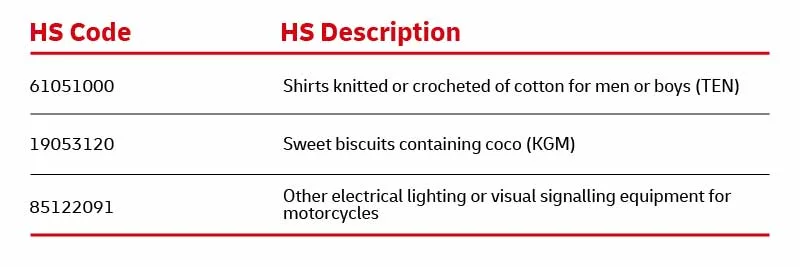
Final identifier: 61051000
To accurately apply the correct HS code for your product, you should indicate the identifier in your import and export documents, particularly on the commercial invoice. This practice ensures a uniform and efficient customs clearance process every time.
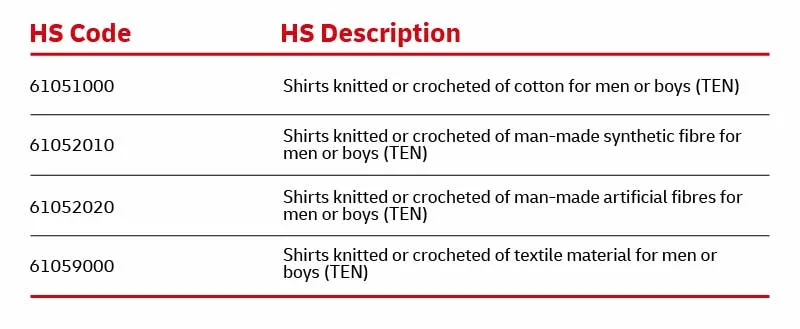
Additionally, there may be some instances in which two or more classifications seem to apply to a single commodity. This is because there are many sub-classifications within each category.
For instance, the general item 'shirt' can be broken down into about ten different codes based on material, such as men’s shirts made of cotton, synthetic fibres, or other textiles.
In such a situation, select the one that represents the closest possible match to the actual item being shipped.
To ensure seamless customs clearance, avoid the following common pitfalls when using HS codes:
Incorrect classification: Misclassifying your goods can lead to incorrect duties, taxes, or shipment delays and penalties. As such, always ensure your HS code matches your product as closely as possible.
Omitting HS codes: Without an HS code, customs will need to identify your goods manually, resulting in delays. To avoid that, always include the code on your shipping documents.
Using outdated codes: The World Customs Organization updates the Harmonised System every five to six years, so check that your HS code is up to date to avoid misclassification4.
The first six digits of HS codes are standardised globally by the World Customs Organization, creating a common foundation for classifying goods internationally.
However, in some regions, there may be two or more additional digits for more specific classifications within local systems.
For instance, countries in the EU, including Belgium, apply the Combined Nomenclature to reflect conventional duties under EU tariff commitments in the WTO, as well as EU autonomous duties.
Using an incorrect HS code could lead to several issues for your shipment:
Unforeseen taxes and duties: You may face unexpected or higher charges upon import.
Import restrictions: Your goods might be subject to stricter regulations than intended.
Shipment delays or rejection: Incorrect classification can cause customs hold-ups or, in the worst case, the outright denial of your package at the border.
While it is not strictly mandatory to include the Harmonised System code on all shipping documents, it is highly recommended.
Providing the HS code on your invoice and other relevant shipping documents can ensure accurate customs clearance, significantly minimise delays, and mitigate potential issues with duties and taxes. This small effort can save considerable time and expense.
If you're struggling to determine the correct HS code for your product, several resources are available:
Consult your country’s customs authority: If you’re based in Belgium, you can seek guidance from the Federal Public Service Finance (FPS Finance).
Utilise online HS code finders: Tools like DHL Express’ Global Trade Services (MyGTS) portal can help you find your identifier using keywords or an HS code list.
Seek advice from DHL Express’s customs experts: DHL Express has specialists well-versed in global customs regulations who can offer tailored assistance.
Yes, HS codes are used universally for classifying goods in international shipping, irrespective of whether they are being imported into a country or exported from one.
No, you cannot use the same HS code for different products. Each product is assigned its own unique Harmonised System tariff code that precisely reflects its characteristics, composition, and intended use.
DHL Express handles thousands of documents, parcels, and cargoes every single day, simplifying complex international logistics for businesses like yours. Its extensive global network of international specialists is well-versed in customs regulations and HS code variations, ensuring that every shipment moves on to its destination without unnecessary delay.
By opening a DHL Business Express Account, you gain access to comprehensive support in managing customs complexities, including parcel packing tips, custom duty calculations, and accurate HS code classification.
This frees you to concentrate on what matters: selling and growing your core business.
1- European Commission, July 2025
2- ASEAN, July 2025
3- Official Journal of the European Union, European Commission, July 2025
4- World Customs Organization, July 2025


 Share
Share