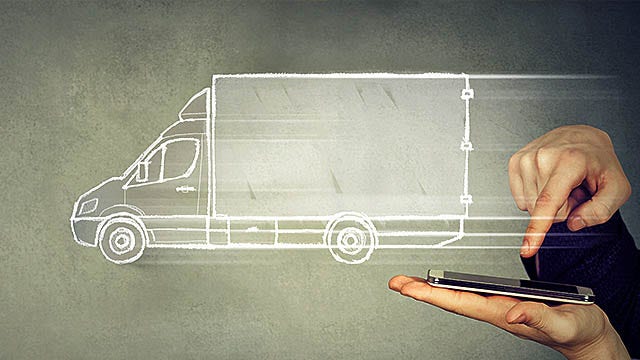
Over the past few years, artificial intelligence in logistics has moved along considerably. What once felt experimental is now shaping real-world operations at scale – helping businesses handle rising costs, increasing complexity, and customers who expect more than ever.
For e-commerce brands and growing businesses, this shift isn’t just interesting – it’s practical. AI is becoming one of the most useful tools available for building faster, more resilient supply chains.
In this article, we’ll explore how AI in logistics has evolved, where it’s already making a difference (especially in last-mile delivery), and what that means for your business.
How AI in Logistics Has Evolved in Recent Years
Not that long ago, AI in logistics was something companies tested cautiously – often in isolated pilots. That’s changed.
Today, AI is embedded in day-to-day operations, influencing decisions in real time across entire supply chains. It’s forecasting demand in the background, adjusting delivery routes on the fly, and helping businesses respond faster when something unexpected happens.
A few big shifts have accelerated this. E-commerce has exploded, bringing more orders – and more complexity – with it. Customer expectations have also moved sharply upwards: faster delivery, more flexibility, better visibility. At the same time, global disruptions have exposed just how fragile supply chains can be.
Put all that together, and AI has gone from “nice to have” to something much closer to essential. The conversation has moved on – from should we use it? to where will it make the biggest difference?
Last-Mile Delivery Challenges in a High-Expectation Economy
Ask any e-commerce business where things get difficult, and the answer is usually the same: the last mile. It’s the part customers actually see – and the part they judge you on.
Today’s online shoppers expect flexible, on-demand delivery. That means narrow time windows, real-time updates, and the ability to change plans at the last minute. Behind the scenes, though, it’s rarely that simple. Traffic, missed deliveries, and fragmented networks all make the final stretch more expensive and harder to manage.
There’s also growing pressure to make deliveries more sustainable, especially in urban areas where emissions are under scrutiny.
For many businesses, the last mile has become a balancing act between cost, performance, and customer satisfaction. Get it right, and it builds loyalty. Get it wrong, and it’s often the only thing the customer remembers.
This is where AI is starting to make a noticeable difference.
Real-World Applications of AI in Logistics
AI in logistics is already shaping how supply chains run day to day. Here’s what that looks like in practice:

Predictive analytics
AI can sift through huge volumes of data and spot patterns early – whether that’s a spike in demand or a potential disruption caused by weather.
It’s the difference between being caught off guard by a sudden surge in orders – and being ready for it before it even hits. The result is fewer surprises and more time to respond.
Demand forecasting
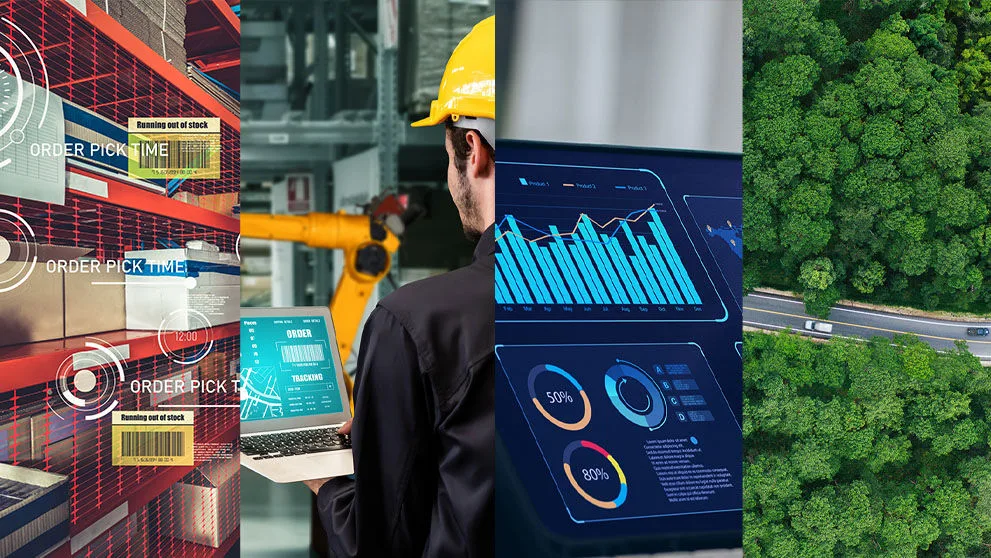
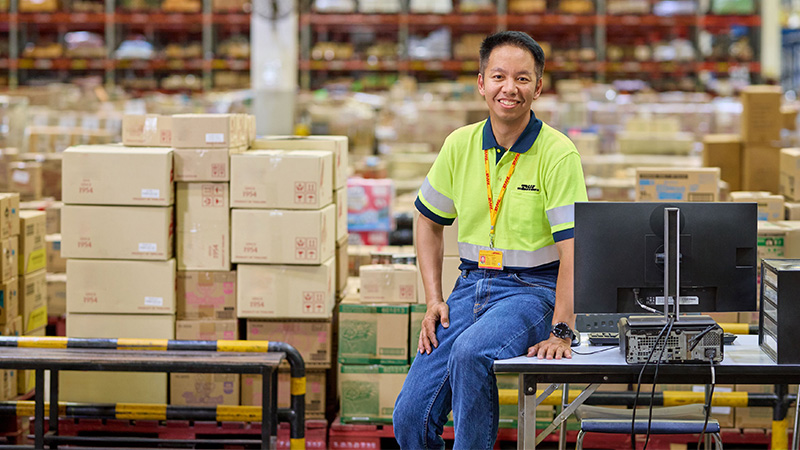
There’s nothing more frustrating for a customer than seeing an “out of stock” message on a retailer’s website – and for the business, it’s a missed sales opportunity. AI helps reduce those moments by making demand far more predictable, so stock is in the right place at the right time.
Warehouse automation
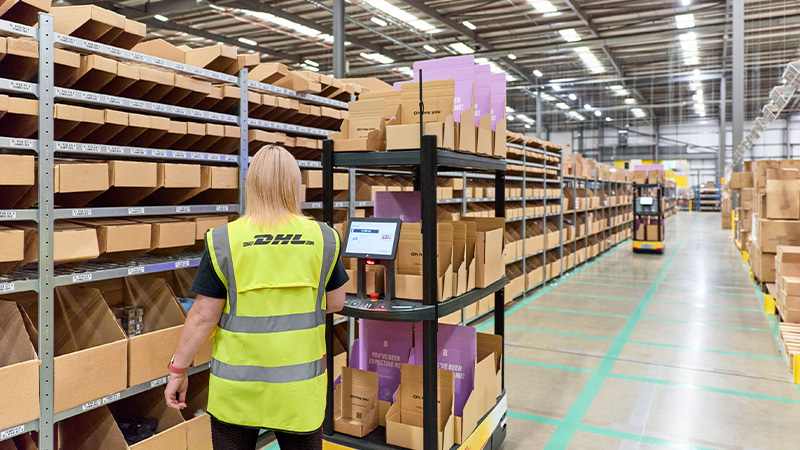
Inside the warehouse, AI-powered systems are taking over repetitive tasks and supporting human workers. Picking becomes faster, errors are reduced, and operations can scale without everything becoming more complicated.

Smarter customs preparation
AI is also making it easier to prepare international shipments before they even leave the warehouse. For example, DHL Express' AI-powered item identification tool allows customers to simply take a photo of the item they're shipping. The technology then generates a structured, customs-compliant goods description that customers can review before completing their shipment.
By helping businesses provide more accurate customs information from the outset, the tool minimizes the risk of delays and makes international shipping easier – particularly for SMEs and first-time exporters.

Route optimization
Anyone who’s watched a delivery van sit in traffic on a tracking map knows how quickly delays can build up. But now, with AI, couriers have more flexibility with their delivery routes. If congestion worsens, routes can adjust in real time. That often means quicker deliveries – but also less wasted fuel and fewer missed slots.
Intelligent last-mile delivery
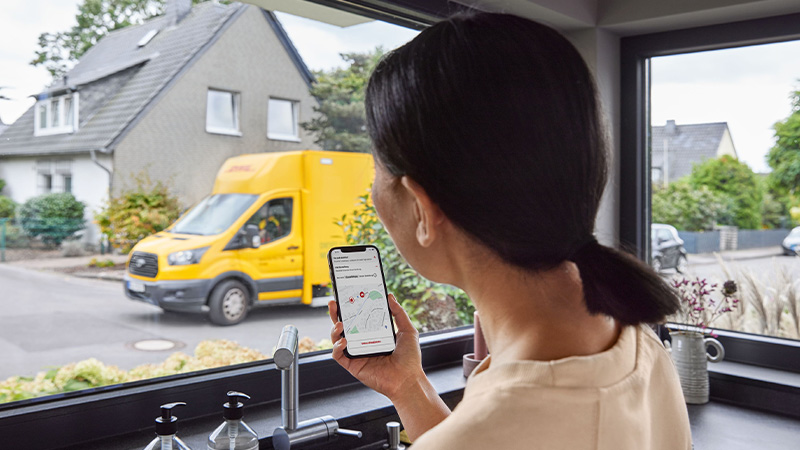
AI is also improving how deliveries are experienced by customers. More accurate delivery windows, live tracking, and proactive updates all help reduce uncertainty – and increase the chances of getting it right first time.
It means fewer missed deliveries, fewer “sorry we missed you” notes – and a much smoother experience overall.
Benefits of AI in Logistics for Modern Supply Chains
AI is changing how supply chains behave – not just making them faster, but also smarter. At a high level, businesses are seeing:
- Better visibility across the supply chain
- More accurate planning
- Increased automation
- Faster, more reliable deliveries
- Improved customer experience
- Lower operational costs
Let’s take a closer look at how these improvements play out in everyday operations – with commentary from Oliver Facey, SVP of Global Network Operations Programs at DHL Express.
Real-Time Visibility and Data-Driven Decision Making
One of the biggest changes AI brings is visibility. Instead of reacting to issues after they happen, businesses can see what’s unfolding across their supply chain in real time. That makes it easier to step in early, adjust plans, and avoid disruption – for example, if a shipment is delayed at customs.
Over time, this turns logistics into something more strategic – less about firefighting, and more about making informed decisions.
Smarter Demand Forecasting and Supply Chain Agility
One of the most valuable applications of AI in supply chain and logistics is its ability to improve forecasting.
By analyzing historical data alongside real-time inputs, AI can predict demand more accurately and help businesses respond faster to changes in the market. This reduces the risk of stockouts or overstocking and enables more efficient inventory management.
Oliver Facey highlights the impact of this kind of precision, noting that businesses can forecast with “90 to 95 percent certainty” when shipment volumes will arrive at specific facilities.
In practice, this creates more agile supply chains – capable of adapting quickly to shifting customer demand and external disruptions.
Warehouse Automation and Operational Efficiency
AI-supported systems are making fulfillment faster and more reliable, without requiring a complete overhaul of operations. Tasks that once slowed things down – like manual picking or inventory checks – can now be handled more efficiently, often with fewer errors.
Oliver shares an example: “The advancement of vision picking technology within the warehouse environment includes “smart glasses.” Rather than relying on hand-held scanners, humans can save time with wearable glasses which read barcodes and react to voice commands.
Imagine 100 couriers lined up either side of a conveyor belt of parcels. They have to look at each one’s label to check the address and find the right one for them. But if we could automatically read the barcodes to indicate that a specific parcel needs to be allocated to a specific vehicle, using glasses and some sort of visual reading or showing guidance, we would save time and reduce errors. As a company, we’re currently exploring this and similar technology.”

Faster and More Efficient Last-Mile Delivery
We’ve all had that moment – watching a delivery window come and go, with no update. But AI helps to address this by enabling real-time route adjustments, taking into account traffic conditions, delivery density, and last-minute changes. All of which leads to higher first-attempt delivery success rates.
As Oliver explains, “our remit has always been to enable faster and smoother last-mile deliveries for our customers – something which AI is certainly helping with.”
Enhanced Customer Experience and Personalization
Delivery is now an integral part of the customer experience – as any online shopper who has eagerly tracked a parcel to their doorstep can attest.
AI is helping make that experience smoother and more predictable. Customers know when to expect their order, can track it in real time, and receive updates if anything changes.
It’s a small shift, but it builds trust – and that often makes the difference between a one-time purchase and a repeat customer.
Key AI Trends Shaping Logistics and Supply Chains
Looking ahead, AI will become even more embedded in how supply chains operate – and far more visible in the way decisions are made.
We’re already seeing this play out in practical ways. Generative AI, for example, is starting to support logistics teams by creating reports, simulating different supply chain scenarios, and even recommending actions when disruptions occur. In fast-moving environments, that kind of support can save valuable time.
At the same time, advances in forecasting are making supply chains more precise. AI can now anticipate demand shifts with far greater accuracy – helping businesses position stock closer to customers before orders even come in.
Finally, as we’ve explored, innovation in last-mile delivery is accelerating. In some markets, we’re even seeing early experiments with autonomous delivery vehicles and drones – offering a glimpse of what the next phase could look like.
Individually, these developments are powerful. Together, they point to a supply chain that is not just faster, but far more responsive – able to sense, adapt, and act in real time rather than simply react after the fact.
Challenges of Implementing AI in Logistics
Of course, adopting AI isn’t without its challenges. Data quality is often the first hurdle. Without reliable data, even the best AI tools struggle to deliver value. Integration is another common issue, particularly for businesses relying on older systems that weren’t designed to connect easily.
There’s also the question of skills and investment. AI isn’t just about technology – it requires the right expertise and processes to support it.
For many businesses, the most effective approach is to start small, focus on high-impact areas, and build from there.
How DHL Express is Supporting the Future of AI in Last-Mile Delivery
Looking ahead, AI will continue to make last-mile delivery more efficient, while enabling more personalized customer experiences. Businesses that adopt it early – and work with partners already operating at scale – will be best placed to meet rising expectations for speed, reliability, and sustainability.
DHL Express is already using AI across its network, including route optimization, real-time tracking, and predictive analytics. These tools are fully integrated into day-to-day operations, improving efficiency and visibility. For customers, this means they can benefit from AI-driven logistics without building complex systems in-house.


 Share
Share

Similar Stories