#ShippingWithDhl

Documents required for export from India: 2026 digital compliance guide

6 Mins Read
woman handling an e-commerce box with export documents attached

As India transitions to a 100% paperless "Customs 2.0" ecosystem, staying up to date on the required export documents is critical to operational success. This guide breaks down the mandatory digital registrations and international shipping documents needed to navigate automated compliance and avoid penalties. Learn how to streamline your international shipping from India using the latest digital tools and mandates.

International shipping from India is set to undergo a major transformation in 2026. Known as “Customs 2.0”, India’s government is targeting the full automation of customs processes by April 20261. The implementation of this new 100% paperless workflow will greatly improve customs speed when it comes to international shipping from India, but comes with increased challenges for Indian exporters.

Most notably, an error in your export shipping documents shipping documents for export will result in automated penalties on the ICEGATE portal, making compliance more rigorous than ever. To avoid this, Indian exporters must master the documents required for exporting goods from India and ensure, ensuring their export documents in logistics are perfectly aligned with the latest digital mandates.

What are the “big three” mandates for exporting from India?

New to international shipping from India? These are mandatory, India-specific registrations required by the Directorate General of Foreign Trade (DGFT) and Customs. They don't change from shipment to shipment and identify your business as a legal entity authorized to trade.

  • IEC (Importer Exporter Code): This is one of the primary export documents issued by the DGFT. As of 2026, the IEC is permanently linked to your PAN, creating an automated trail for tax tracking. Without this 10-digit code, you cannot legally engage in exporting goods from India.
  • AD Code (Authorised Dealer Code) Registration: To ensure legal forex realization, your 14-digit AD Code must be electronically registered with ICEGATE at every specific port of exit you use. This registration is a non-negotiable part of your export document list, as it tells the government which bank will receive the foreign currency for your global shipping services.
  • GST & LUT (Letter of Undertaking): Managing cash flow is critical for export services. By filing a valid LUT for the current financial year on the GST portal, you can ship your products as "zero-rated supplies." This allows you to export without the burden of paying upfront IGST, provided you meet the timeline for the current financial year.

Mandatory list of documents required for export from India in 2026

Export documents in logistics tell customs about the contents for your shipment, its value and its destination. For India’s “Customs 2.0”, all documents required for exporting goods must be digitized and uploaded into the ICEGATE portal before your shipment is approved for export.

Air Waybill

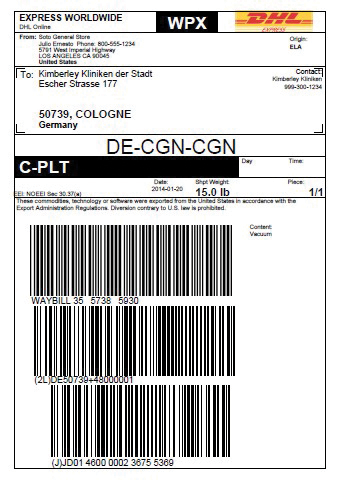
If you are shipping by air, the Air Waybill is one of the core international shipping documents issued by the carrier (like DHL Express). It contains information like the receiver’s info, shipper’s info, description of shipment, and serves as a digital receipt that tracks your shipment across the globe in real-time. In India’s "Customs 2.0", this document is electronically linked to your Shipping Bill to ensure that international shipping from India is fast, traceable, and fully compliant with global security standards. Here is an example of how an Air Waybill from DHL Express looks like:

Commercial invoice and packing list

The commercial invoice is the primary export document, serving as the formal bill of sale and definitive evidence of the transaction between the exporter and the importer. In the 2026 digital landscape, this document is now the master data source used by customs authorities to classify merchandise, ensure regulatory compliance, and verify that all duties and taxes have been accurately assessed.

This document is a mandatory part of the list of documents required for export and must include your GSTIN, IEC, and 8-digit HS Codes. Under the 2026 automated verification system, even a single digit error in the HS Code can trigger a "data mismatch" flag on ICEGATE, delaying the approval of your international shipping documents.

KYC (Know Your Customer) documents

One of the most important export documents when international shipping from India are the KYC documents to be presented to Customs during shipment clearance. This is a non-negotiable step to prevent identity fraud and ensure that all export documents in logistics are linked to a legitimate entity. At the same time, an export service like DHL Express may also verify your identity and address before picking up your shipment.

However, you do not have to go through a new KYC process every time you want to ship something overseas. By submitting your validated ID (such as a PAN or Aadhaar) and proof of address once, you create a permanent digital profile that streamlines future global shipping, ensuring your shipments are never flagged or delayed during the final automated clearance stage.

Advanced export documents

While the basic export document list ensures your goods leave the country without a hitch, strategic documentation is what makes your business competitive and profitable. These are commonly used to unlock government incentives or reduce import duties for your customers.

  • Certificate of Origin (e-CoO): This is a critical document required for exporting if you want to give your buyers a price advantage. By leveraging the paperless DGFT portal, you can issue an e-CoO to claim preferential duty benefits under India’s various Free Trade Agreements (FTAs) with the UAE, Australia, and the UK. It serves as official proof that your goods were made in India, allowing your international customers to pay lower or zero import duties.
  • CSB-V (Courier Shipping Bill): For e-commerce players, the CSB-V is the backbone of high-frequency, small-value international shipping from India. As of early 2026, the India government has removed the Rs 10-lakh cap2 on courier exports to improve global access for India’s SMEs and startups. Using the right CSB-V ensures that your exports qualify for tax benefits.
  • e-BRC (Electronic Bank Realisation Certificate): The e-BRC is a digital certificate issued by your bank to confirm that payment for your goods has been successfully received in foreign currency. It is reconciled with your shipping bill to secure government incentives.

How DHL Express simplifies export documents with digital tools

dhl express staff going through shipping tools with a customer

Navigating the complexities of "Customs 2.0" requires more than just a list of documents required for export, it requires a partner that integrates global logistics with local digital expertise. DHL Express empowers Indian businesses to export reliably by providing end-to-end visibility and automated tools that bridge the gap between your warehouse and the international market.

  • MyGTS (Global Trade Services): A game-changer for managing international shipping documents. Find accurate 8-digit HS codes for over 220 countries and calculate total landed costs including duties and taxes so you know exactly how much it costs to export to a specific market.
  • Dedicated KYC Portal for India: Simplify compliance and uploading and storing KYC documents for exporting at kyc.india.express.dhl.com so you can streamline the KYC process for recurring shipments without having to perform manual verification.

Simplify your digital compliance, sign up for a DHL Express business account and automate your export documentation today.

Frequently asked questions about documents required for exporting

The mandatory export document list typically includes the Commercial Invoice, the Air Waybill or Bill of Lading, and the Shipping Bill. For successful international shipping from India, you must also ensure your business has an IEC, AD code and GST and LUT to clear India’s customs.

Yes, as of 2026, India has moved to a 100% paperless workflow, meaning all international shipping documents must be uploaded electronically via authorized portals.