Is your business ready for international expansion? To successfully sell to global markets, you first need a clear understanding of where the strongest opportunities lie. Identifying the most promising and high-growth regions is essential for building a smart, sustainable global strategy.
That’s exactly where the DHL Trade Atlas 2025 becomes an indispensable resource…
Produced in partnership with the New York University Stern School of Business, the DHL Trade Atlas analyzes extensive global data to map the evolving landscape of international trade and supply chains.
To help businesses identify growth potential, the DHL Trade Atlas 2025 delivers data-driven insights spanning nearly 200 countries and territories, offering a comprehensive view of global trade dynamics.
Released at a critical moment for the global economy, this edition comes amid rising international trade tensions. However, the findings point to encouraging long-term signals for global commerce.
Global trade is projected to expand at a slightly faster rate over the next five years compared with the previous decade. Even under scenarios where proposed U.S. tariff increases are implemented and met with retaliatory measures, worldwide trade is still expected to grow—though at a slower pace.
Key structural trends remain consistent with previous editions of the Atlas: global trade routes continue to lengthen, and major economies such as China, the United States, and India are expected to maintain their positions as leading drivers of trade growth. At the same time, new high-growth markets are emerging, with Viet Nam, Indonesia, and the Philippines forecast to be among the fastest-expanding trade economies over the next five years.
Overall, global trade continues to demonstrate resilience despite a volatile geopolitical and economic environment. The report suggests that businesses should prepare to capture emerging opportunities while actively managing risks in an increasingly complex global trade landscape.
With detailed maps, charts, and data visualizations, the DHL Trade Atlas 2025 serves as an essential resource for identifying emerging trade opportunities and guiding international growth strategies toward the world’s most dynamic and promising markets.
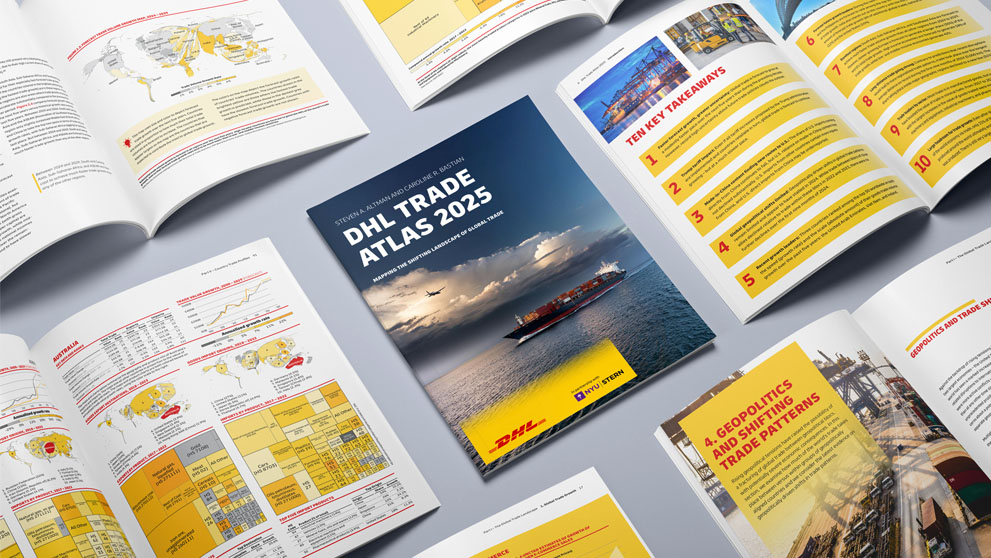
Plan your cross-border growth strategy with the DHL Trade Atlas 2025.
If you’re looking to – or already do – ship internationally, this report is essential reading. Brought to you by the world’s most international company, it reflects DHL's position at the heart of global trade and their commitment to help customers identify the most prosperous markets for expansion.
Download the report nowDHL Trade Atlas 2025: 10 Key Takeaways

1. Faster forecast growth, greater uncertainty
Global trade is forecast to grow at a modestly faster pace over the next five years than during the preceding decade. However, record high uncertainty about future trade policies clouds the outlook.

2. Trump tariff impact
Even if all tariff increases proposed by the Trump administration are implemented and countries retaliate in turn, global trade is forecast to continue growing – but at a much slower pace.
3. Made-in-China content finding new routes to U.S.
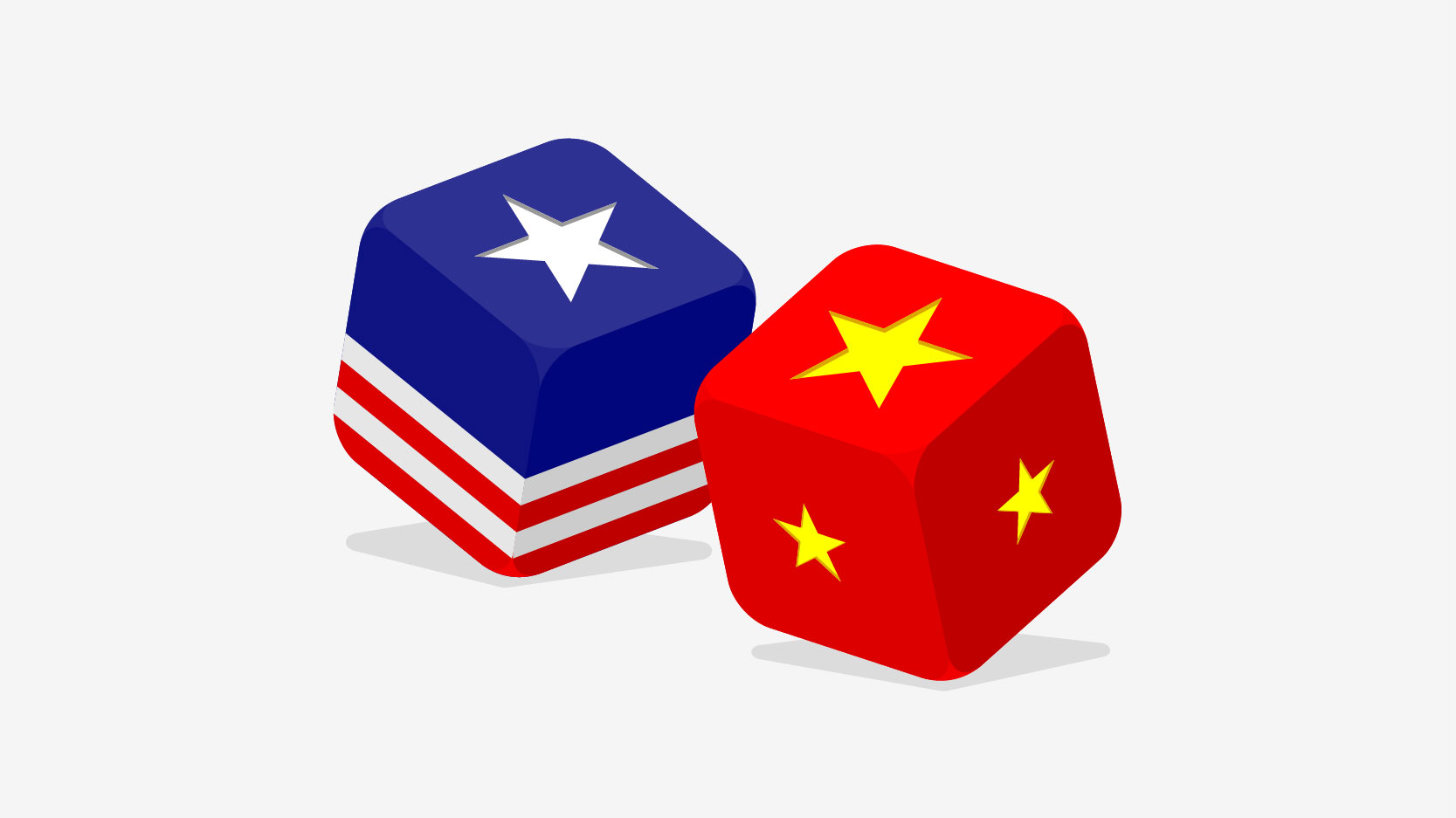
The share of U.S. imports coming directly from China continues to fall, but U.S. reliance on made-in-China content has not declined substantially. U.S. imports from other countries contain more inputs from China, and U.S. direct imports from China may be underreported.

4. Global geopolitical shifts limited
Geopolitically driven shifts in global trade patterns remain limited and appear to have stalled in 2024. While trade between blocs of close allies declined relative to trade within these blocs in 2022 and 2023, there were no further declines over the first nine months of 2024.

5. Recent growth leaders
Three countries ranked among the top 30 worldwide on both the speed (growth rate) and the scale (absolute amount) of their goods trade volume growth over the past five years: the United Arab Emirates, Viet Nam, and Ireland.

6. Forecast future growth leaders
During the next five years, India, Viet Nam, Indonesia, and the Philippines are forecast to rank among the top 30 for both speed and scale of trade growth. India also stands out as the country with the third largest absolute amount of forecast trade growth (6% of additional global trade), behind only China (12%) and the United States (10%).

7. Standout regions
South Asia, Sub-Saharan Africa, and Southeast Asia are forecast to achieve much faster trade volume growth than all other regions from 2024 to 2029. However, slower-growing Europe is forecast to generate a larger share (30%) of the world’s total trade growth. High income economies are forecast to generate 58% of trade growth, while low- and middle-income economies generate 42%.

8. Long distance trade going strong
Contrary to predictions that recent disruptions would lead to more regionalized trade patterns, trade took place over the longest average distance on record during the first nine months of 2024 (5,000 km). The share taking place inside major geographic regions declined to a new low (51%).

9. Trade leaders by sector
Most trade is in manufactured goods, but price increases have boosted the value of trade in mineral fuels. From 2017 to 2022, the categories with the largest increases in the value of goods traded were mineral fuels, electrical machinery and equipment, industrial machinery, and pharmaceuticals.

10. Large headroom for trade growth
Even after decades of increases in the integration of the world economy via trade, only 21% of the value of all goods and services produced around the world ultimately ends up in a different country from where it was produced. There is still very large potential for future trade growth.
Plan your cross-border growth strategy with the DHL Trade Atlas 2025.
If you’re looking to – or already do – ship internationally, this report is essential reading. Brought to you by the world’s most international company, it reflects DHL's position at the heart of global trade and their commitment to help customers identify the most prosperous markets for expansion.
Download the report now


 Share
Share

Similar Stories