

Neither exactly. The temporary duty is charged per customs declaration line, which generally means each unique HS code and Country of Origin (where applicable.)

If your business sells low-value goods to customers in the EU, or if you are purchasing products through e-commerce platforms, an important EU customs change is now in effect.
From 1 July 2026, the EU removed its customs duty exemption for low-value B2C imports, introducing a temporary €3 customs duty on eligible items valued at €150 or less. It's the latest step in the EU's wider customs reform and means many international sellers will need to provide more customs information – and factor additional costs into every shipment.
The good news? With a little preparation, the changes don't need to disrupt your business. In this guide, we'll explain what's changing, who it affects, and the practical steps you can take to keep your shipments moving smoothly.
Until 1 July 2026, many low-value goods imported into the EU benefited from what's known as the de minimis threshold. This meant that goods valued at €150 or less could enter the EU without customs duty (although import VAT still applied).
It's worth noting that this is different from the EU's 2021 VAT reforms. Since July 2021, all commercial goods imported into the EU have been subject to VAT, regardless of their value. The new changes don't replace VAT – they introduce customs duty on top for eligible low-value B2C imports.
The rules apply when shipping to any of the EU's 27 member states:
Austria, Belgium, Bulgaria, Croatia, Cyprus, Czech Republic, Denmark, Estonia, Finland, France, Germany, Greece, Hungary, Ireland, Italy, Latvia, Lithuania, Luxembourg, Malta, Netherlands, Poland, Portugal, Romania, Slovakia, Slovenia, Spain and Sweden.
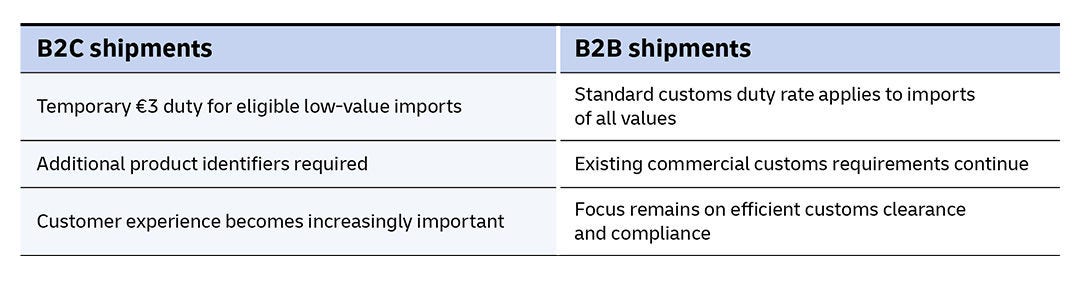
From 1 July 2026, most B2C shipments entering the EU with a value of €150 or less are subject to a temporary €3 customs duty*. (*When all conditions are met, preferential customs duty rates apply for B2C shipments without IOSS.)
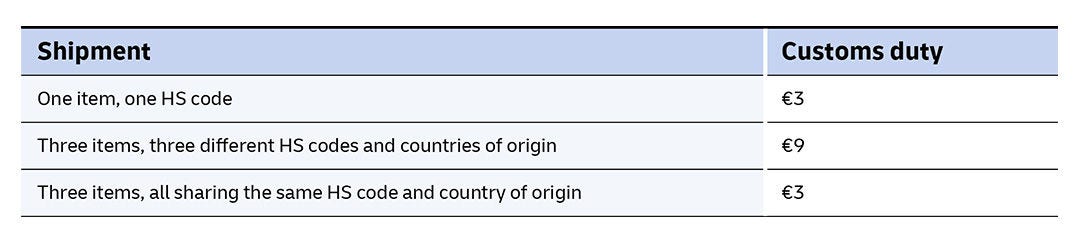
Unlike traditional customs duties, which are calculated as a percentage of a product's value, this temporary charge is calculated per customs declaration line (usually based on the product’s HS code and country of origin) rather than per parcel.
For example:
The temporary €3 flat-rate charge applies only to qualifying B2C shipments. Low-value B2B imports (€150 or less) are also affected; they remain subject to the standard EU customs duty rates, including any applicable preferential tariff rates where the relevant conditions are met, subject to evaluation by the EU.
Later in the year, customs data requirements for B2C shipments from non-EU countries will become more detailed.
From 1 November 2026, businesses will also need to provide a Product Identifier (PID) for each different type of product in the e-commerce shipment.
A Product Identifier (PID) is a unique alphanumeric code that identifies a specific product, so it can be easily tracked throughout the supply chain. There are two main types of Product Identifiers:
Here’s the timeline at a glance:

The temporary €3 customs duty comes into effect for eligible low-value B2C imports. The standard EU customs duty rates continue to apply to B2B imports of all values.
Additional product identifiers become mandatory. A separate EU customs handling fee may also be introduced.

The temporary €3 flat duty is scheduled to end, with normal customs tariff rates replacing it.
The biggest driver is volume.
Cross-border e-commerce has grown rapidly in recent years, with billions of low-value parcels entering the EU every year. That surge has placed increasing pressure on customs authorities while raising concerns around product safety, unfair competition and compliance with EU regulations.
The reforms aim to modernize customs processes and create a more level playing field for EU businesses. They’ll also ensure imported products meet the same standards expected of goods sold within the EU.
For businesses shipping internationally, it also reflects a broader trend: customs authorities increasingly expect richer, more accurate shipment data before goods even reach the border.
If you're shipping to customers in the EU
The new rules primarily affect businesses outside the EU selling directly to consumers.
In practical terms, shipping low-value products into the EU will now involve additional customs duty, and more detailed customs information – with a greater emphasis on getting shipment data right first time. Incomplete or inaccurate customs declarations are more likely to result in delays.
If you're receiving goods in the EU
EU customers may also notice a difference. Low-value imports that previously arrived without customs duty could now attract additional charges.
To create a smoother customer experience, DHL Express offers a Duty Tax Paid (DTP) billing option, allowing the sender to take responsibility for duties and taxes. DHL pays these charges to customs on the sender's behalf and bills them afterwards, helping avoid customers being contacted for payment before delivery. Sellers can also choose to include these costs at checkout, creating a more seamless post-purchase experience.
For many SMEs, these changes mean international shipping to the EU will require a little more planning – but they don't need to become a barrier to growth.
First, costs may increase. Since customs duty is now added on top of VAT for eligible shipments, you may need to review your pricing strategy and landed costs.
Second, customs paperwork becomes even more important. Accurate goods descriptions, HS codes and commercial invoices will help keep shipments moving and reduce the likelihood of delays.
Returns also deserve some attention. If you're in sectors such as fashion or consumer electronics – where returns are relatively common – it's worth understanding that customs duties paid on an outbound shipment may not automatically be refunded if goods are returned.
The good news? Moments like this can also be an opportunity to review your international strategy. Whether that means adjusting your pricing, exploring additional overseas markets, or strengthening your customs processes, businesses that prepare early will be better placed to continue growing across borders.
The changes may introduce new requirements, but a few practical steps now can help avoid problems later.
Start by checking your product catalog.
Make sure every product has a product identifier, an accurate goods description and the correct HS code, and avoid generic descriptions such as "parts" or "samples." For e-commerce shipments (B2C), ensure the declared customs value reflects the actual retail value, as this is the value used for customs purposes. Where possible, submit your commercial/proforma invoice data electronically to help speed up customs processing. From 1 November, a Merchant PID and a non-standardized manufacturer PID (ex. SKU) will be required for each type of product in your shipment.
Will your customers pay customs charges on arrival, or will your business cover them?
If you want customers to receive their orders without unexpected charges, DHL Express' Duty Tax Paid option can help create a smoother delivery experience.
The additional customs duty may affect your margins on lower-value products.
Now is a good time to review your landed costs and consider whether product pricing, shipping charges or minimum order values need adjusting.
If you use the Import One Stop Shop (IOSS) scheme, ensure your registration remains up to date, as you are now the declarant and legally responsible for customs import clearance (not the final receiver.) Please note, when you are IOSS registered, you always have to use IOSS for applicable B2C shipments. DHL Express also requires a valid Power of Attorney from the IOSS holder to use the scheme.
Customs rules change – but your international growth plans don't have to.
Whether you're shipping occasional orders to Europe or managing thousands of cross-border deliveries each month, DHL Express can help you navigate changing customs requirements with confidence.
From customs expertise and digital shipping tools to electronic customs documentation and flexible duties and taxes solutions, we're here to help simplify international shipping – so you can spend less time worrying about regulations and more time growing your business in new markets.
Neither exactly. The temporary duty is charged per customs declaration line, which generally means each unique HS code and Country of Origin (where applicable.)
No. Import VAT still applies under the existing rules. The €3 customs duty is an additional charge on eligible low-value B2C imports.
The temporary flat-rate duty is expected to apply from 1 July 2026 until 1 July 2028, after which it is planned to be replaced by normal customs tariff rates.
For fast, international shipping – to the EU and beyond – open a DHL Express Business Account.


 Share
Share