

HS code stands for Harmonized System code.

Customs clearance has grown increasingly complex over the years as the explosion of goods being sent across borders has become more diversified. For Brazilian small and medium enterprises (SMEs) looking to scale globally or source internationally, navigating the strict oversight of the Receita Federal (Brazilian Federal Revenue) and international customs authority networks requires absolute precision.
To avoid your packages being delayed at customs, you need to supply accurate data — and that means listing the products you are sending in detail. The Harmonized System code (or HS code) is designed to label all existing goods in precise detail, making it easier to identify products internationally.
When managing cross-border logistics in Brazil, a single classification mistake can halt your operations, trigger heavy tax fines, or lead to the seizure of your cargo.
Harmonized System (HS) codes are a unique identifier to classify the exact type of goods you are shipping. They serve as the foundational language for global trade, determining exactly how much duty your business will pay and which administrative rules apply to your inventory.
HS codes were created by the World Customs Organization, and are internationally recognized in almost every country. As customs and government bodies now have a common point of reference to instill regulations based on HS classes, they are able to create a standard to approach each HS category the same way.
This in turn creates a more organized importing/exporting structure and a good guideline for countries wanting to implement new regulations.
To find the correct HS code for your product, you must use official government classification platforms or advanced digital routing tools provided by your international carrier. Shippers can execute a search via the Siscomex platform (the integrated foreign trade system managed by the Brazilian government) or utilize DHL Express' dedicated Interactive Classifier tool.
The responsibility of providing the HS code always falls on the shipper, meaning your business must execute a reliable harmonized code lookup before generating any international waybill.
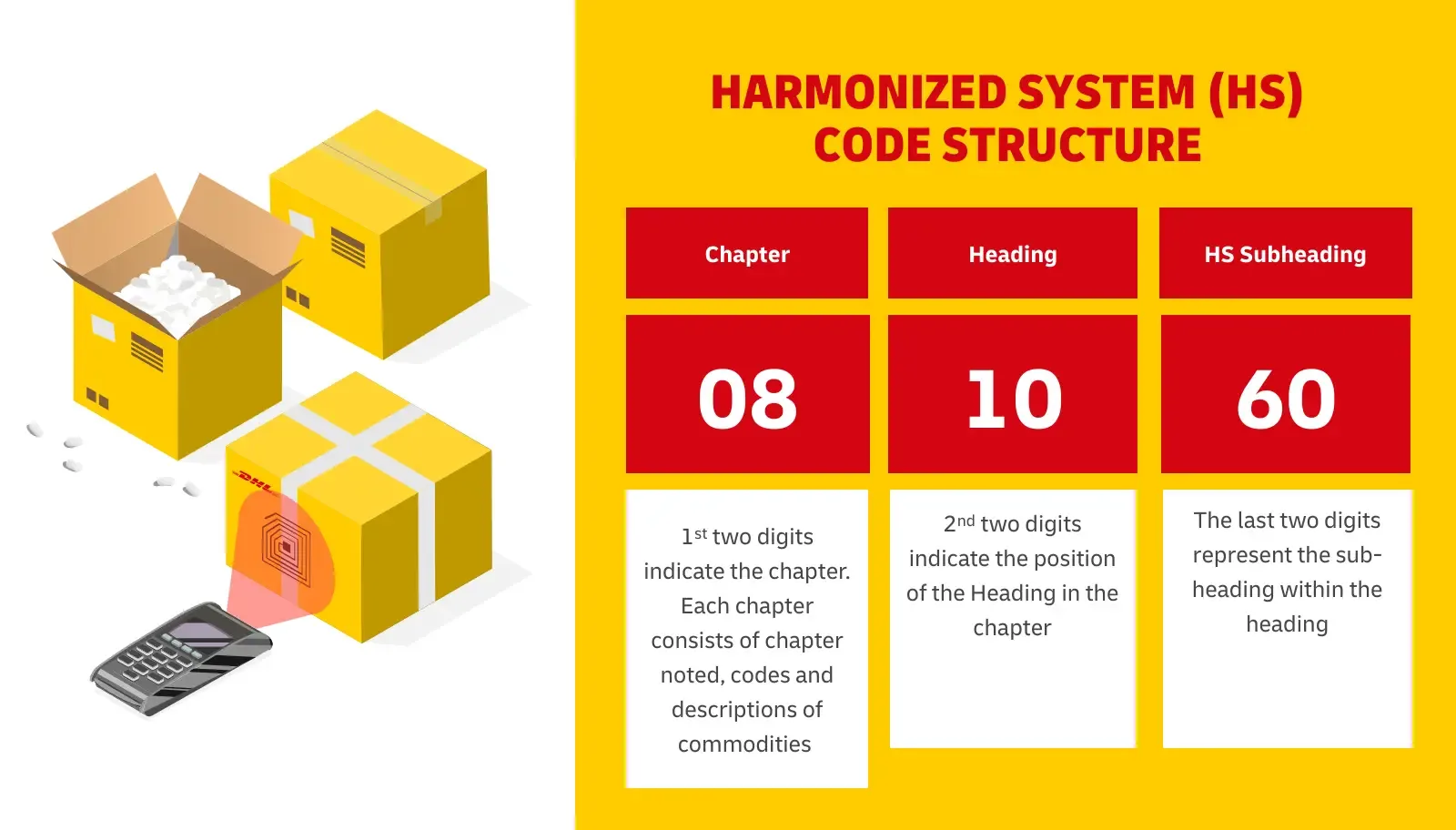
The international Harmonized System uses a standardized six-digit numerical structure to classify commodities:
The first two digits identify the primary chapter under which the product falls. Globally, there are 21 overarching sections divided into 99 chapters that generalize broad product sectors.
The next four digits break down the item further into its specific heading and sub-heading within that designated chapter.
[ 0 9 ] -> Chapter (e.g., Coffee, Tea, and Spices)
[ 0 1 ] -> Heading (e.g., Coffee, whether or not roasted)
[ 1 1 ] -> Subheading (e.g., Not decaffeinated, unroasted)
While global trade relies on the foundational six-digit HS structure, regional trade agreements frequently append extra digits for local tax and regulatory purposes. Just as ASEAN nations use an eight-digit classification called the ASEAN Harmonized Tariff Nomenclature (AHTN), Brazil and its fellow Mercosul members utilize the NCM (Nomenclatura Comum do Mercosul).
The NCM is an eight-digit system where the first six digits mirror the international HS code perfectly, while the final two digits define regional sub-classifications unique to Mercosul trade.
When exporting from or importing to Brazil, you must track both systems: the six-digit HS code is universally accepted globally, but the eight-digit NCM code is mandatory for domestic fiscal documents (like the Nota Fiscal Eletrônica or NF-e) and customs declarations.
ASEAN countries follow the ASEAN Harmonized Tariff Nomenclature (AHTN) – where the first six digits still take reference from the international HS codes – but there are an additional two digits at the end that further break down the sub-headings. Commodities shipped within ASEAN normally use the eight digit AHTN classification, but the six digit HS codes are also considered valid.
Businesses are encouraged to indicate the HS code in their shipping documents to ensure a uniform mode of clearance every time.
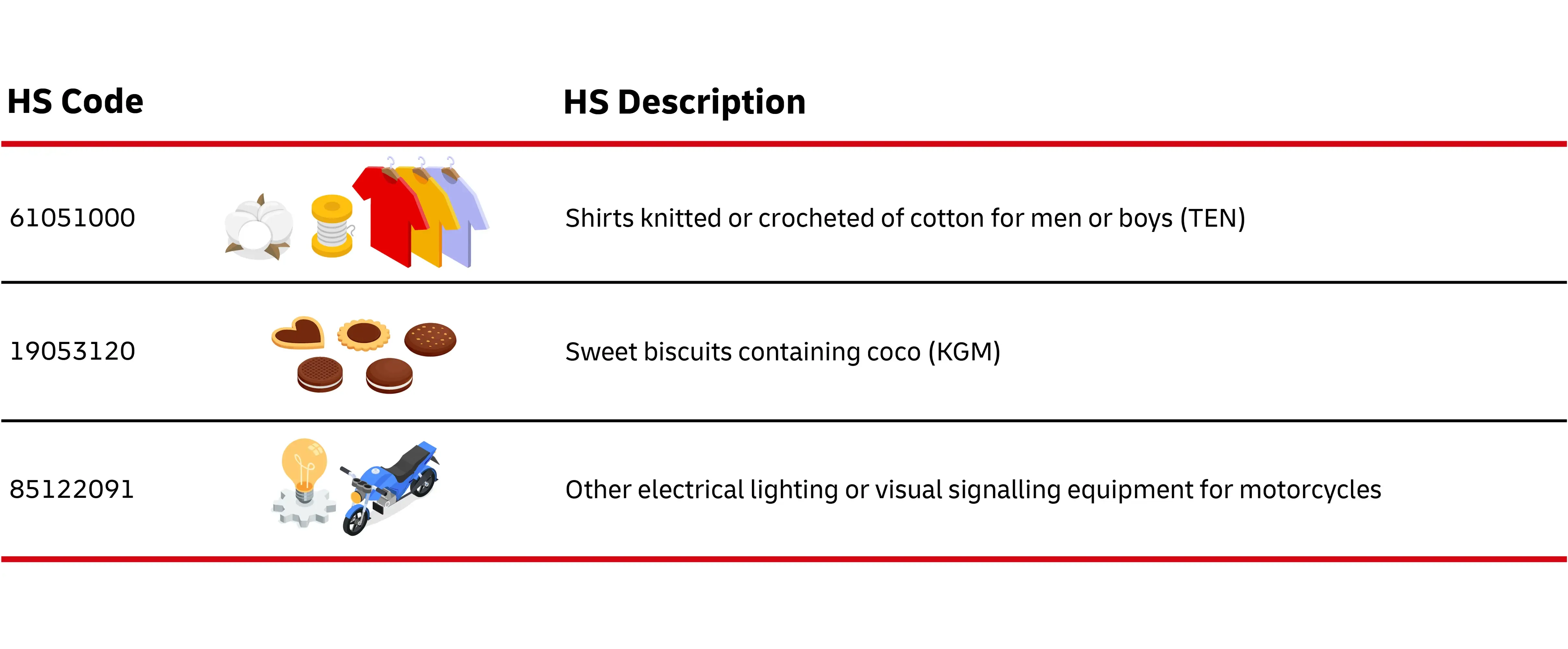
There are thousands of different HS codes, and each commodity is further dissected into highly specific technical descriptions to leave zero room for customs misinterpretation.
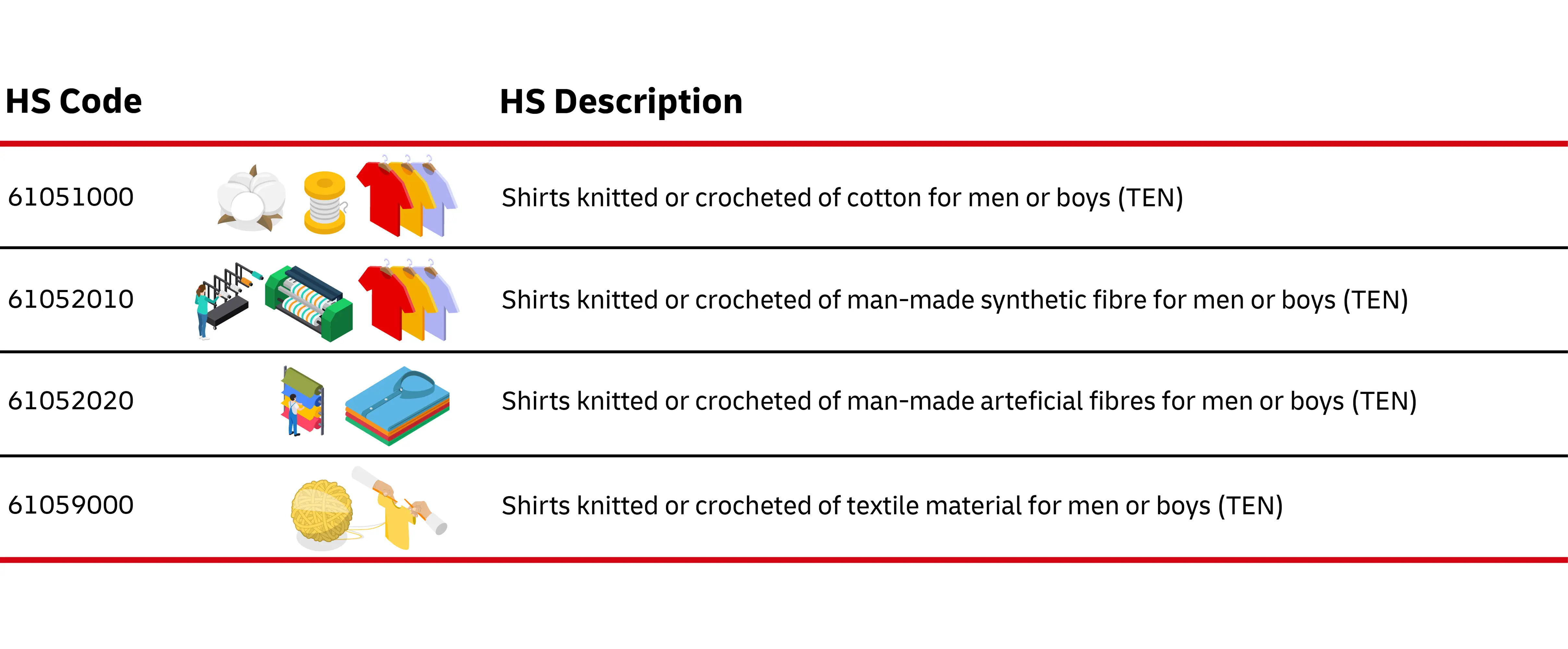
For example, when looking up a standard apparel item like a men's shirt, you will discover that the system splits into roughly 10 distinct codes depending on material composition. There are separate, specific categories for:
Men’s shirts made out of pure cotton
Men’s shirts constructed from synthetic fibers
Men’s shirts assembled from other alternative textiles
In some instances, certain technical commodities may contain overlapping definitions where two or more codes initially seem to apply. In such cases, you only need to select the single closest possible match to the actual structural item.
Product Type | Core Global HS Code | Common Local ERP Integration |
Cotton Apparel | 6205.20 | Syncs with Bling / Tiny for automated packing slips |
E-commerce Electronics | 8517.13 | Requires ANVISA or INMETRO check depending on use case |
Processed Foods | 2106.90 | Demands strict MAPA import/export clearance authorization |
The customs department of almost every country has predefined specific regulatory treatments, tariffs, and non-tariff barriers based on these exact classifications.
When you apply an incorrect code on your commercial invoice, your business risks triggering severe unintended duties, hitting tight import restrictions, facing heavy administrative penalties from the Receita Federal, or experiencing outright cargo rejection at destination.
While it is not strictly illegal to omit the code from basic transport waybills in certain regions, leaving it off is a major business liability.
It is highly recommended to display the HS code clearly on your commercial invoice to give a transparent, indisputable representation of your shipment contents, especially if your product relies on complex technical components.
Consider a Brazilian SME exporting "Television Parts". While that phrasing is clear to a person, customs software cannot process it safely. Television parts break down into dozens of distinct sub-categories based on technical composition, screen type, or circuitry. To define exactly what you are shipping and ensure it clears customs without weeks of manual inspections, you must use the specific HS code.
In some instances, certain commodities may contain overlapping codes, where two or more codes apply. In such cases, the shipper only needs to select one – usually the closest possible match to the actual item.
The customs department of almost every country would have already defined different regulations based on different classifications. When you include the incorrect code, there might be a risk of unintended duties and taxes, higher restrictions on importing, or in the worst-case scenario, rejection of entry into the destination country.
While it is not necessary to indicate your product’s HS code in any of the documents, it is always recommended to indicate it on your invoice to give a clear and accurate representation of the contents of your shipment, especially if the item you are shipping is very technical. Let’s use the example of “Television Parts” as a description on your invoice. Although the term to explain the product is straightforward, Television Parts can be further broken down into many different categories depending on the technicalities of the component. To truly define exactly which part you are shipping would require a HS code to clearly label the item.
HS code stands for Harmonized System code.
An HS code is a globally recognized classification of a traded product, via a system of names and numbers.
The first six digits of an HS code are standardized globally by the World Customs Organization. This ensures a common foundation for classifying goods internationally. However, some countries, like those in APAC, may add two additional digits for more specific classifications within their region.
A: Incorrect HS codes can lead to several issues:
Unforeseen Duties and Taxes: Your shipment might be subject to higher or unexpected fees.
Import Restrictions: The product may face stricter import regulations than intended.
Shipment Delays or Rejection: In the worst-case scenario, customs officials may delay or even reject your shipment.
A: While not strictly mandatory, it's highly recommended. Providing the HS code on your invoice and other shipping documents ensures accurate customs clearance, minimizes delays, and helps avoid potential issues with duties and taxes.
A: The World Customs Organization reviews and updates the Harmonized System (HS) codes every five years to reflect changes in technology, trade patterns, and emerging products.
A: If you're having trouble identifying the right HS code, you can:
Consult Your Country's Customs Authority: They often provide resources and guidance.
Use Online HS Code Lookup Tools: Many online tools, including DHL Express' Interactive Classifier, can help you find the correct code.
Seek Advice from DHL Express: Our international specialists are experts in customs regulations and can help you organise all your paperwork - apply for an account today.
A: Yes, HS codes are used universally for classifying goods in international trade, whether they are being imported into a country or exported from it.
A: While both are used for classifying goods, HS codes are used internationally, while Schedule B numbers are specific to the United States and are used for exporting goods.
A: No, each product should have its own unique HS code that accurately reflects its characteristics and composition.
DHL Express handles thousands of documents, parcels, and cargoes every single day. Its global network of international specialists are well-versed in customs regulations and HS code variations so that every shipment moves on to its destination without delay. Whether you're importing or exporting, opening a DHL Business Express Account means all the hassle of customs will be taken care of for you, so that you can focus on the business of selling!


 Share
Share