


Looking for a fast and reliable way to ship heavy packages around the world? For growing businesses in Brazil, relying exclusively on traditional freight forwarding services often introduces costly transit times and unpredictable port delays that can harm your customer relationships.
Thankfully, there is an efficient international alternative that fits seamlessly into your supply chain. Read on for a quick guide to the best way to manage heavy and oversized shipments directly from your local facility.
What are the main challenges of heavy freight forwarding in the Brazilian market?
The main challenges of heavy freight forwarding in the Brazilian market include severe port congestion, complex customs procedures at international gateways, and unpredictable ocean freight pricing that directly eats into retail margins.
With roughly 90% of global trade moved via sea containers, ocean infrastructure faces constant capacity bottlenecks. Data from ABCOMM (Associação Brasileira de E-Commerce) shows that logistics infrastructure limits are a top concern for local exporters trying to scale cross-border sales—especially during high-volume retail seasons.
While local businesses regularly utilize express air services to send light consumer products or small sample packages, many assume that bulkier industrial goods or wholesale inventory require slow ocean freight.
However, you can bypass traditional port gridlock by leveraging time-definite international express networks for large cargo. This model avoids the long warehouse wait times associated with traditional sea freight forwarding, allowing you to maintain a lean, responsive international supply chain.
Large vs heavy vs oversized items: what’s the difference?
When routing cargo through cross-border logistics Brazil channels, understanding the specific technical breakdown of your shipment’s physical attributes is essential for calculating exact pricing and ensuring customs compliance. International carriers categorize shipments into three distinct profiles:
Large items
Definition: Large items are packages with two sides measuring more than 800mm, or a single side that exceeds 1200mm, but which do not necessarily carry extreme physical density. They require strategic warehouse stacking and specialized handling to maximize space efficiency.
Local Market Examples: Flat-pack office desks sourced for corporate clients, commercial fitness equipment, and large-screen digital displays sold on platforms like Mercado Livre or Amazon.com.br.
Heavy items
Definition: Heavy items are individual packages or crates that exceed 30kg in total weight. These shipments require multiple handlers or automated mechanical equipment to load, and they can damage standard, non-reinforced shipping containers if left unsecured.
Local Market Examples: Major household appliances (such as industrial refrigerators or washing machines), palletized agricultural supplies, and localized distribution machinery like compressors or generators.
Oversized items
Definition: Oversized items, officially classified as out-of-gauge (OOG) cargo, exceed standard courier dimensions in length (300cm), width (200cm), height (160cm), or a combined calculation of these limits. They require customized transport routes and specialized loading decks.
Local Market Examples: Automotive engines and transmissions being shipped to overseas assembly plants, high-value medical diagnostic scanners, and handcrafted musical instruments.
What are the weight and size limits for express international shipping?
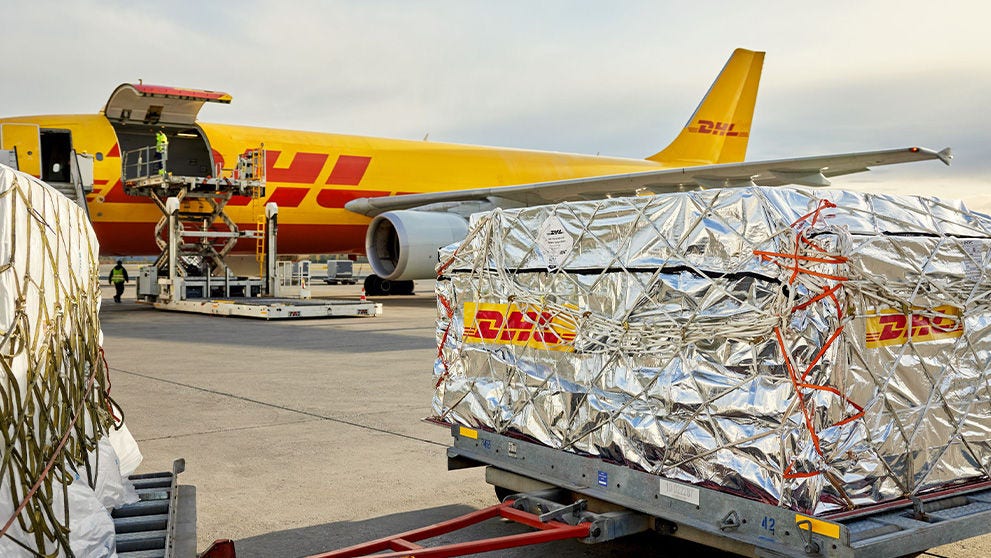
The weight and size limits for shipping large or heavy items through express international air corridors allow you to route major commercial freight without resorting to sea containers. Utilizing a premium international carrier ensures that your heavy boxes bypass regional ports and clear customs seamlessly.
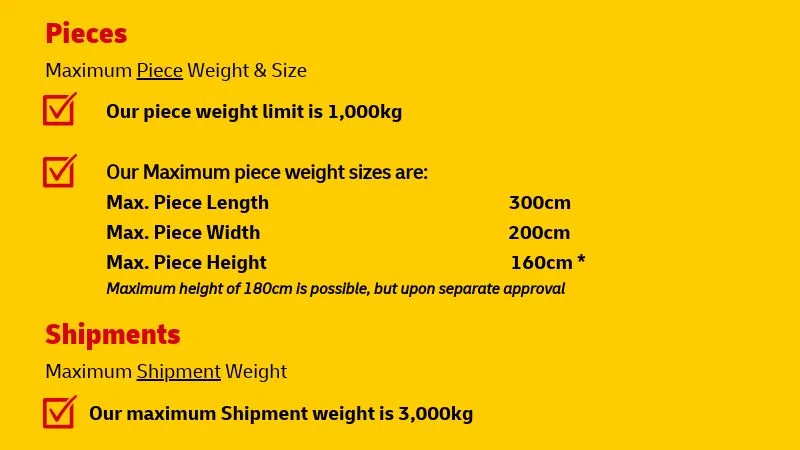
[Individual Piece Max: 1,000kg] ➔ [Total Shipment Max: 3,000kg] ➔ [ Max Dimensions: 300cm L x 200cm W x 160cm H]
Maximum dimensions for large or heavy pieces
Each individual piece in your manifest must not exceed a maximum length of 300cm and a width of 200cm. The standard allowable height is capped at 160cm. However, if your specific product requires more vertical clearance, you can secure separate approval for heights up to 180cm.
Maximum allowable freight weight
An individual packaged item or pallet must not exceed 1,000kg in weight. For multi-piece shipments, the combined weight of the entire consolidated booking is capped at 3,000kg.
If your inventory exceeds these metrics, you must arrange a specialized cargo booking with your provider. For explicit breakdown data, you can download our comprehensive packing guide.
How do Receita Federal and NCM codes impact large cargo costs?
Receita Federal and NCM codes impact large cargo costs by determining the exact export taxes, administrative customs fees, and physical inspection requirements applied to your shipment before it leaves Brazil.
According to data from SEBRAE, incorrect product classification is a leading cause of international shipment rejections and financial penalties for small and medium-sized enterprises.
When your business exports heavy equipment or bulk inventory, your logistics team must prioritize exact compliance data entry:
NCM Code Mapping: Every heavy item must link to its correct Nomenclatura Comum do Mercosul (NCM) code. A mismatch between your commercial invoice description and the digital code can prompt Receita Federal to issue an immediate operational hold.
Fiscal Valuation: Large and high-value industrial goods face intense valuation scrutiny at customs. Ensure your documentation clearly lists the true value, net material weight, and country of origin.
Regulatory Clearances: If your heavy items include specialized electronics or medical hardware, you may need to attach export authorizations from bodies like ANVISA or INMETRO directly to your shipping manifest.
How do you safely pack and secure a commercial pallet?
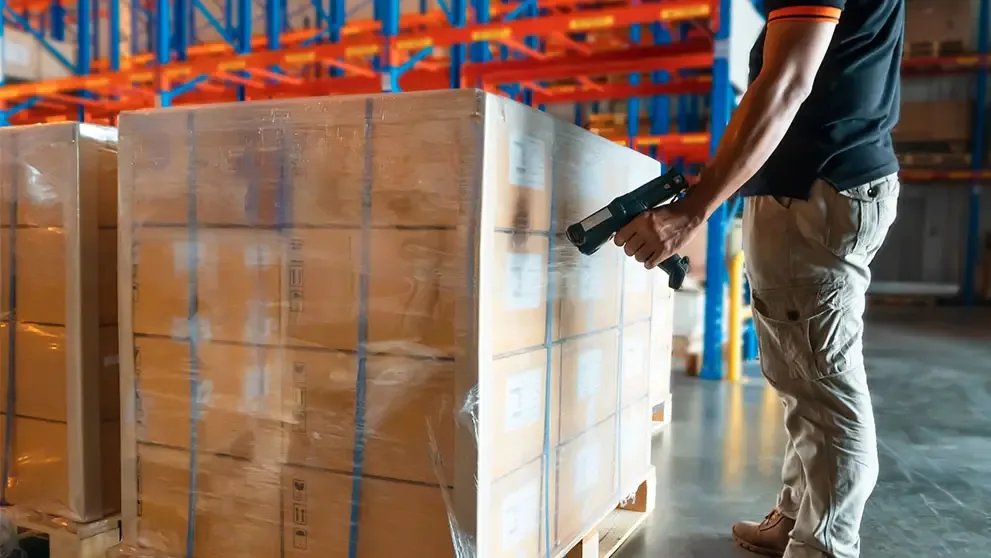
You safely pack a commercial pallet by stacking heavier items flat at the base, utilizing uniform box sizes to build a stable structure, and securing the entire load to the skid using heavy-duty strapping or shrink wrap. Pallets are the industry standard for transporting high-density cargo, making it much easier for warehouse teams to load and unload goods using forklifts.
To ensure your palletized goods move smoothly through time-definite international networks without experiencing operational damage or delays, you must adhere to clear packing guidelines:
Verify Dimensions: Use standard commercial pallets with a footprint up to 120 cm (W) x 120 cm (L), and confirm the final stacked height does not exceed 160 cm.
Reinforce and Bind: Ensure your individual products are securely boxed or packed into wooden crates, then apply heavy-duty plastic banding, strapping, or industrial shrink wrap to bind the cargo directly to the pallet base.
Prioritize Stackability: Build a flat top surface using square, stackable boxes. Containers with irregular shapes or non-stackable designs may face operational surcharges from air carriers.
Monitor Weight Caps: Individual pieces over 70 kg will trigger a standard handling surcharge, and no single piece can exceed the maximum limit of 1000 kg. Ensure the entire consolidated shipment stays under the 3000 kg threshold.
Respect Width Boundaries: Avoid shipping individual pieces that exceed 300 cm in length or 200 cm in width, as express air networks cannot accept them.
To see a complete breakdown of packaging rules, download our packing guide to review the critical do's and don'ts of industrial cargo preparation.
Practical tips for preparing large or heavy shipments
Managing heavy logistics requires proactive planning at your fulfillment facility. By introducing these warehouse practices, your business can significantly reduce the risk of structural damage or transit delays:
Deploy Double-Walled Boxes: Always choose thick, corrugated cardboard boxes or reinforced crates designed to bear high-density weight. Avoid reusing old or weakened containers, as they are highly susceptible to buckling under pressure.
Use Reinforced Packaging Tape: Seal every seam and edge using heavy-duty, water-activated reinforced packing tape. Apply an extra H-tape pattern across both the top and bottom flaps to prevent the box from splitting open.
Split Into Multi-Piece Shipments: If an item is exceptionally heavy, consider dividing the inventory across several smaller boxes. Distributing the weight across multiple packages makes manual handling safer and can often reduce overall freight costs.
Consolidate Export Documentation: Verify that your commercial invoices, detailed packing lists, and certificates of origin are completely aligned before dispatching the cargo. Clear data prevents manual data-entry corrections at international borders.
What are the business advantages of express shipping for large items?
The business advantages of express shipping for large items include predictable transit times, end-to-end cargo visibility, and a resilient transport network that operates independently of sea port congestion.
Choosing an express air provider allows your business to optimize its cross-border workflows:
Supply Chain Resilience: Because express logistics rely exclusively on dedicated air and land networks, your shipments avoid the major maritime disruptions and union strikes that frequently slow down traditional ocean freight forwarding.
Rapid Delivery Lead Times: Time-definite shipping allows your brand to deliver critical replacement parts, medical hardware, or high-value machinery on a fixed schedule, giving you a competitive edge over competitors relying on sea routes.
All-Inclusive, Transparent Pricing: Express providers offer a clean, all-in-one cost layout. This transparent pricing eliminates the surprise surcharges common in traditional sea freight—such as sudden airport handling fees, delivery adjustments, or unexpected export documentation costs.
Centralized Customs Brokerage: International express networks feature in-house customs expertise that manages border entry automatically. This comprehensive customs assistance is integrated into your standard shipping rate, ensuring your packages clear border checkpoints quickly.
Real-Time Tracking: Both your operations team and your international customers can monitor the cargo's progress from origin to destination, providing complete peace of mind.
Shipping large or heavy commercial goods does not have to be a complicated, high-risk process for your enterprise.
By matching your fulfillment workflow with a trusted global carrier that understands international compliance and industrial packaging best practices, you can expand your brand's footprint securely.
If your business is ready to move beyond slow sea freight and access the benefits of time-definite air transit, open a DHL Express Business Account today.
Let's get things moving...
Shipping big items doesn’t have to be daunting – it’s just about knowing how to handle the unique challenges that come with their size and weight. DHL's extensive experience in handling heavy, large, and oversized items makes them a trusted partner for your shipping needs. Their global network, specialized equipment, and commitment to adhering to industry best practices ensures that your cargo is always in safe hands.
If you don't currently ship with DHL Express, but are ready to enjoy the benefits, open an account by clicking the button below.


 Share
Share

Similar Stories