
DHL Trade Barometer 2025:
An in-depth look at the state of Australia’s exports
DHL Trade Barometer 2025:
An in-depth look at the state of Australia’s exports
Despite geopolitical shifts and tariff concerns, Australian exporters are remarkably optimistic. Why? Explore key highlights from the DHL Export Barometer 2025 report and uncover the state of Australia’s exports to benchmark your business and find global market opportunities.
The global market trends of the past few years have created a dynamic and often challenging environment for Australia's export sector. Geopolitical shifts and new trade policies continue to present uncertainty , yet Australian businesses are demonstrating remarkable resilience and adaptability.
2025’s DHL Export Barometer report examines the issues directly impacting Australian exporters, from market sentiment and challenges to assessing global market opportunities for Australia. Explore the key findings of this year’s report and get actionable, data-driven insights to help your business navigate the evolving global economy.
At a glance: Key highlights from the 2025 DHL Trade Barometer report
The Export Barometer 2025 suggests that most Australian businesses are optimistic yet measured about navigating current global market trends. The key findings show that business performance is improving across the board with an increase in digital adoption as well as the use of Free Trade Agreements (FTAs) and Artificial Intelligence (AI) are on the rise.
- Overall confidence: Despite global challenges, 60% of Australian exporters are confident in the year ahead and expect revenues to increase. This tracks close to the long-term average of 63%
- Business performance: Half of Australian businesses (50%) saw orders increase in the past 12 months, with only 14% reporting a decrease, one of the lowest figures in a decade.
- Top markets: New Zealand remains the top trading partner for Australia exports. The average number of export markets per trader has grown from 3.8 in 2021 to 5.2.
- Free Trade Agreements: The importance of FTAs has risen sharply, with 84% of traders now viewing them as crucial to their decision-making, up from 79% two years ago.
- Digital adoption: 82% of businesses continue to generate orders or enquiries through online channels.
- New technology: While only 19% of exporters currently use AI, a significant 36% plan to implement it in the near future for tasks like marketing and demand forecasting.
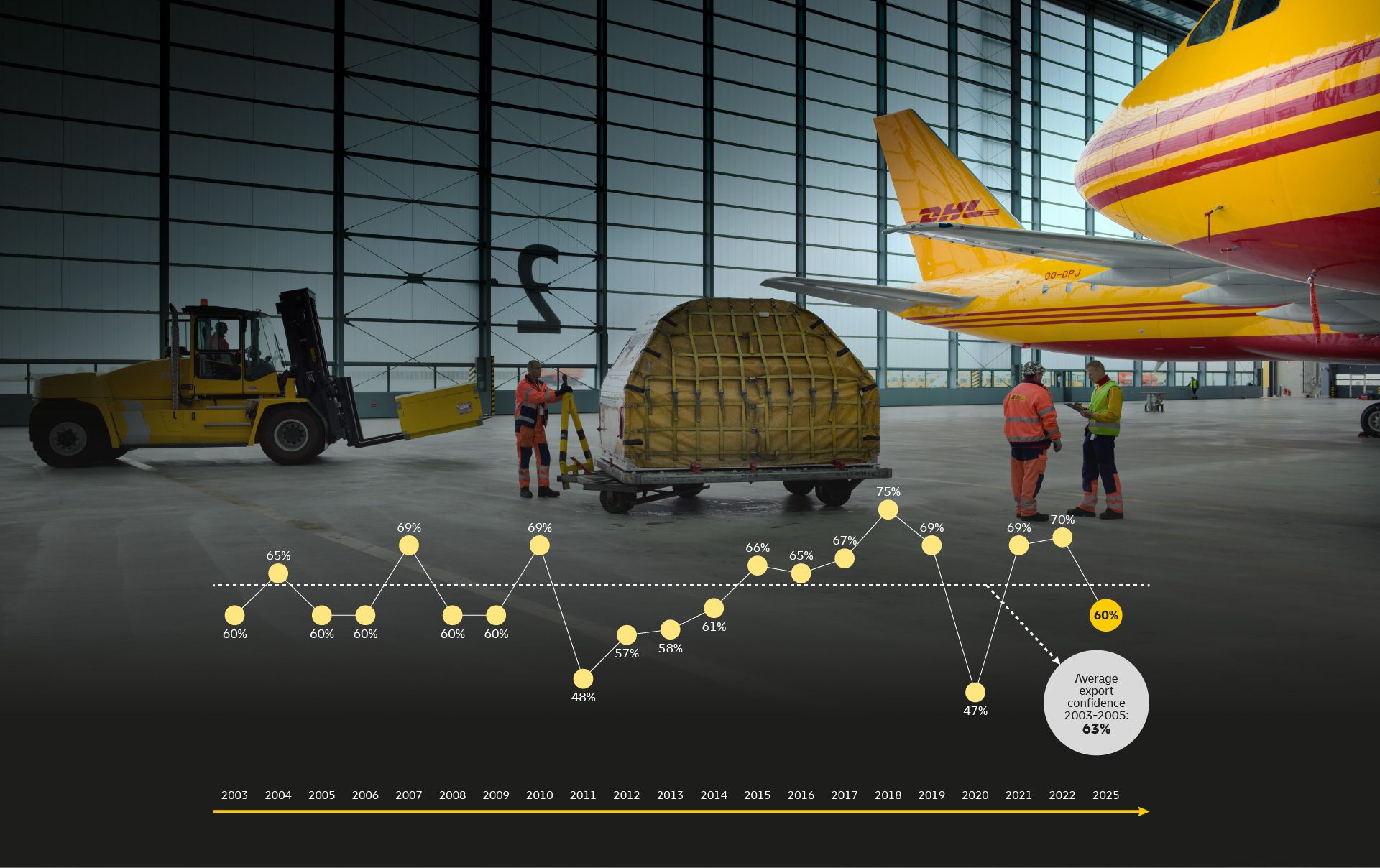
Exporter confidence and performance of Australian exports remains strong
Despite a slight dip in confidence to 60%, Australian exporters remain upbeat. This figure is still a "far cry from other challenging times" like the Global Financial Crisis (48%) and the height of COVID-19 (47%). In fact, 50% of businesses saw orders increase in the past 12 months, with only 14% reporting a decrease, one of the lowest figures in the last decade.
Exporter confidence and performance of Australian exports remains strong
Despite a slight dip in confidence to 60%, Australian exporters remain upbeat. This figure is still a "far cry from other challenging times" like the Global Financial Crisis (48%) and the height of COVID-19 (47%). In fact, 50% of businesses saw orders increase in the past 12 months, with only 14% reporting a decrease, one of the lowest figures in the last decade.
- Small to medium businesses drive optimism: Medium-sized and small businesses are the most optimistic about their future prospects, with 67% and 64% expecting a positive year ahead respectively.
- Newcomers see brighter prospects than long-standing exporters: At the same time, new businesses (exporting 5 years or less) were much more optimistic about revenue growth, with a striking 83% reporting revenue is likely to increase in the year ahead. A dramatically different perspective compared to longer-tenured exporters (operating for more than 20 years), where only 49% forecast a positive or stable outlook.
- Customer-facing businesses hold highest confidence levels: B2C companies were also more optimistic about future prospects compared to B2B businesses (75% vs 51%), with Consumer Goods having the highest level of confidence at 75%.
Are Australian businesses right to be optimistic about their future prospects? Let’s take a closer look at performance in export markets to find out.
- B2C leads the way: B2C businesses reported the strongest performance, with 65% seeing rising orders in the last 12 months compared to 46% of B2B businesses.
- Agriculture and mining saw the largest increase in exports: Agriculture and mining led the sectors, with 55% of traders seeing an increase in orders, followed by Consumer Goods (54%), Manufacturing (40%) and Services (30%).
Export performance of Australian businesses by key firmographics:
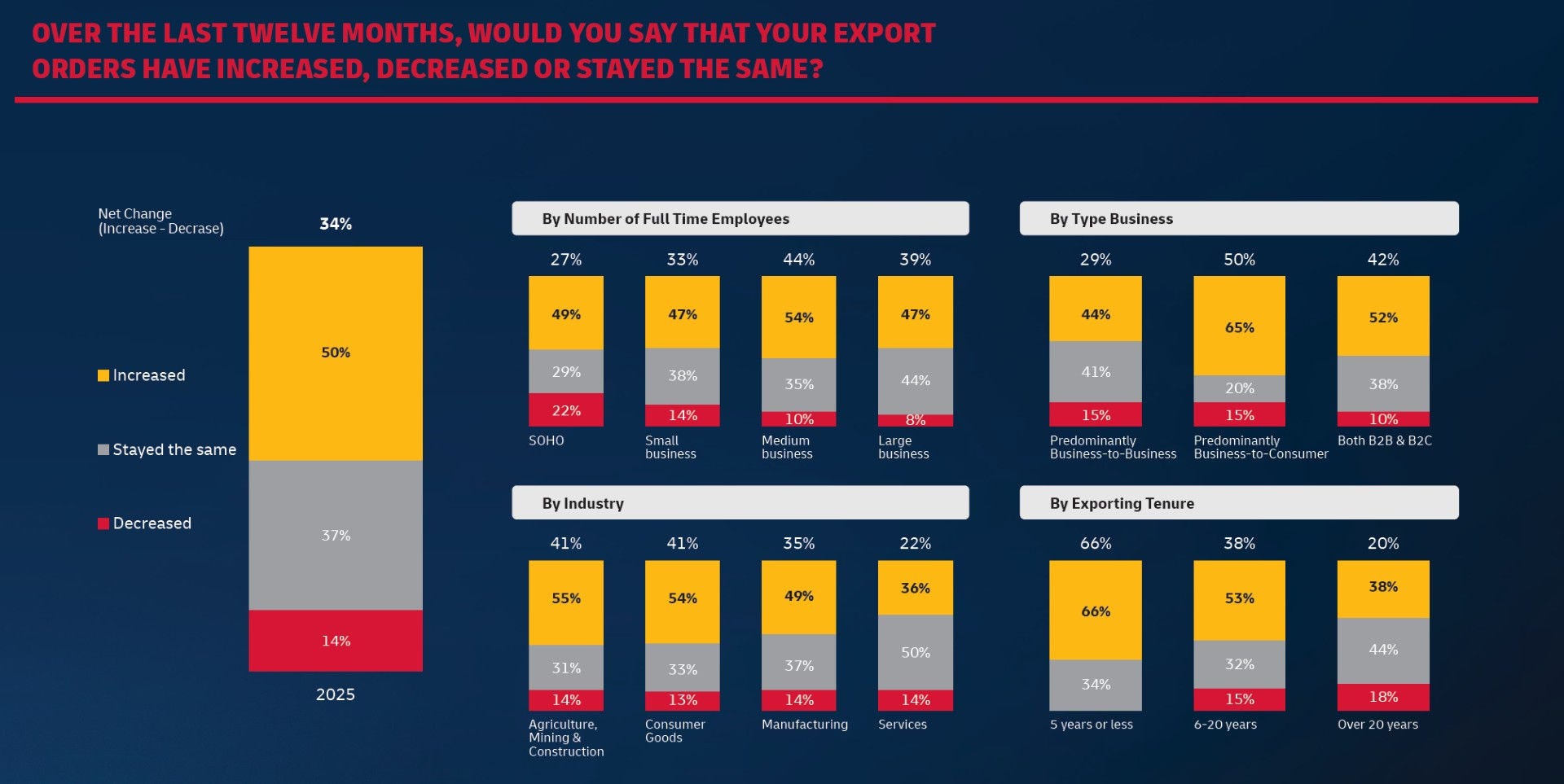
Key takeaways: The strong performance of B2C firms and the Consumer Goods sector as indicated in 2025’s DHL Trade Barometer report highlights the effectiveness of digital commerce and direct customer engagement in Australia exports. B2B firms can look to improve their export growth by adopting B2C principles like customer personalisation to better seize new global market opportunities.

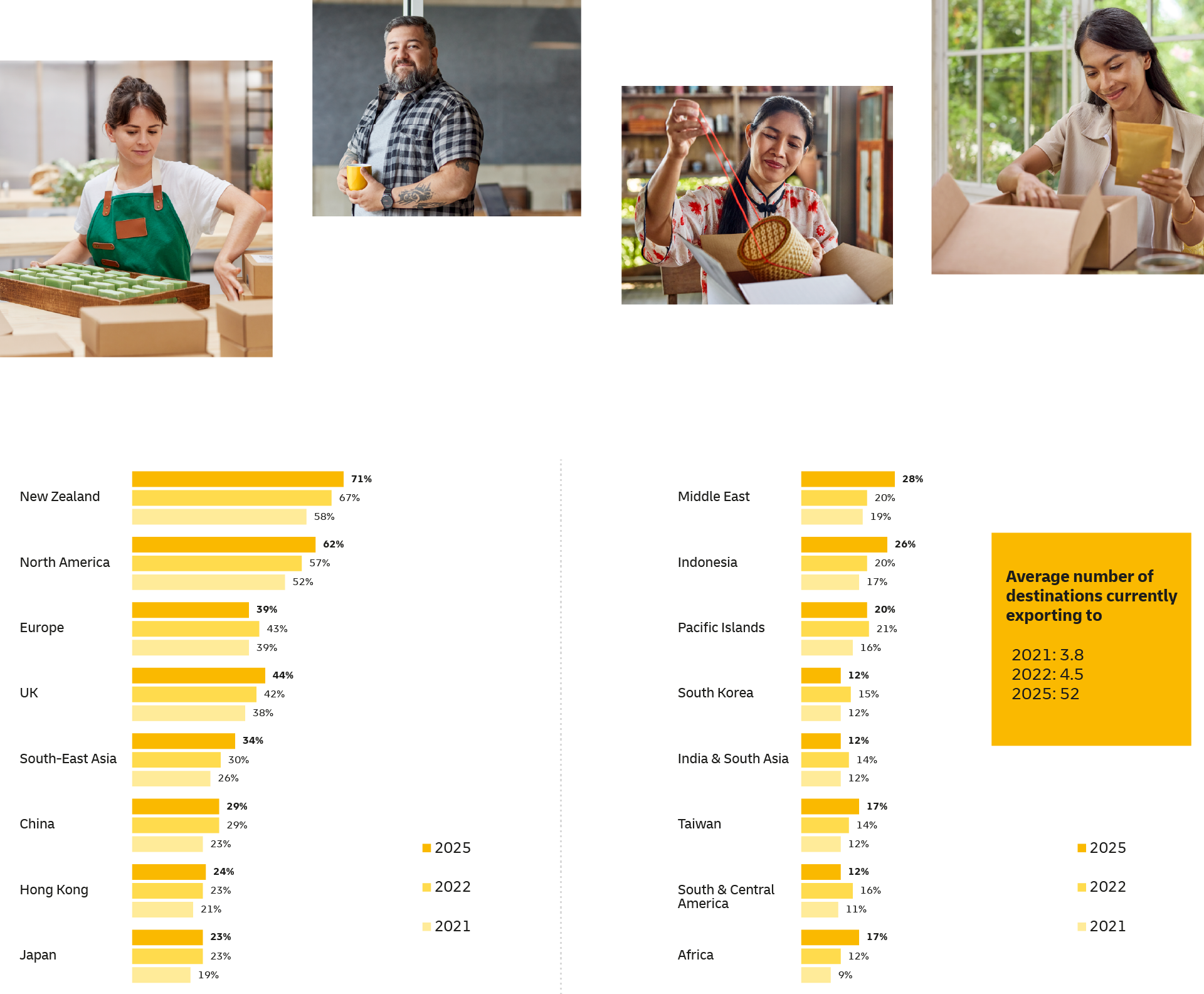

New destinations for Australia exports
Around 46% of Australian exporters plan to export to new countries in the next 12 months, which is higher compared to previous years.
- Belief in US markets still strong: Exporters targeting North America remain the most optimistic (76% confident) despite concerns over US tariffs. In contrast, those targeting New Zealand saw a decline in confidence (51% forecasting revenue increases). Businesses focusing on South-East Asia were among the least optimistic (45%).
- Diversification into frontier markets: SOHOs are driving diversification into emerging regions. SOHO penetration into the Middle East doubled from 16% to 32% while penetration into Africa jumped from 8% to 19%
Countries/export destinations Australian exporters are planning to target over the next 12 months:
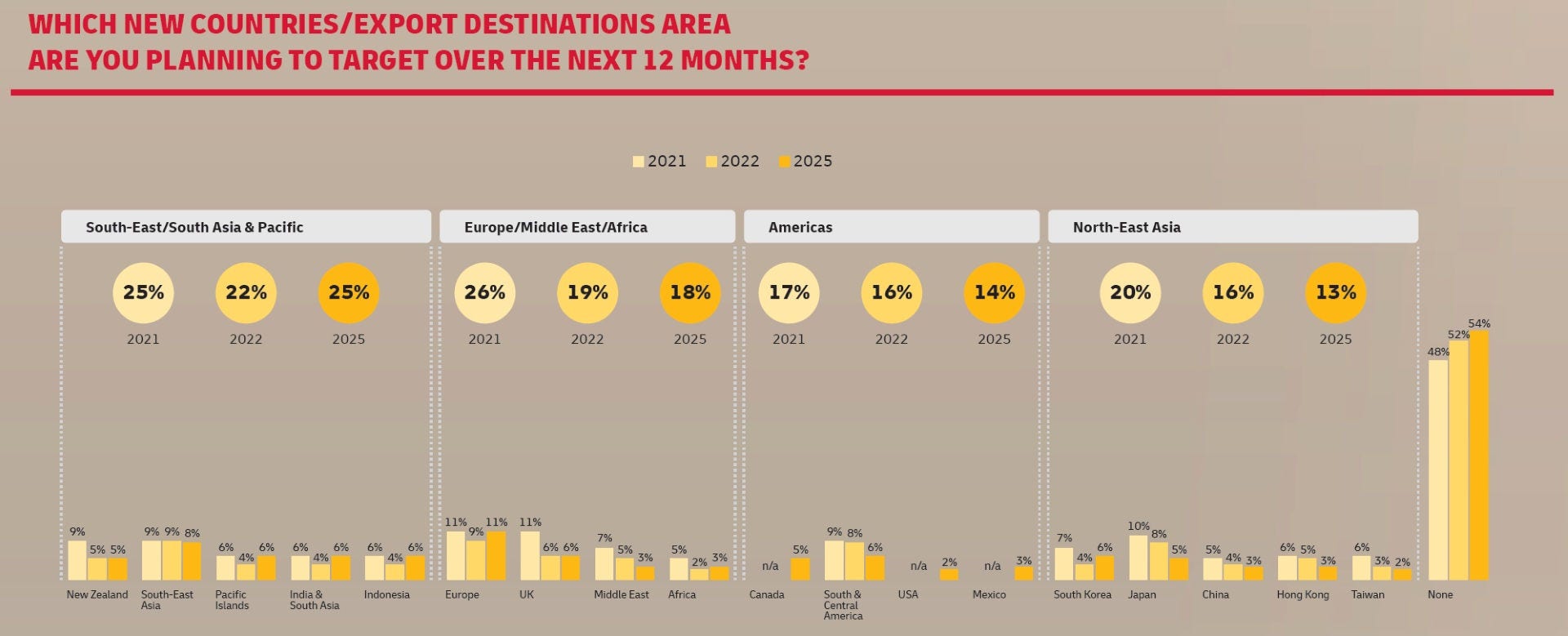
Key takeaways: The high confidence in the US market despite geopolitical headwinds, suggests that exporters are relying on strong underlying demand and are willing to absorb or mitigate political risk. Conversely, caution in Asia Pacific markets (New Zealand, SE Asia) may signal local economic slowdowns or increased competition. The rapid growth in frontier markets (Middle East, Africa) suggest promising global market opportunities, especially for nimble SOHOs exporting overseas into high-growth niches.
Free Trade Agreements for Australia exports
FTAs are now perceived as a crucial tool for competitiveness. 84% of traders now view FTAs as a key part of their decision to export to new countries, up from 79% two years ago.
The three most utilised FTAs were:
- Australia-New Zealand Free Trade Area (AANZFTA)
- China-Australia Free Trade Agreement (ChAFTA)
- Australia-United States Free Trade Agreement (AUSFTA)
Amongst industries, 64% of consumer goods exporters rated FTAs as a very important consideration before entering a new export market, while over 50% of manufacturing and service exporters rated FTAs as a key part of their decision-making process when exporting overseas.
How different Australian industries rate the importance of FTAs when expanding to a new export market:
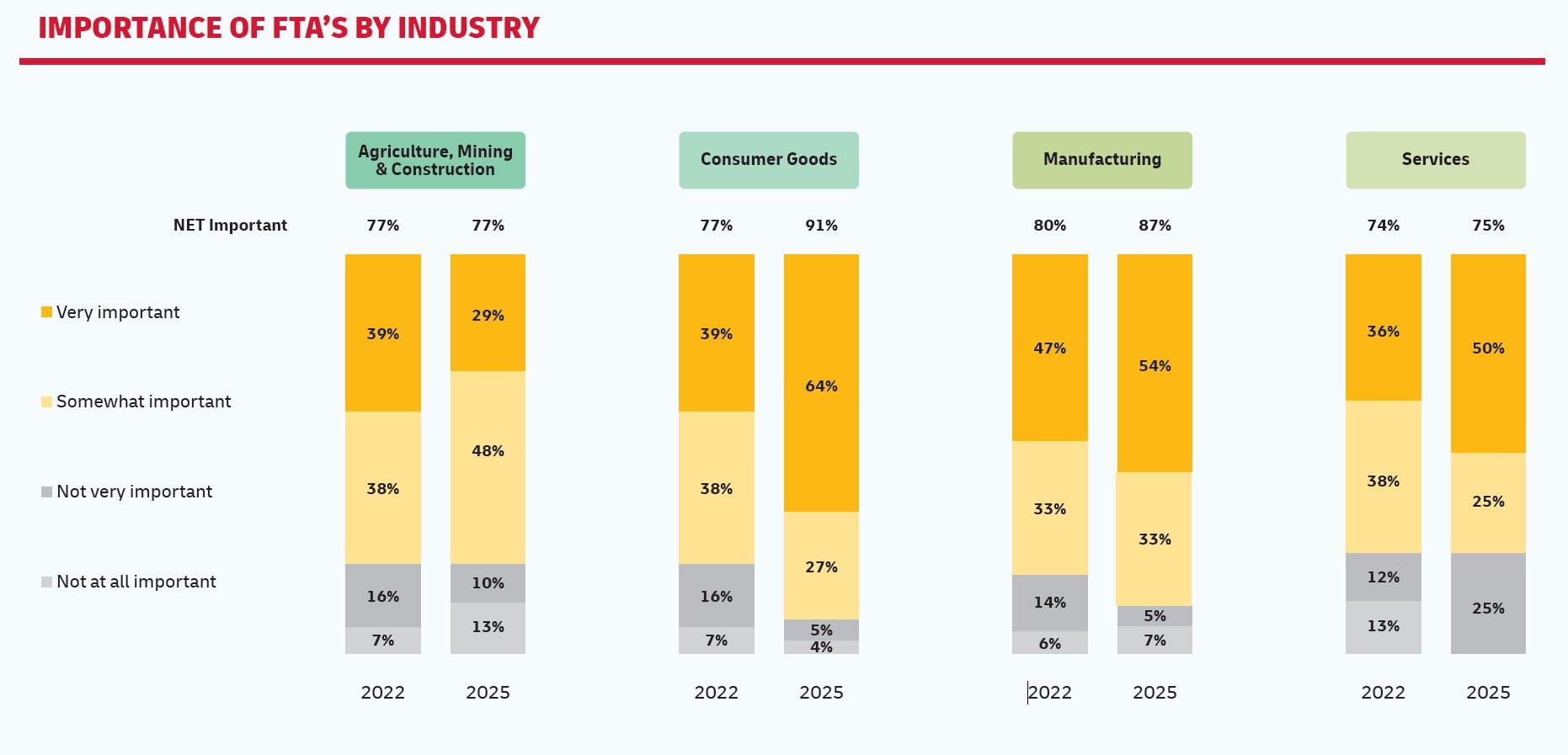
Key takeaways: The increasing reliance on FTAs indicates that margins are tight, and exporters are prioritising the elimination of tariffs and reduction of complexity. For consumer goods and manufacturing in particular, FTAs have become a critical competitive necessity for market access and pricing strategy. Businesses must proactively use these agreements not only to sustain existing export markets but as a key metric when assessing global market opportunities for expansion.
Digital adoption and new technology use amongst Australian businesses
E-commerce continues to drive business, with almost 82% of businesses generating orders through online channels. Looking ahead, exporters are embracing technology with a focus on efficiency; 36% of surveyed exporters plan to integrate AI into their operations to assist with marketing, demand forecasting, and customer engagement.
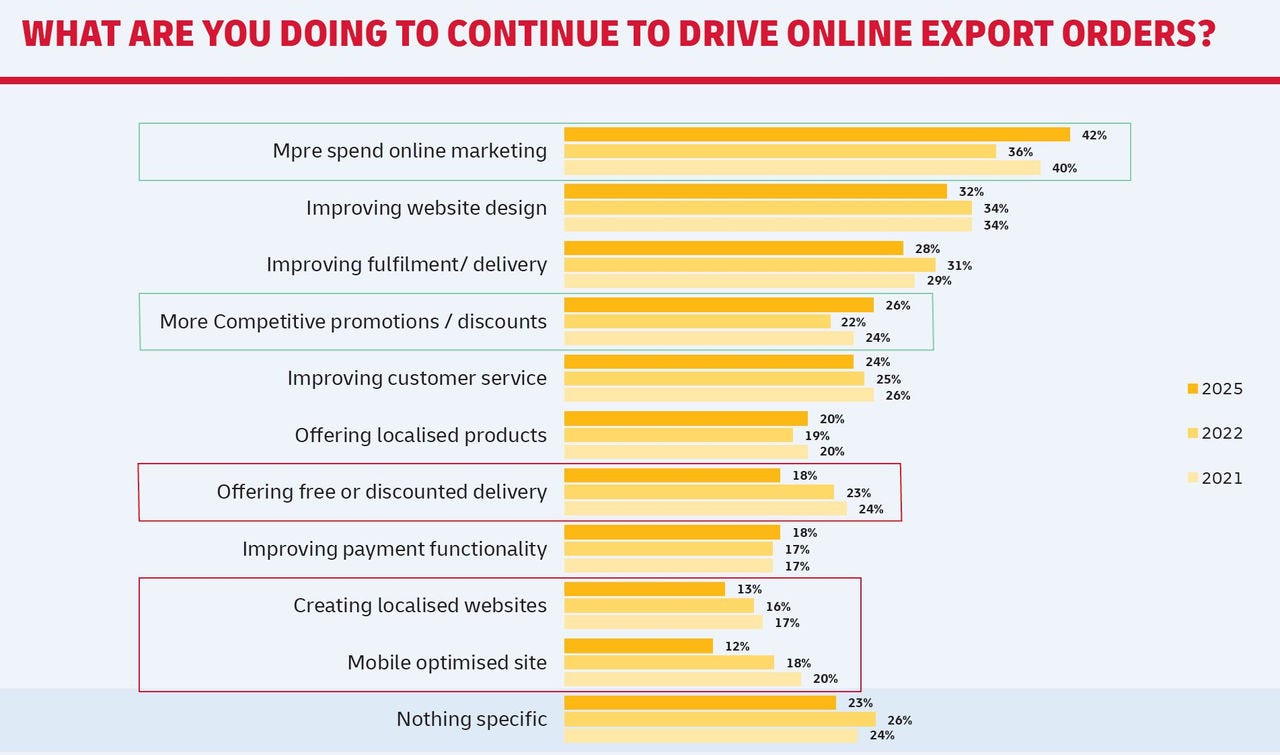
- Hard sales-driving tactics still seen as the way to go: The top strategy to drive online orders is increasing spending on online marketing (42% planning to spend more), followed by improving website design and fufilment methods.
- B2C businesses are more likely to embrace AI for front end business tasks: One in three B2C businesses use AI, compared to 13% of B2B peers. The primary use case for AI is marketing content creation (62%) and customer service automation (49%), followed by market intelligence and demand forecasting.
What Australian businesses are doing to drive online export orders:
How Australian exporters are currently using or planning to use AI:
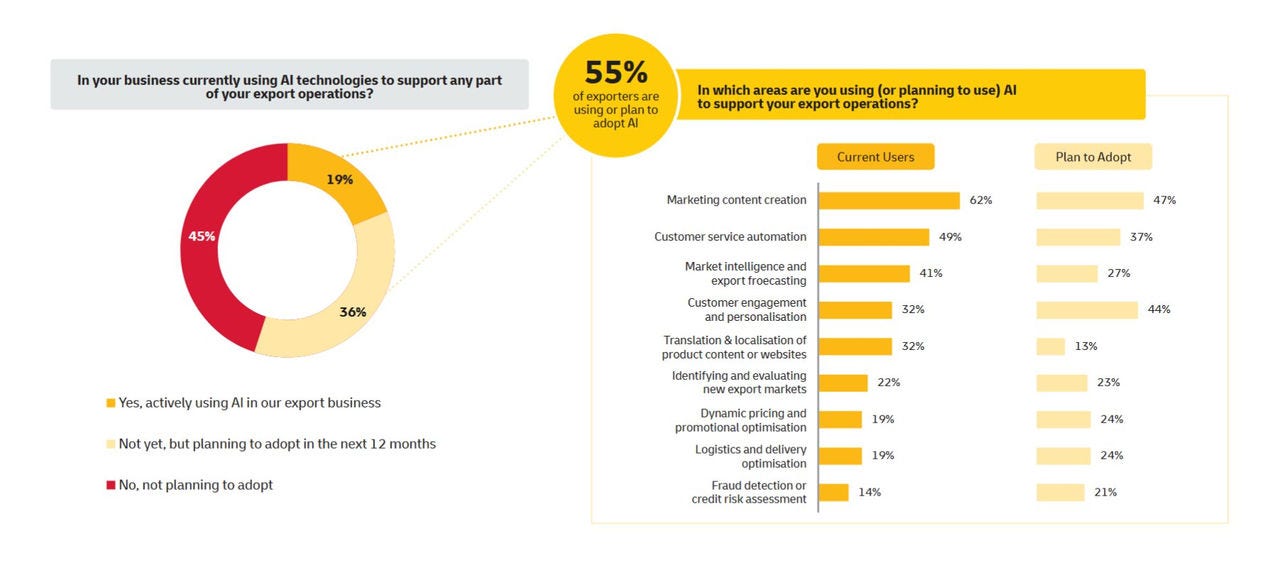
Key takeaways: The shift away from blanket incentives like free delivery towards targeted digital marketing and competitive pricing suggests a move toward cost-aware, optimised digital strategies. Meanwhile, the preference for AI adoption among B2C firms suggests that AI’s greatest immediate value is in enhancing customer engagement. B2B firms should seek pilot AI programs focused on market intelligence and demand forecasting to strategically capture new global market opportunities.
Download the full DHL Trade Barometer 2025 report
The DHL Trade Barometer shows Australian exporters are not just reacting to global market trends but proactively shaping their futures through aggressive diversification, strategic use of FTAs, and incremental adoption of digital tools. The success of B2C firms and newer exporters highlights the potential for agile small businesses to grow by taking advantage of niche global market opportunities.
To gain a deeper understanding of the export markets influencing your industry and to uncover more in-depth insights not covered here, we invite you to download the full DHL Export Barometer 2025 Report today.