



The medical industry continues to grow at a rapid pace, driven by advanced developments in pharmaceuticals, personalized medical devices, and innovative dental solutions. As medical innovation progresses, logistics solutions are also evolving and expanding to meet the industry’s increasingly complex and high standards.
Against this backdrop, DHL Group recently announced the expansion of its air transport networkwith enhanced cold chain capabilities, as part of a strategic investment in Health Logistics. This move strengthens the ability to transport temperature-sensitive products - from medicines and vaccines to advanced therapies - while maintaining full control and end-to-end visibility.
These developments highlight that logistics in the medical industry is not just an operational function, but a critical component in treatment success, clinical trial management, and product integrity.
So, let’s take a closer look at the key trends shaping the medical industry - and the logistics solutions that support a precise, controlled, and flexible supply chain.
Overview
The medical industry is expanding rapidly, with projections indicating it will reach a value of $269.56 billion by 2035. This growth is driven by emerging technologies such as AI-based diagnostics and wearable health monitoring devices, which are gaining popularity at an annual rate of 15–20%.
The sector spans a wide range of fields, including pharmaceuticals, clinical trials, orthopedics and rehabilitation, customized medical devices, and specialized components for planned surgical procedures. Alongside these are areas such as medical optics, personalized hearing solutions, aesthetic implants, and post-surgical care products.
Across all these segments, highly precise products are manufactured based on specific clinical data. These include orthopedic insoles and braces produced using digital scanning, surgical guides developed according to pre-operative planning, customized medical lenses, patient-specific implant components, and rehabilitation devices required for immediate use after medical procedures.
In many cases, measurements are taken at local clinics, while production is centralized in advanced facilities - often located in Europe or Asia. Fulfillment is then carried out based on exact, on-demand requirements.
This operating model is highly time-sensitive. Accurate and timely delivery to clinics, laboratories, or end customers is critical to:
- Maintaining continuity and success of treatment
- Preventing product damage caused by prolonged storage
- Strengthening competitive advantage in a time-driven industry
What Trends Are Driving the Industry?
As the medical sector evolves toward precision, data-driven manufacturing, several key trends are shaping how supply chains are managed:
Personalized Manufacturing
More products are now produced based on individual patient data and on-demand orders, rather than held as standard inventory. This increases reliance on fast, accurate, and demand-driven supply chains.
Expansion of Delivery Points
Beyond hospitals and medical centers, products are now delivered to private clinics, laboratories, and sometimes directly to end users. The final delivery stage has become a critical part of the overall process.
Sensitivity to Medical Timelines
Scheduled surgeries, clinical trials, and treatment procedures require precise coordination between production, transportation, and delivery.
Stronger Regulatory Requirements and Quality Control
Shipment documentation, temperature monitoring, and compliance with international standards are integral parts of operations in this sector.
Digitalization, AI, and Monitoring Solutions
AI-driven tools are accelerating medical innovation - such as advanced diagnostics - while also increasing the use of monitoring technologies and personalized healthcare solutions.
Challenges in the Medical Supply Chain
The shift toward precision manufacturing, combined with strict timelines and rigorous regulatory requirements, creates an exceptionally high operational standard. Unlike standard products, medical shipments typically have no backup inventory and leave little room for delays or corrections.
Shipments may include temperature-sensitive materials, items subject to specific regulatory classifications, or products intended for scheduled medical procedures. This requires thorough pre-planning, including route optimization, tailored packaging, full documentation of transport conditions, and precise delivery coordination.
In addition, when delivery points include clinics, laboratories, or medical centers with defined receiving windows, managing the final delivery stage becomes an integral part of the overall process.
In this reality, the supply chain is not just a transportation channel - it is a control system designed to ensure stability, visibility, and coordination at every stage.
DHL Medical Express Solutions – A Complete Shipping Framework for the Medical Industry
In a reality where medical shipments are an integral part of scheduled clinical processes, a logistics solution must go beyond transportation and fully understand the professional context of the shipment’s contents.
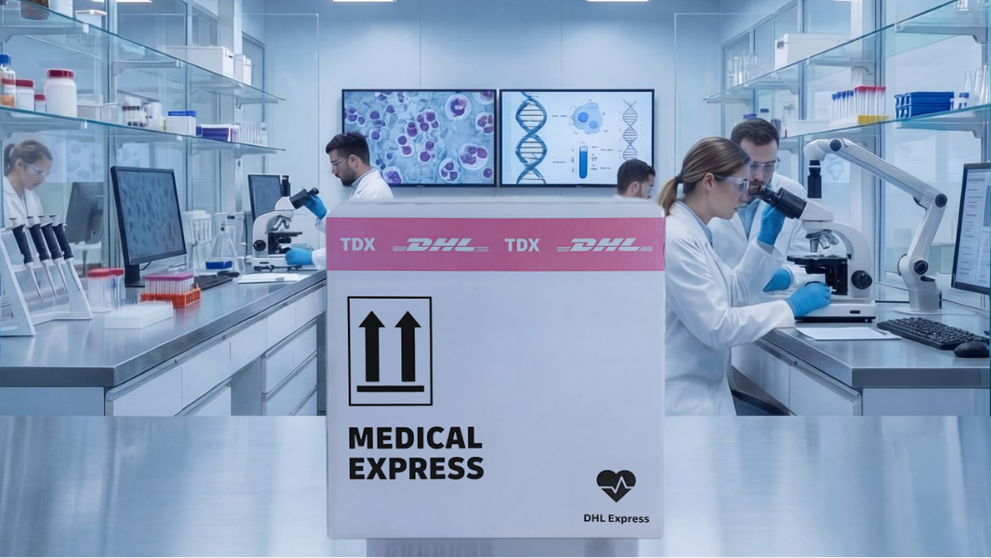
DHL Medical Express is designed to support time- and temperature-sensitive shipments, providing a tailored solution within a precise and reliable medical supply chain.
In Summary,
The medical industry today operates in an environment where precision, coordination, and adherence to professional standards are integral to daily operations. When products are manufactured based on patient data, intended for scheduled procedures, or subject to regulatory requirements, shipping management must rely on careful pre-planning, strict condition control, and broad operational capabilities.
Proper preparation reduces uncertainty, maintains operational continuity, and ensures that products reach their destination according to specifications - whether that’s a clinic, laboratory, or end customer.
At DHL Express, we support medical shipments with a comprehensive range of specialized solutions, including temperature management, monitoring and control, regulatory compliance support, and advanced last-mile services - customized to the nature of the shipment and the business needs of every organization in the life sciences and healthcare sector.


 Share
Share
Similar Stories