

Globalization remains at a historically high level – despite escalating geopolitical tensions, rising U.S. tariffs, and unprecedented uncertainty about future trade policies. This is one of the key findings of the new DHL Global Connectedness Report 2026, released by DHL and New York University’s Stern School of Business.
Based on more than 9 million data points tracking international flows of trade, capital, information, and people, the report offers the most comprehensive view of globalization available – making it an essential resource for any business with cross-border trade ambitions.
For New Zealand, the 2026 findings underscore the continued importance of international connectivity for a geographically distant, trade‑dependent economy. Despite a slight decline in NZ’s overall connectedness score since 2019, the country remains tightly integrated with key global partners, particularly in information and services flows.

International business growth requires informed decisions: read the full report here.
Read the Report NowGlobal Trade Holding Firm in an Era of Uncertainty – Why it matters for New Zealand
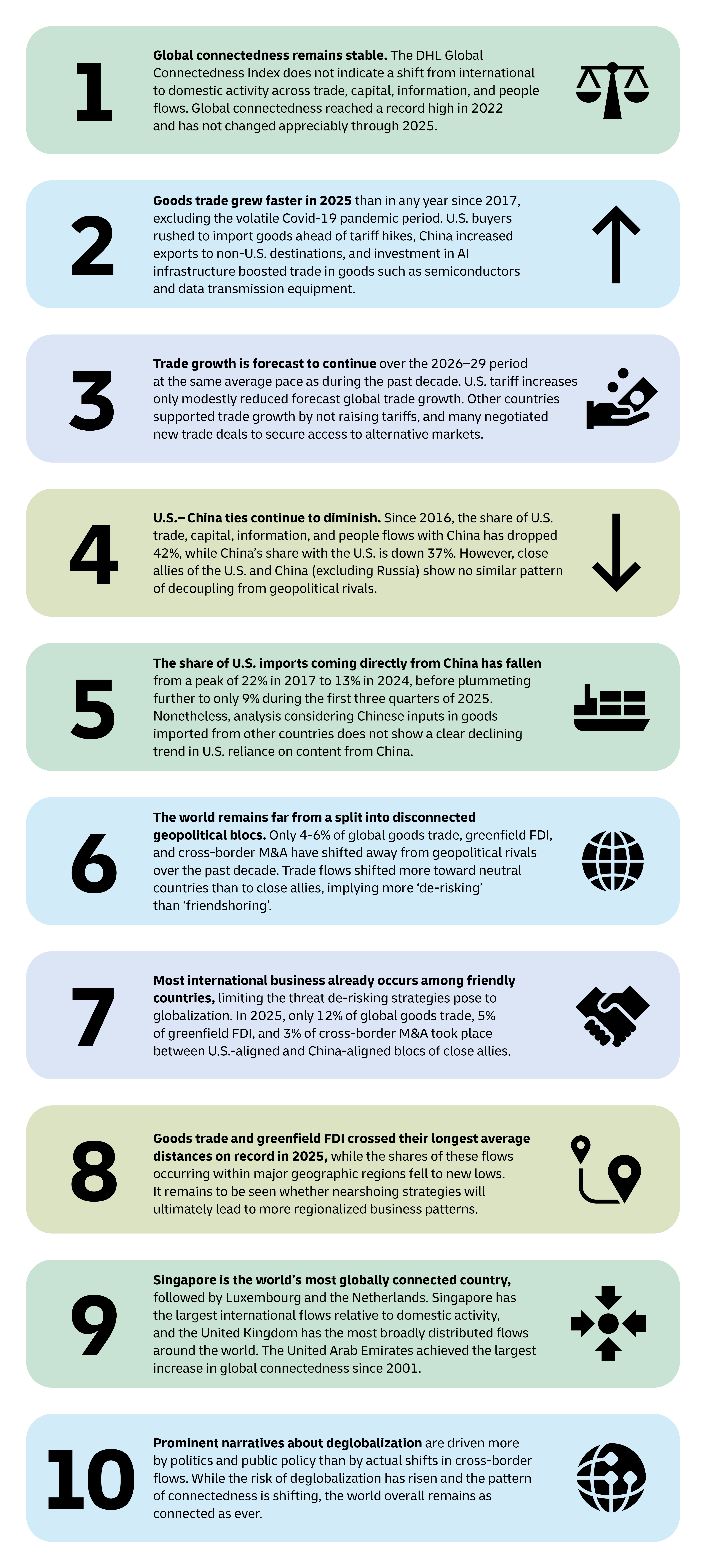
Despite a volatile 2025 shaped by tariff hikes, geopolitical friction, and ongoing uncertainty around global supply chains, international trade proved more resilient than many expected. The DHL Global Connectedness Report 2026 shows that the world’s level of globalization held steady at 25% last year – matching the record high first reached in 2022. In other words, cross-border flows of goods, capital, information, and people have not retreated. Businesses may be adapting, but they are not pulling back from global markets.
For countries like New Zealand – ranked 37th globally for connectedness – the findings highlight the continued importance of maintaining strong international trade relationships, particularly for export-driven sectors such as agriculture, food production, and advanced manufacturing.
Trade performance in 2025 was particularly striking. Global goods trade grew faster than in any year since 2017 (excluding the pandemic rebound). Early in the year, U.S. importers accelerated shipments ahead of new tariff increases. At the same time, China redirected exports toward non-U.S. markets, sustaining overall global volumes. Meanwhile, surging investment in AI infrastructure drove significant increases in trade for semiconductors, data transmission equipment, and other AI-related products – which, according to WTO estimates, accounted for 42% of goods trade growth in the first three quarters of the year.
New Zealand operates at exceptionally long average distances in its cross‑border activity, ranking 2nd globally on average distance across flows, underscoring the importance of reliable air and ocean links. NZ also ranks 24th for the breadth of its international connections, reflecting a diversified market reach despite its size.
Looking ahead, higher tariffs are expected to modestly slow – but not reverse – trade expansion. Global goods trade is projected to grow at an average annual rate of 2.6% through 2029, in line with the past decade. Crucially, most global trade flows do not involve the United States, and many countries are actively diversifying partnerships and negotiating new trade agreements. The result is a global trading system that is continuing to stretch across longer distances and connect markets worldwide. This trend is particularly relevant for smaller trading nations such as New Zealand, which rely on diversified export and import markets across Asia-Pacific, Europe, and the Americas.
All of which means that the outlook for cross-border business remains positive. Global trade is not retreating – it is reconfiguring. Companies that understand where flows are strengthening and which markets are deepening ties will be well positioned to capture new growth. And that’s where the insights from the DHL Global Connectedness Report are invaluable.
Key Takeaways from the DHL Global Connectedness Report 2026
New Zealand Snapshot
Overall Rank: 37/180 (score 57.0), down from 28/180 in 2019 (58.3).
Strength areas: Information pillar ranked 8/144; breadth 24/180.
Top partners by share of NZ flows: Australia 23%, United States 18%, China 10%, United Kingdom 8%.
People flows: Inbound international students rank 9/105 (as share of tertiary enrolment), while tourism arrivals per capita are comparatively lower.

Discover where global trade is heading next.
Visit the DHL Global Connectedness Report hub
Read the ReportThe report has the insights to help your business find new markets – DHL Express has the international logistics expertise to get you there.
Open a DHL Express Business Account for fast shipping to over 220 countries across the world – with full support from the global experts at every step.


 Share
Share