







Healthcare and life science logistics solutions for Belgian businesses
Belgium sits at the heart of one of Europe's most active life sciences ecosystems, home to GSK, UCB, Janssen, and a dense network of biotech firms, contract manufacturers, and life sciences logistics companies that supply healthcare markets worldwide. Moving these products across borders takes more than standard shipping. Pharmaceuticals, vaccines, clinical trial materials, and medical devices each carry strict regulatory requirements, narrow temperature tolerances, and zero margin for error.
DHL Express is Belgium's specialist partner for healthcare logistics, life science shipping, and medical supply distribution. Backed by more than 30 years of life sciences and healthcare expertise across DHL Group, a network reaching 220 countries and territories, and over 11,000 certified specialists worldwide, DHL Express helps Belgian businesses move sensitive shipments safely, compliantly, and on time.
The healthcare and life sciences sector: What's at stake
The life sciences industry is undergoing accelerated transformation. New therapies are reaching patients faster, clinical trials are decentralising, and treatments themselves are becoming more sophisticated, more sensitive, and more difficult to transport.
Market analysts project that the global life sciences sector will reach US$269.56 billion by 2035, driven by advances in artificial intelligence (AI) diagnostics, wearable health trackers (growing at 15-20% annually), and personalised drugs developed using genetically engineered organisms. Innovations in materials such as graphene and chip-sized lasers are also producing a new generation of smaller, smarter medical devices.
For Belgian businesses, this growth is more than a global trend. Belgium hosts one of Europe's most concentrated pharmaceutical clusters, with major players such as GSK, UCB, and Janssen alongside a strong base of biotech innovators and clinical trial sponsors. Every advance produced here depends on healthcare logistics and life science shipping that can move highly sensitive products to global markets without compromise.
The biggest challenges in healthcare and medical logistics
Healthcare shipments face pressures that ordinary cargo never encounters. Regulatory standards can differ widely across countries, products often degrade outside narrow temperature ranges, and patient data must remain protected at every stage. A delay, a deviation, or a documentation error can compromise trial integrity, breach compliance rules, or render a shipment unusable. Modern healthcare logistics must combine speed, control, traceability, and regulatory expertise within a single coordinated process.
Specialized logistics for the life sciences & healthcare industry
Standard shipping cannot meet the requirements of medicines and medical devices. These shipments demand real-time compliance and safe handling from start to finish. For healthcare logistics companies and businesses managing medical supply logistics at scale, three pillars define what specialist execution looks like in practice:
- Smart warehousing: Advanced systems track stock movements and optimise picking to reduce errors and improve throughput.
- Bespoke environments: Facilities are purpose-built for ambient, chilled, or frozen products, each with controlled conditions monitored around the clock.
- Collaborative design: Logistics partners work directly with manufacturers to build resilient supply chains for biologics, radiopharmaceuticals, and advanced therapies.
Temperature-controlled logistics for pharmaceuticals and life sciences
Controlled environments are the foundation of successful life sciences and healthcare logistics. Whether the task is delivering vaccines, shipping clinical trial supplies, or returning samples, temperature integrity must hold from pickup to the final mile.
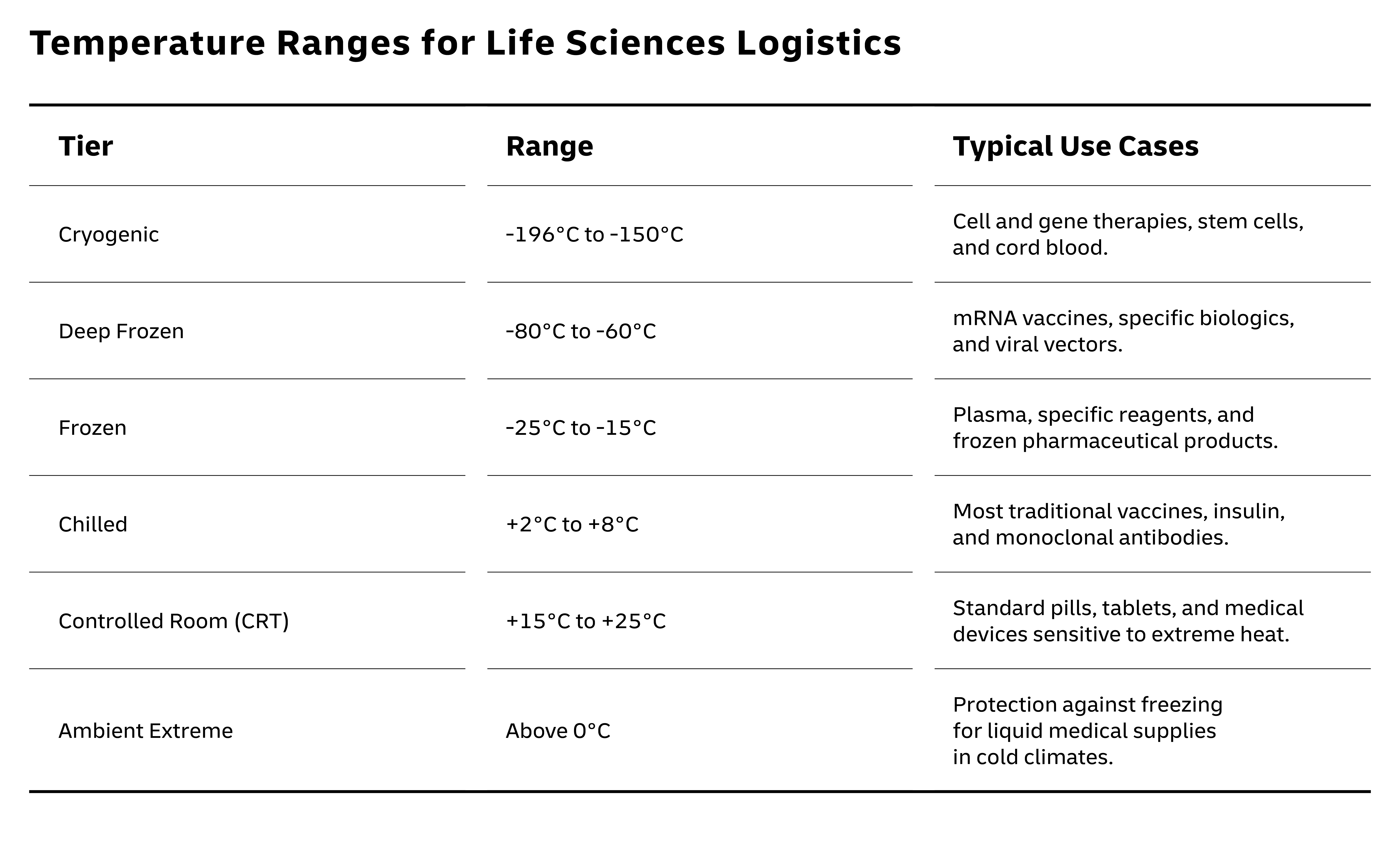
A modular, agile approach works best for each customer. Speciality pharma treatments demand rigorous temperature regimes to preserve integrity and efficacy. Whether the requirement is controlled-ambient, chilled, or deep-frozen, environments must be carefully calibrated and continually monitored across a global Good Distribution Practice (GDP) network.
Maintaining consistent temperatures from +25°C to -196°C takes more than specialist environments. Temperature-controlled packaging, data loggers, control towers, and active shipment monitoring technology must work together so that any change in location, condition, or temperature triggers an immediate response. On a planet where ambient temperatures at sea level range from +57°C to -89°C, maintaining a stable global shipment environment is only possible with dedicated specialist logistics.
Case Study: Casgevy Gene therapies like Casgevy require cryogenic temperatures. Stem cells are collected at a treatment center and moved to a factory at -196°C using liquid nitrogen. Once the new cells are ready, they are frozen again for the trip back to the patient. Speed and temperature are non-negotiable.
Healthcare logistics solutions from DHL Express
Standard shipping falls short for pharma and medical devices. DHL Express operates a dedicated life sciences and healthcare service purpose-built for the sector, combining the global reach of an international express network with the specialist depth expected of a third-party logistics (3PL) partner for healthcare. Services cover clinical trials, regulatory compliance, temperature-sensitive packaging, and real-time tracking across every leg of the journey.
Clinical trial logistics & direct-to-patient models
As biopharma and advanced therapies progress, clinical trials are shifting from the clinic to patients' homes. Decentralised models make participation easier, but they also add logistical complexity. A single trial may involve thousands of connections between sponsors, researchers, and patients across multiple countries.
DHL Express supports this shift with fast, flexible direct-to-patient services. Pre-conditioned packaging and 'blinded shipping' techniques protect patient confidentiality, while expedited handling keeps shipments moving on schedule. Strong logistics support helps sponsors maintain trial retention rates and reach results faster.
Active vs passive packaging: Choosing the right system
Selecting the right thermal packaging is a balance of risk, cost, and transit duration. Healthcare logistics relies on two main categories of thermal protection.

Active Systems
Active systems work like a mobile refrigerator, using mechanical or electric cooling and heating components powered by internal batteries or an aircraft's electrical supply. These are best suited to high-value biologics such as cell and gene therapies, intercontinental routes with possible customs delays, and products that need ultra-precise temperature control. Active units respond to changes in the external environment and often include real-time telemetry covering location, temperature, and battery life.

Passive Systems
Passive systems rely on advanced insulation and Phase Change Materials (PCMs) such as gel packs, dry ice, or thermal blankets, with no external power required. They suit regional distribution, last-mile delivery to hospitals or clinics, and shorter transit times of around 24 to 96 hours. Passive shippers are more cost-effective, flexible in payload size, and easier to manage in regions with limited power infrastructure.
Comparison of active and passive packaging systems
Feature | Active systems | Passive systems |
Mechanism | Thermostatically controlled motors and fans | Insulation and pre-conditioned coolants |
Power source | Batteries or an external electrical plug-in | None (thermal energy exchange) |
Precision | Highly precise; adjusts to the environment | Depends on initial pack-out and transit duration |
Maintenance | Requires charging and technical servicing | Minimal maintenance needed during transit |
Sustainability | Usually reusable (closed-loop) | Available in reusable or single-use formats |
Sustainability is also a growing factor in this decision. Demand for sustainable packaging across the life sciences sector is rising, with reusable, closed-loop systems offering a way to balance temperature performance and reduce waste over repeated shipping cycles.
Regulatory compliance and quality assurance
Compliance must meet all applicable international and in-country standards. For shipments of biological materials and medical devices, proactive compliance is integrated into end-to-end handling protocols. Strong reporting and auditing cultures keep processes clearly defined, supported by electronic quality management systems (e-QMS) that track records, training, and audits. In-house regulatory experts provide guidance at every clinical stage.
Good Practice (GxP) certification across all life sciences and healthcare sites ensures that specialist knowledge matches regulatory rigour. Mature quality management systems embedded within the logistics culture form a baseline that protects every shipment moving through the network.
Real-time visibility across every healthcare shipment
Visibility is the core of peace of mind in healthcare shipping. End-to-end shipment tracking combines dedicated monitoring teams with digital platforms, supported by quality control centres staffed by life science personnel who maintain an 'eyes-on' approach around the clock.
Digital tracking from pickup to delivery
Internet of Things (IoT) solutions and high-quality smart sensors provide continuous Global Positioning System (GPS) tracking along with feedback on temperature, humidity, and light exposure. When a deviation is registered, the system immediately triggers proactive intervention. Customers also need direct access to shipment data, with status updates available via web-based tracking tools and automated notifications for key events.
Digital visibility supports more than security. It also helps manage regulatory compliance and optimise inventory levels, driving further efficiency across the supply chain. The LifeTrack platform extends this further with a centralised dashboard that integrates sensor data, milestone tracking, and proactive alerts.
Secure and validated transportation networks
Hermetically sealed, safeguarded networks, supported by GDP- and GxP-certified warehousing, transportation, and specialist staff, define the highest standards in global life science shipping. Within these networks, every shipment is handled only by certified specialists.
Expert guidance on customs procedures helps prevent delays, while pre-clearance and 'best flight out' options provide priority movement. Packaging and processes are validated to ensure compliance with local, regional, International Air Transport Association (IATA), and GDP regulations.
DHL Express for life science and healthcare logistics ships:
Put your healthcare logistics in the safest hands
DHL Express draws on more than 30 years of life sciences and healthcare expertise within the DHL Group, with an integrated, end-to-end global network spanning over 220 countries that supports the timely delivery of healthcare shipments in the right condition anywhere in the world. The guiding purpose remains consistent: 'We care.'
Across DHL Group, more than 11,000 certified specialists work from over 30 clinical trial depots, 250 GDP and GxP-certified sites, and 106 life sciences-certified air freight stations, managing more than 2.5 million square metres of temperature-controlled space.
As part of a €2 billion investment in DHL Health Logistics, DHL Group has expanded a dedicated Airfreight Cold Chain Network to strengthen global transport of temperature-sensitive pharmaceuticals, vaccines, biologics, and advanced cell and gene therapies. Combined with DHL Aviation connectivity across more than 30 GDP-compliant aviation hubs, this expansion gives Belgian shippers greater capacity and stronger temperature integrity from origin to destination.
Sustainable logistics is also becoming a defining priority for life sciences shippers, with carbon insetting initiatives and optimised cold-chain networks helping to reduce emissions across long-haul healthcare shipments without compromising product integrity.
For Belgian life sciences companies looking to scale their global supply chains with confidence, DHL Express offers specialist expertise, regulatory know-how, and a network purpose-built for healthcare shipping.
Frequently asked questions about healthcare logistics
Can DHL handle clinical trial logistics and direct-to-patient delivery?
Yes. DHL Express supports both centralised clinical trial logistics and decentralised direct-to-patient models. Pre-conditioned packaging, blinded shipping protocols, and dedicated trial expertise help protect patient confidentiality, maintain product integrity, and support trial retention. Sponsors gain access to a global network with specialist handling at every stage, from investigational drug delivery to sample returns.
What is GDP-certified logistics, and why does it matter for healthcare shipping?
Good Distribution Practice (GDP) is the EU regulatory framework governing how medicinal products are stored, transported, and handled throughout the supply chain. GDP-certified logistics ensures that pharmaceutical shipments maintain proper temperatures, security, documentation, and traceability throughout transit. For Belgian businesses exporting medicines or biologics, GDP-certified logistics is a baseline requirement for regulatory compliance and product integrity.
What documentation is required to ship medical devices internationally from Belgium?
Shipping medical devices internationally from Belgium typically requires a commercial invoice, a packing list, and a certificate of origin, along with medical device-specific paperwork. Devices placed on the EU market must bear the CE marking under the EU Medical Device Regulation (MDR), accompanied by an EU Declaration of Conformity. Depending on the destination, additional documents may include import permits, licences, or Safety Data Sheets (SDS) for products containing hazardous materials. DHL Express customs specialists provide guidance on country-specific requirements so shipments clear smoothly.


 Share
Share