
1 - IHL Group, 2025

To define logistics simply: it is the planning, movement, and storage of goods as they travel from their point of origin to the customer. It is the practical engine that gets the right products to the right people, at the right time and cost.
At its core, logistics covers procurement, inventory management, warehousing, transport, packaging, and distribution. When these elements work as one system rather than separate tasks, goods move smoothly and customers stay happy.
For any business selling physical products, getting logistics right is often the difference between a loyal customer and a lost sale. Here is what it means, why it matters, and how to make it work harder for your business.
In a commercial setting, logistics is the end-to-end set of processes a business uses to move goods from supplier to customer, managed as one connected system.
This matters to businesses of every size, but the stakes are highest for small and medium-sized businesses (SMBs), especially those in e-commerce. With tighter margins and less room to absorb a costly mistake, strong logistics underpins three things that decide whether they grow:
Cost control: Efficient movement and storage reduce waste, overstocking, and unnecessary handling.
Competitiveness: Faster, more reliable delivery keeps you in step with larger rivals.
On-time delivery: Meeting the promised date protects customer trust and repeat sales.
Logistics and supply chain management (SCM) are often used interchangeably, yet they describe different scopes. Supply chain management is the wider, end-to-end network across many parties, while logistics is the subset a business directly controls: movement, storage, inventory, and packaging.
Feature | Supply chain management (SCM) | Logistics |
Definition | The entire network of entities, people, and resources involved in moving a product from supplier to manufacturer to consumer. | The specific step within that chain that involves the movement and storage of goods. |
Objective | Competitive advantage and overall market positioning. | Customer satisfaction and efficient product delivery. |
Scope | Multidisciplinary, spanning finance, manufacturing, sales, and marketing. | Focused on transportation, warehousing, and inventory. |
Control | Often involves external parties a business has little control over. | The part of the chain a business can directly control and optimise. |
Within that controllable part sit several distinct types of logistics, each handling a different stage of a product's journey.
Understanding the main types of logistics helps you see which part of your operation needs the most attention. These are the categories most relevant to growing SMBs and e-commerce sellers.
The movement of raw materials and parts from suppliers into your production site or warehouse. Getting this stage right keeps production running and procurement costs down.
The movement of finished products out to the end customer, covering order fulfilment, distribution, and last-mile delivery. This stage shapes how reliable your brand feels.
The management of returns from the customer back to the seller. A smooth returns process builds trust and helps recover value from returned stock.
Outsourcing operations such as warehousing, packing, and fulfilment to a specialist provider. This lets you scale without heavy investment in your own fleet or warehouses.
A single partner that coordinates multiple providers and manages your wider supply chain design, acting as a control tower over the whole operation.
The storage, handling, and organisation of goods inside a facility, from stock placement through to picking and packing.
High-volume, small-parcel fulfilment built for speed and real-time tracking, often integrated with platforms such as Shopify and WooCommerce.
Reducing the environmental impact of moving goods through measures such as efficient routing, right-sized packaging, and lower-emission transport.
Whichever types apply to your business, they all point to the same question: why does logistics matter so much to the bottom line?
Logistics decides far more than whether a parcel arrives. It shapes four things every business cares about: cost, inventory control, customer experience, and competitiveness.
On cost, logistics is often one of the largest controllable expenses a business carries. Sharper routing, right-sized packaging, and leaner warehousing all feed straight back into margin.
Inventory control is a constant balancing act. Globally, out-of-stocks and overstocking cost retailers around US$1.7 trillion, roughly 6.5% of retail sales.1 Too little stock loses the sale. Too much drives up storage and handling costs, and any goods that spoil or fall out of demand are lost outright.
Customer experience follows close behind. An empty product page, a late parcel, or a damaged delivery each sends a shopper to a competitor, and that stings any retailer, but it lands hardest on a smaller business with less room to absorb the loss.
Competitiveness ties them all together. A business that moves goods faster, cheaper, and more reliably than its rivals can promise more at checkout and keep the customers it wins.
The clearest way to see all of this in practice is through a few everyday examples.
These short examples show logistics running end to end across different business types.
E-commerce order journey: A customer places an order online, the item moves from the supplier to a fulfilment centre, and it is then picked, packed, and handed to a carrier for last-mile delivery to the doorstep.
Manufacturer using just-in-time (JIT) intake: A factory schedules parts to arrive only as they are needed on the production line, which keeps stock low and cuts the cost of storing parts that would otherwise sit waiting.
Retailer redistributing stock: A shop with surplus in one location transfers it to another where demand is higher, balancing availability across its network.
Once you can see these journeys clearly, the next step is making them run more efficiently.
How to optimise your logistics strategy
Start by setting a clear goal, whether that is lower costs, faster delivery, or less overstocking. From there, small improvements across each core function add up quickly, and automation and artificial intelligence (AI) can support many of these steps.
Use software to track stock in real time and trigger reorders automatically, so you avoid both stockouts and overstocking.
Review your layout and place best-selling items close to packing stations to cut the time staff spend walking the floor.
Use route optimisation to plan the most efficient journeys, improving on-time delivery while lowering fuel use and cost.
Right-size your packaging. Less material means lower dimensional weight, cheaper transport, and less waste.
Offer flexible options at checkout, such as time slots or collection points, to raise first-time delivery success.
Some shipments are simply larger or heavier than standard parcels. For oversized or bulk freight, the DHL Express heavyweight service is built to move these consignments across borders, so growing businesses can ship bigger loads without switching providers.
Optimising these functions is far easier with the right partner alongside you.
Sooner or later, every growing business faces the same question: handle logistics in-house, or hand it to a specialist. Running your own fleet and warehouse gives you control, but it ties up capital and attention that a smaller business usually needs elsewhere. Outsourcing frees you to focus on your product while a partner moves the goods.
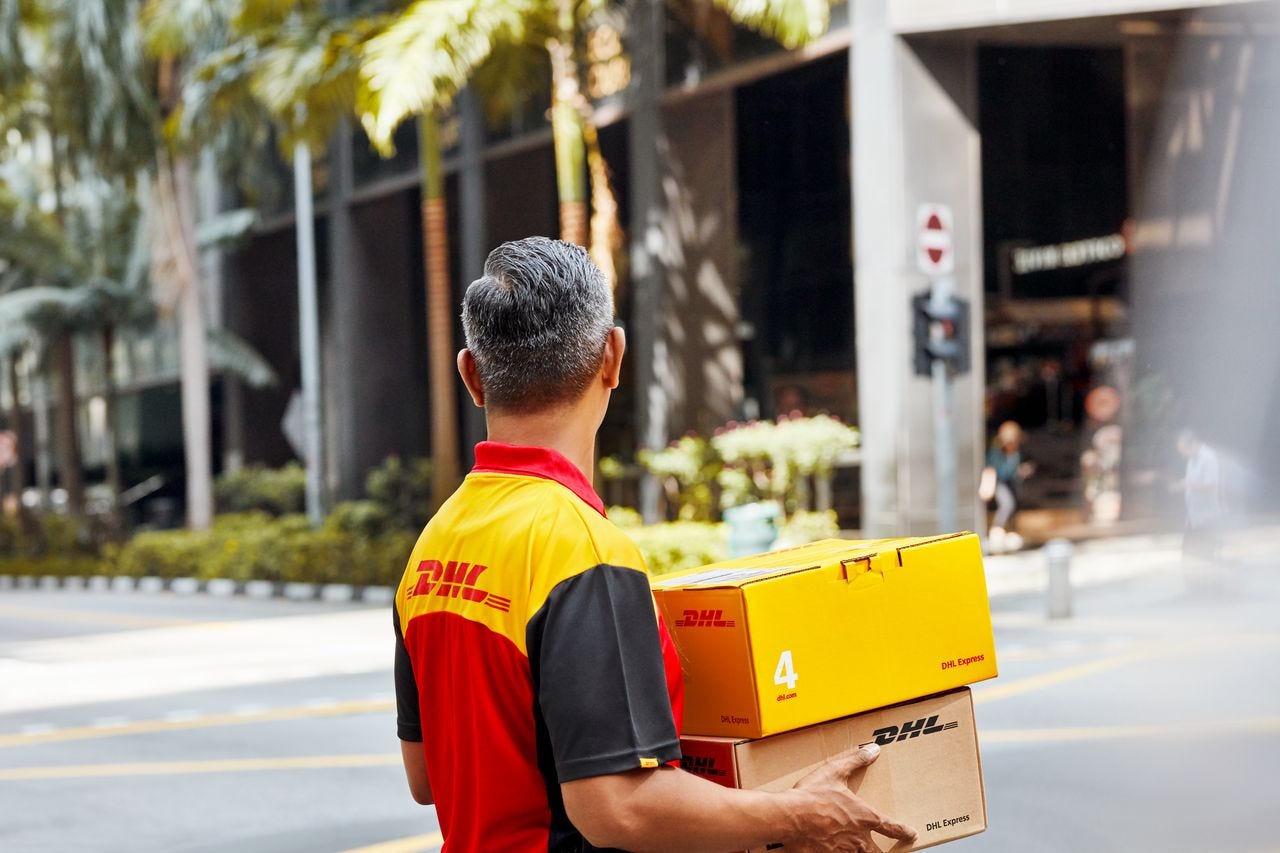
The right partner also gives you reach and expertise that can take months or even years to build alone, from customs know-how to reliable cross-border delivery. DHL Express brings that international network within reach of any business, whether you are an established exporter or an SMB e-commerce seller sending your first parcels abroad, along with tracking and sustainable options such as GoGreen Plus, which uses carbon insetting and Sustainable Aviation Fuel (SAF) to lower shipping emissions.
Ready to take the next step? Opening a DHL Express business account gives your business the international reach, customs support, and reliable delivery to grow with confidence.
The seven R's are a simple checklist for getting logistics right: the right product, in the right quantity, in the right condition, at the right place, at the right time, to the right customer, and at the right cost. Meet all seven and your business stays competitive in a demanding global market.
Where the seven R's cover the mechanics, the seven C's focus on the customer side of the operation:
Customer-centricity: Putting the end customer's needs first.
Condition: Making sure goods arrive in perfect order.
Confirmation: Keeping customers informed with real-time tracking.
Cost: Balancing price against the value delivered.
Consistency: Offering reliable service every time.
Clarity: Communicating openly at each stage.
Compliance: Meeting legal and customs requirements.
Together, they help a business build trust through reliable, transparent service.
These terms describe how much of your logistics you outsource:
First-party logistics (1PL): You handle everything yourself, using your own staff and vehicles.
Second-party logistics (2PL): You own the goods but hire a carrier, such as an airline or haulier, to move them.
Third-party logistics (3PL): A provider such as DHL Express manages several functions, including warehousing, packing, and fulfilment.
Fourth-party logistics (4PL): A partner coordinates multiple providers and oversees your wider supply chain, acting as a control tower.
Fifth-party logistics (5PL): A provider manages entire supply networks using automation, AI, and data, typically for high-volume online marketplaces.
1 - IHL Group, 2025


 Share
Share