#LogisticsAdvice

How to palletize cargo in Brazil: a packing guide for large and heavy shipments

Marcelo Godoy Rigobello
VP Global Customer Support - Customs & Trade Compliance, DHL Express
9 min read
Article hero banner default image
In this article
When a shipment should travel on a pallet
Which pallet to choose, including PBR and ISPM 15
How to stack, wrap and strap the load
Labelling, documents and the mistakes behind damage

To pack a large shipment, palletize it: choose a pallet rated for the weight, stack the boxes in columns with the heaviest items at the bottom, wrap everything in stretch film from base to top, strap the load in all directions and label every side. For exports, wooden pallets need ISPM 15 treatment, proven by the IPPC mark.

Knowing how to palletize cargo properly is what separates a smooth delivery from a shipment that arrives damaged, gets held or picks up a surcharge. Poor packing remains one of the most common causes of damage, delays and extra charges in international cargo shipping. This guide covers the whole process from a Brazilian warehouse: choosing the pallet, stacking, securing, internal protection, labelling and the mistakes to avoid before the cargo leaves your dock.

When does a shipment stop being a parcel and become palletized cargo?

The practical rule used by DHL Express: a shipment is considered large when two sides exceed 800 mm or one side exceeds 1,200 mm. It is considered heavy when individual pieces go above 30 kg, the point where manual handling stops being safe and a forklift comes in.

The DHL Express packing guide valid from 2026 adds clear lines for packaging. Goods up to 25 kg can travel in a box, a pallet or crate is recommended above 25 kg, and pieces over 70 kg must be loaded on a pallet or in a fork-movable crate, with possible variations by country. Source: DHL Express, Packing Guide for Large and Palletised Goods, valid from 2026.

From there, bringing loose boxes together on a single pallet is usually the better decision. The cargo becomes one stable unit, handling gets faster and the risk of losing individual boxes drops. In express heavy shipping, such as DHL Heavy Weight Express, a shipment can go from 50 kg to 3,000 kg, with palletized pieces of up to 1,000 kg each.

Palletize when:

  • you ship two or more boxes to the same destination;
  • the item has an irregular shape;
  • the cargo is fragile or high value and needs stability;
  • the weight no longer allows safe manual lifting.

For lighter shipments that still travel as boxes, the guide on how to prepare your package for international shipping covers the basics.

Which pallet should you choose for international shipping?

The classic palletizing problem starts with the wrong base. Three decisions define the right pallet: material, size and condition.

The material defines cost, durability and phytosanitary requirements. The table sums it up:

Material

When to use it

Watch out for

Wood

General use, heavy cargo, reusable

Exports require ISPM 15 treatment with the IPPC mark

Plastic

Food, healthcare, humid environments

No ISPM 15 needed; higher cost

Cardboard or composite

One-way exports, light cargo

Limited weight capacity

On size, Brazil works with the PBR pallet, the national standard of 1.00 x 1.20 m established by the distribution sector. In international trade, the most common are the Euro pallet (1,200 x 800 mm) and the North American standard (48 x 40 inches). DHL Express recommends standard-size pallets, with length and width of up to 120 cm, and a total height of up to 160 cm, so the PBR fits that recommendation. Pieces longer than 300 cm are not accepted. Source: DHL Express packing guide, valid from 2026.

In DHL Heavy Weight Express, a palletized piece can reach 1,000 kg within 300 x 200 x 160 cm. Choose four-way entry pallets, which accept a forklift from any side.

The detail that stops exports: wooden packaging without the IPPC mark of the ISPM 15 treatment (NIMF 15, in its Brazilian name) can be refused or sent back at destination. In Brazil, the Ministry of Agriculture (MAPA) accredits the companies that carry out this treatment and apply the IPPC mark. Source: MAPA, Phytosanitary and Quarantine Treatment service page, consulted in September 2026.

Before loading, also check for cracked boards, protruding nails and signs of moisture. The export side of the process is covered in the guide on exporting from Brazil.

How should you stack and distribute the weight on the pallet?

Stacking decides how stable the cargo is in transit. Three rules solve most cases.

Heavy at the bottom, light on top. Heavier items at the base keep the center of gravity low and reduce the risk of tipping during handling.

The right stacking pattern. Boxes of the same size call for column stacking, corner to corner and edge to edge, which preserves the structural strength of the cardboard. Interlocking stacks tie mixed loads together, but only if the contents are rigid: with soft contents, the DHL Express packing guide warns that interlocking can cut compression strength by as much as 50%. Avoid the pyramid shape: it weakens the load and leaves no level top, which prevents other cargo from being stacked on it and can lead to extra charges for space.

Nothing over the edge. Any box beyond the pallet edge becomes a collision point with forklifts, warehouse racks and other cargo, and the same guide notes that overhang can reduce the strength of each box by more than 30%.

How do you secure the load to the pallet?

A perfect stack still falls apart if the securing fails. The sequence that works:

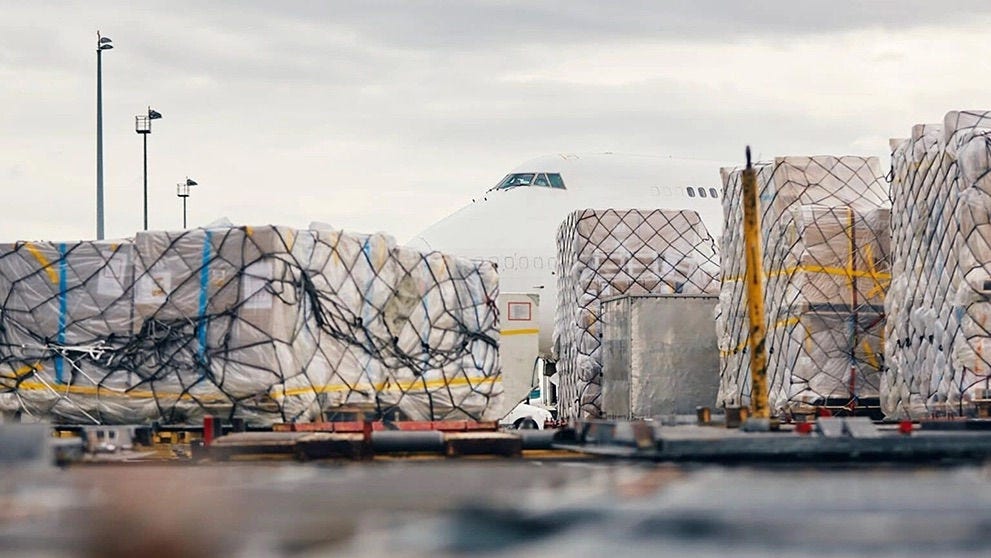
  1. Stretch film from base to top. Start by wrapping the pallet itself, to anchor the load to the base, and move up in a spiral with each layer overlapping the previous one by about half. Give at least three full turns at the base and three at the top, with enough tension to stop any movement, and criss-cross the film over the top until it is covered.
  2. Straps for heavy cargo. The DHL Express packing guide calls for straps in all directions, with at least four tightly securing the load, each one looped under the pallet and over the goods. Metal suits heavy, solid items; nylon or polyester (PET) straps suit boxes and lighter goods.
  3. Edge protectors. Applied to the vertical edges before strapping, and horizontally on the top boxes, they spread the pressure of the straps and protect the corners of the boxes.

Loose cargo on a pallet is one of the leading causes of damage in palletized shipping. Securing is not an optional step.

What internal protection should you use?

The pallet gives stability; the packaging protects the product. For heavy or fragile cargo, use double- or triple-wall corrugated boxes, foam, bubble wrap or air pillows to absorb impact, and seal every box seam with reinforced tape in the H pattern.

Between the pieces goes dunnage: the blocking material that fills gaps and stops the cargo from moving inside the load. The most common types:

  • Inflatable dunnage bags for gaps between pallets or inside containers;
  • Technical foam around items sensitive to impact;
  • Wooden blocking and bracing for machinery and irregular cargo;
  • Kraft paper or honeycomb board as light void fill;
  • Edge protectors and reinforcement boards between layers of boxes.

The more valuable or fragile the cargo, the more internal protection matters. A 300 kg machine poorly braced inside a crate reaches its destination with the same damage as a box thrown around. For bulky single items, the guide on how to ship large items adds more practical tips.

How should you label and document the shipment?

A label nobody can see means cargo that stops. Apply shipping labels and handling marks to every side and to the top of the pallet, with instructions such as FRAGILE, THIS WAY UP or DO NOT STACK when they apply. Barcodes must be readable on the outside of the stretch film, never covered by it.

For shipments with two or more pallets, number each one (1 of 3, 2 of 3, 3 of 3). For international shipments, check that the commercial invoice and the waybill are complete and consistent with each other: incomplete documents remain one of the main reasons for customs holds, as the guide on customs clearance and restrictions explains.

Which mistakes most often derail palletized shipments?

These are the errors that keep turning up in damage reports:

  • Loading the pallet beyond the carrier's weight limit;
  • Stacking in a pyramid or unevenly;
  • Saving on stretch film or skipping the straps;
  • Covering the barcode or forgetting handling marks;
  • Using a damaged pallet, or an unmarked wooden pallet, for exports;
  • Ignoring dunnage and letting the cargo travel with room to move.

Every one of them costs less to prevent than to fix. The DHL Express packing guide is blunt about it: goods that do not meet the minimum packing standards cannot be accepted for transport.

Frequently asked questions about how to palletize cargo in Brazil

Dunnage is any material used to block, separate and stabilize cargo during transport, such as inflatable bags, foam, wooden bracing, kraft paper and edge protectors. It fills gaps and stops the pieces from moving inside the pallet, container or crate.

Yes, as long as it is made of wood treated under ISPM 15, with the IPPC mark clearly visible, a treatment carried out in Brazil by companies accredited by the Ministry of Agriculture. Without the mark, the cargo can be held or sent back by the destination country.

In DHL Heavy Weight Express, each palletized piece can weigh up to 1,000 kg, within 300 x 200 x 160 cm, with total shipments from 50 kg to 3,000 kg, according to the DHL Express 2026 Rate and Service Guide for Brazil.

It is not mandatory, but it is recommended: it accepts forklift forks from all four sides, which speeds up handling in warehouses and aircraft and reduces forced maneuvers that damage the cargo.

The DHL Express packing guide valid from 2026 asks for strapping in all directions, with at least four straps tightly securing the load and edge protectors on the top boxes so the bands do not cut into them.

Ready to pack? Then plan the shipment

With the cargo palletized, secured and documented, what is left is a service built for it. DHL Heavy Weight Express was designed for shipments from 50 kg to 3,000 kg, with an integrated express network and customs clearance included.

To quote your palletized shipment and manage your international shipping in one place, open a DHL Express business account.