#LogisticsAdvice

International heavy freight shipping from Brazil: how to grow without multiplying complexity

Marcelo Godoy Rigobello
VP Global Customer Support - Customs & Trade Compliance, DHL Express
9 min read
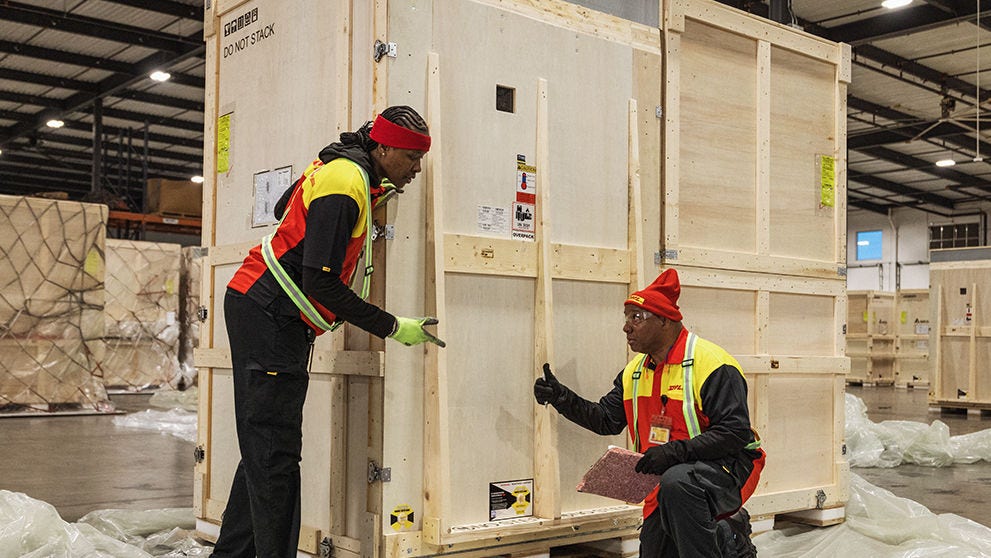
DHL employee strapping a pallet of goods for an international heavy shipment
In this article
Why heavy freight gets harder as your company grows
The customs and document layer when you ship from Brazil
A seven-step heavy freight playbook for new markets
How an integrated express network cuts handovers

International heavy freight gets complicated when every new market adds carriers, contracts and tracking systems. The way to scale from Brazil without losing control is to concentrate the operation in a single integrated network, with customs clearance included and end-to-end visibility, so that fewer suppliers hand the cargo over to one another.

Closing a new customer abroad is the good part. Delivering a machine, a piece of equipment or a palletized batch on time, country after country, is where the operation gets tight. This guide to heavy freight shipping from Brazil shows why heavy cargo logistics gets harder precisely when a company grows, which challenges are specific to international transit out of Brazil and what well-designed freight management solves in practice.

Why does heavy freight get harder as your company grows?

Growth changes the nature of the operation. A handful of domestic shipments turns into a regular flow to several countries, each with its own routes, partners and customs requirements.

The problem is rarely volume itself. It is coordination: every new market adds a layer of suppliers to manage. Three symptoms show up first.

  • Fragmented processes. Freight forwarder, airline, customs broker and local trucking company, each with its own contract, invoice and system. Nobody sees the whole shipment.
  • Too many handovers. Every change of hands is a point where the cargo can wait, be rerouted or get damaged, with no one taking responsibility for the whole journey.
  • Inconsistent visibility. One tracking system per leg, none of them talking to the others. When the customer asks where the machine is, the honest answer is often "we are checking".

How much does the coordination nobody hired cost?

Many companies assume that scaling logistics means hiring more carriers. In practice, every new supplier brings one more commercial relationship, one more invoice to reconcile and one more platform to check.

Over time, coordination itself becomes the bottleneck. The sales team arranges pickups, chases updates, solves issues and acts as a bridge between companies that do not talk to each other. Those are hours that should be serving customers or opening markets.

Well-run freight management looks simple from the outside: one logistics partner answering for the whole journey, one contract, one tracking platform, one point of contact when something needs attention. Fewer moving parts, more predictable timelines and far less backstage work to manage.

Which challenges are specific to international freight?

Domestic delivery has its own pains. Borders, customs and multiple transport legs multiply all of them. The biggest problems in international freight rarely happen while the cargo is moving: they happen where the journey pauses, a document is checked or responsibility changes hands.

The table below links each challenge to its effect on the business and to what solves it.

Challenge

Effect on the business

What solves it

Transit time variation

Production and installation dates missed

Fewer legs and connections on the route

Customs compliance in each country

Cargo held, fines, frustrated customer

Documents prepared by specialists

Unpredictable cost

Budget overruns, eroded margin

All-in, door-to-door pricing

Split tracking

Late decisions when a delay happens

End-to-end visibility on one screen

If you operate from Brazil, the customs layer has its own contours. Two points are worth knowing before you ask for any quote.

First, the regime. Express courier shipments with a customs value of up to USD 3,000 follow the simplified regime, explained in the guide to courier imports and the RTS in Brazil. Cargo above that value enters the formal flow, with a declaration in Siscomex (Brazil's foreign trade system) and prior registration of the company, according to the Receita Federal international shipments manual, updated on June 12, 2026.

Second, the documents. The commercial invoice, the transport document and an accurate description of the goods must be consistent with one another. A mismatch between documents is still among the main reasons for holds, as the guide on customs clearance and restrictions explains. Deciding early who pays duties and fees at destination also avoids surprises on delivery.

How do you cross borders without collecting complexity?

Expanding into another country should not mean building a new logistics operation for every market. The right international freight service removes friction instead of adding it.

At customs, working with a partner that has the expertise built into the service pays off quickly: documents are right from the start, the requirements of each destination are already known and release moves with fewer requests. Your company stops studying foreign regulations on its own.

In multi-market management, consistency is worth as much as speed. A single international network means one way of shipping to any destination: the same processes, the same tracking, the same support. Your team stops relearning the operation with every new country.

How do you build a heavy freight playbook for new markets?

A playbook turns every new market into a repeat of what already works. Before the first shipment to a new country, settle these points once:

  1. Sort your shipments by urgency and value per kilo. Critical, high-value cargo goes express; replenishment with no rush can go on conventional freight.
  2. Standardize packing. Use the same pallet type, stacking pattern and labelling for every market, so the warehouse does not improvise.
  3. Build a standard document kit: commercial invoice, packing list and the tariff code of each product, based on the HS code and on the eight-digit NCM used in Brazil.
  4. Agree the Incoterm per market in the contract, so everyone knows who pays freight, insurance and duties, and where the risk changes hands.
  5. Decide who pays duties and taxes at destination, and tell your buyer before the shipment leaves.
  6. Concentrate providers. Every supplier you remove is one less handover and one less invoice to reconcile.
  7. Track a few numbers: variation in transit time, customs holds, damage rate and total cost per kilo delivered.

The export side of this process, from registration to shipment, is covered in the guide on exporting from Brazil.

Why is visibility worth more when the cargo is expensive?

A late parcel is irritating. A 2-tonne press late for production, or a batch of medical equipment stuck before an installation, interrupts revenue. A technician in the field waiting for cargo that has not arrived costs money by the hour.

The higher the value and impact of the shipment, the sooner you need to know about any deviation. Continuous visibility lets you reschedule the team, warn the customer and replan before a delay turns into a crisis.

When the cargo travels through a single network, tracking is continuous by definition: there are no blind spots between suppliers because there are no handovers between suppliers. One screen shows the whole journey, from pickup to delivery.

How does DHL Express handle international heavy freight?

For shipments where time weighs as much as the kilos, DHL Express designed DHL Heavy Weight Express: shipments from 50 kg to 3,000 kg through the integrated express network, with international transit that can take as little as 1 to 3 days depending on route and customs clearance, according to DHL.

What the operation offers a growing business:

  • A single network in more than 220 countries and territories, without the handovers of the traditional freight model;
  • Time-definite delivery, which brings predictability back to planning;
  • Customs clearance handled inside the service, with specialists taking care of the documents;
  • Real-time tracking of every shipment, including high-value cargo;
  • All-in, door-to-door pricing, with clearance and handling included in the quote.

Before the shipment leaves, also check how to palletize cargo in Brazil: correct packing is what prevents damage, surcharges and holds for non-compliance.

Frequently asked questions about international heavy freight shipping from Brazil

In traditional freight, the cargo passes through several independent suppliers, with transit times that add up and separate tracking. In express heavy shipping, the shipment travels through a single integrated network, with clearance included and a shorter, more predictable total transit time.

Because each leg adds a window of uncertainty: an air connection, an inspection queue, a document check, local transport. The more links and suppliers on the route, the larger the accumulated variation, and cutting legs and handovers is the most effective way to narrow it.

For formal import and export operations, the company needs to be registered in Siscomex, under the Receita Federal rules. Express courier imports of up to USD 3,000 follow the simplified flow, without that requirement.

Complete and consistent documents solve most cases: a detailed commercial invoice, an accurate description of the goods, values that match across documents and the correct tariff classification. Working with a partner that checks everything before shipping greatly reduces requests from customs.

With DHL Heavy Weight Express, a shipment can weigh from 50 kg to 3,000 kg, with palletized pieces of up to 1,000 kg and maximum dimensions of 300 x 200 x 160 cm, according to the DHL Express 2026 Rate and Service Guide for Brazil.

The next step to scale your shipments

If your company's growth is running into logistics, the answer is to simplify before you multiply. Map the routes you already serve, the ones you want to open and the cargo that cannot wait, and price that real scenario.

To see how DHL Heavy Weight Express fits your routes and to manage every international shipment from one account, open a DHL Express business account.