#LogisticsAdvice

Air cargo transport in Brazil: how international air freight works for businesses

Leendert van Delft
Leendert van Delft
Vice-President Global Sales Programs, (Digital) Marketing and Global E-commerce
10 min read
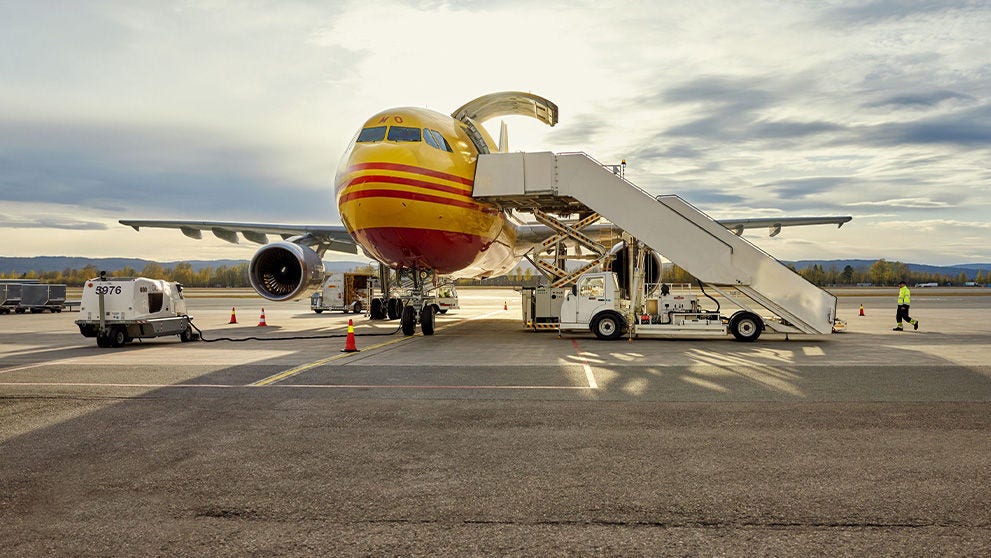
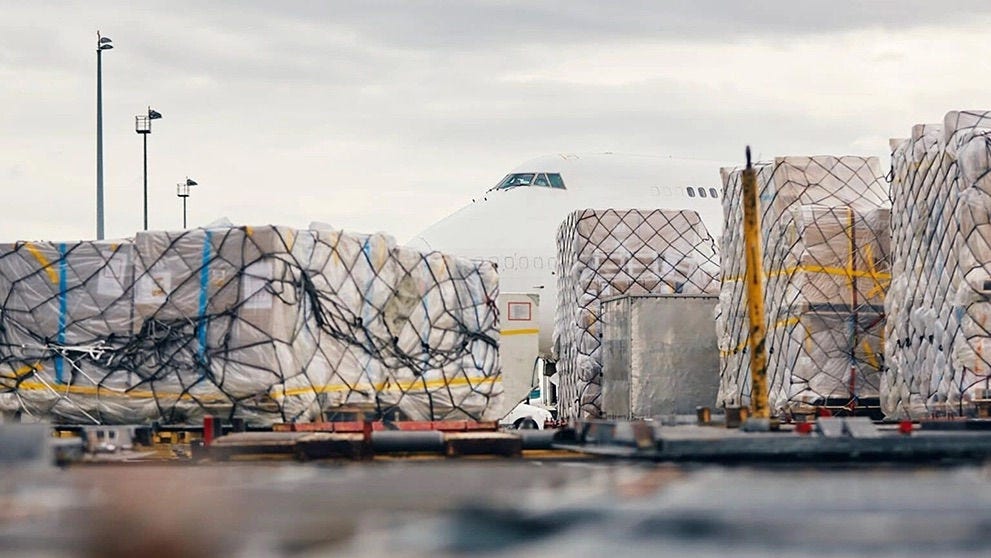
DHL cargo aircraft being loaded on the airport apron at night

Air cargo transport moves goods by plane, on freighters or in the hold of passenger flights, under an air waybill (AWB). For businesses trading with Brazil there are two routes: express, door to door with customs clearance handled by the courier, and conventional air cargo, airport to airport. Air freight pays off when value per kilo is high.

The dilemma usually shows up on a Tuesday. The spare part is ready at the supplier, the production line in Brazil has stopped and the next vessel takes weeks. Flying it solves the lead time, but it is only a good decision when you know what you are paying for, which document governs the shipment and what the airline will refuse at screening.

How does air cargo transport work, from booking to delivery?

Air cargo always follows the same sequence: space booking, handover to the carrier, security screening, documents, flight, cargo data reported to Brazilian customs and clearance at destination. What changes from one provider to another is who runs each step and how many times the cargo changes hands along the way.

  1. Quote and booking, with weight, dimensions, origin, destination and an exact description of the goods.
  2. Pickup at your address or drop-off at the cargo terminal of the departure airport.
  3. Acceptance: the cargo is weighed, measured and screened before it is loaded.
  4. Air waybill issued, with a commercial invoice and packing list that match each other.
  5. Direct flight or a connection through a hub, where the cargo may change aircraft.
  6. Arrival in Brazil, with cargo data reported to the Receita Federal (Brazil's federal revenue and customs authority) by the carrier and the freight agent.
  7. Customs clearance and payment of duties and taxes.
  8. Delivery to the final address.

Steps 6 and 7 are where lead times swing the most, because they depend on the customs check and on the quality of your paperwork. The full import path, including registration, taxes and inspection channels, is covered in the guide to importing into Brazil.

What is the difference between express air shipping and conventional air cargo?

The difference is who answers for the whole operation. With express, a single operator picks up, flies, clears and delivers, under one tracking number. With conventional air cargo, a freight forwarder books space with an airline, and you hire the customs broker, terminal storage and the final road leg separately.

The table compares both models in practice. The limits in the express column come from the DHL Express Brazil 2026 Rate and Service Guide, used here as a reference for a real express network.

Criterion

Express (courier)

Conventional air cargo

Route

Door to door

Airport to airport, with road legs contracted separately

Document

Courier waybill

Master and house air waybills

Customs clearance

Handled by the courier

Customs broker hired by you

Weight per piece

Up to 70 kg per package; above that, on a pallet

Set by the aircraft and the terminal

Weight per shipment

Up to 3,000 kg, with pallets up to 1,000 kg

No practical ceiling for a mid-sized company

Tracking

One number, from pickup to delivery

By leg and by operator

Best fit

Samples, replenishment, critical parts, e-commerce

Large recurring lots with planned lead times

A rule of thumb helps. If the cargo fits in boxes and every idle day costs money, express often comes out ahead on total cost, because pickup, clearance and delivery are already built in. If you ship tonnes every month on a predictable calendar, consolidated cargo tends to win on price per kilo.

What is an air waybill (AWB)?

The air waybill is the contract of carriage between the shipper and the airline. It proves the cargo was received and identifies the shipper, consignee, number of pieces, weight and nature of the goods. Unlike an ocean bill of lading, the AWB is non-negotiable: it cannot be used to transfer ownership of the cargo.

Consolidated cargo has two document levels. The master air waybill (MAWB) is issued by the airline to the freight forwarder, who groups goods from different clients on the same flight. The house air waybill (HAWB) is issued by the forwarder to each client. When the shipment is express, the courier issues its own waybill, which does the same job and carries the tracking number.

In Brazil, carriers and freight agents must report the cargo they bring in to the Receita Federal, as required by article 31 of the Customs Regulation (Decree 6,759/2009). For air shipments, that data goes into the Cargo Control and Transit module (CCT) of the Portal Único Siscomex, Brazil's single window for foreign trade. A mismatch between the AWB, invoice and packing list triggers a customs query and holds the cargo at the terminal while you fix it.

How does volumetric weight change the price of air freight?

On a plane, space costs as much as weight. That is why air freight is charged on chargeable weight: the higher of the actual weight on the scale and the volumetric (dimensional) weight, which converts the box volume into kilos. A large, light box pays for the space it takes.

Each carrier states its conversion factor in the quote. In the DHL Express Brazil 2026 Rate and Service Guide, the formula is length × width × height in centimetres divided by 5,000, per piece. A 60 × 40 × 40 cm box holding 8 kg of goods has a volumetric weight of 19.2 kg, and that is the figure that ends up on the invoice. Source: DHL Express, Brazil Rate and Service Guide 2026.

Four adjustments bring that number down without touching the product:

  • A box sized to the contents, with no air padded out by filler.
  • Products shipped flat or nested when the design allows it.
  • Small orders consolidated into one shipment instead of three or four half-empty boxes.
  • Dimensions checked before pickup, because the carrier may reweigh and remeasure any piece and bill the difference.

What cannot fly, or only flies under special rules?

Dangerous goods such as lithium batteries, aerosols, perfumes, paints, gases and some chemicals only fly if they are classified, packed, marked and declared under international rules. In Brazil, the civil aviation authority ANAC enforces RBAC 175, which follows Annex 18 of the Chicago Convention and the ICAO Technical Instructions (Doc 9284). Source: ANAC, September 2026.

The most expensive problem is the item nobody declared: the perfume inside a gift kit, the battery inside a device. Once it is flagged at screening, it holds up the whole shipment and can lead to a fine for the shipper.

Classification and packing are explained in the guide to shipping dangerous goods internationally, and the rules for each battery type in the guide on how to ship batteries.

Some restrictions have nothing to do with the aircraft. Food, cosmetics, medicines and radio-frequency equipment need clearance from Brazilian agencies such as Anvisa (health regulator), MAPA (agriculture ministry) and Anatel (telecoms regulator) whatever the transport mode. Check this before you book the flight, not after it lands.

When is air freight worth it?

It is worth it when the goods are worth a lot per kilo, when time has a cost and when idle capital weighs more than the freight difference. Brazil's own air cargo transport figures show this split clearly. In 2025, air accounted for 21% of the value of Brazil's imports, US$58.9 billion, and only 0.15% of the weight. Source: MDIC (Brazil's trade ministry), Comex Stat, September 2026.

Put another way, each kilo that arrived by air was worth US$212 on average. Each kilo that arrived by sea, US$1.20. Globally the pattern is similar: IATA estimates that air cargo carries around 33% of world trade by value, more than US$8 trillion in goods. Source: IATA, 2026.

Air usually wins in these cases:

  • A part that stops a production line, a construction site or equipment in the field.
  • High-value, low-weight products such as electronics, components, instruments and accessories.
  • Short-life goods: seasonal fashion, holiday items, launches with a fixed date.
  • Samples and pilot lots before a large order.
  • Restocking items that sold faster than forecast.

Run the numbers on total cost, not on freight alone. Hypothetical example: a US$40,000 lot that spends 30 extra days at sea, at a company that finances inventory at 1.5% a month, costs US$600 in idle capital alone, before counting lost sales. If the freight gap to air is smaller than that, the plane wins.

To add up freight, insurance, duties and local charges without missing a line, use the method in the guide to landed cost.

What changes when a piece weighs more than 70 kg?

In an express network, any single piece above 70 kg must travel palletised, and the shipment is handled as heavy cargo, with its own rules for dimensions, handling and scheduling. Source: DHL Express, Brazil Rate and Service Guide 2026. Limits, pallet preparation and how it compares with conventional cargo are covered in the guide to heavy weight express shipping in Brazil.

Frequently asked questions about air cargo transport in Brazil

It depends on the route, the connections and customs clearance at destination, and there is no guaranteed clearance time. The flight itself takes hours to a few days; what stretches the total is mismatched paperwork, a pending agency approval or cargo selected for inspection.

Yes. Part of all air cargo travels in the hold of commercial passenger flights and part on freighters. For shippers, the difference shows up in size limits and in dangerous goods, which face tighter rules when the aircraft carries passengers.

With conventional air cargo, usually yes, because someone has to file the import declaration and follow the customs check. With express, the courier handles clearance of the shipment, and you provide correct documents and pay the duties and taxes.

On chargeable weight, which is the higher of actual and volumetric weight, applied to the route rate plus surcharges such as fuel. That is why the same goods can cost much less in a well-sized box.

Not automatically. Under the ICAO review in force since 28 December 2024, the Montreal Convention caps carrier liability at 26 Special Drawing Rights per kilo, unless a special declaration of value was made. For high-value goods, buy cargo insurance.

Put the cost of waiting into the equation

When your product is worth a lot per kilo, or every idle day costs sales, air freight should be compared with the cost of waiting, not with ocean freight in isolation. The first step is to get real quotes for your routes, with weight, dimensions and the nature of the goods at hand.

To quote, schedule pickups and follow each express shipment under one tracking number, open a DHL Express business account.