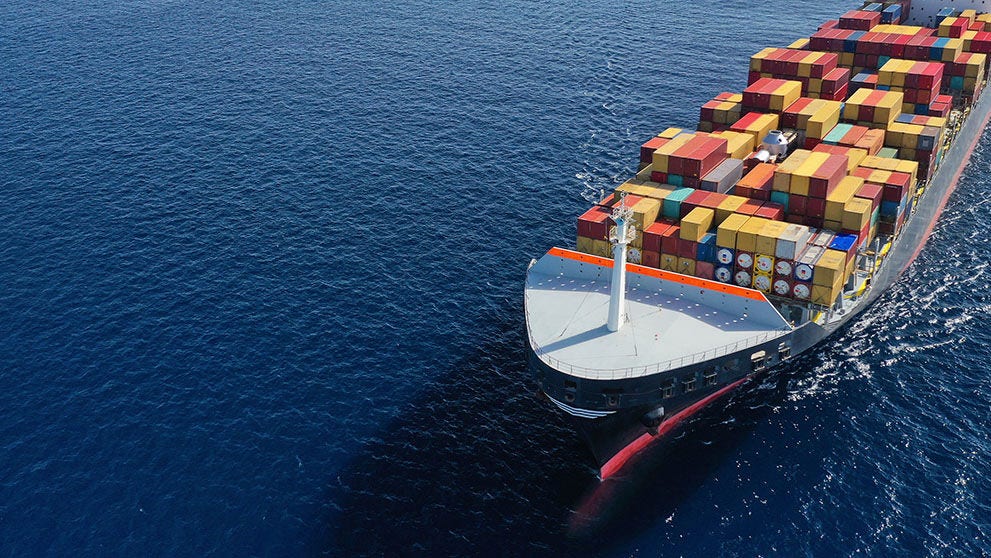
FOB stands for Free On Board. The seller delivers the goods, cleared for export, on board the vessel nominated by the buyer, and from then on cost and risk belong to the buyer.



 Share
Share

Under the FOB Incoterm (Free On Board), the seller's obligations end once the goods, cleared for export, are on board the vessel nominated by the buyer at the named port of shipment. From then on, freight, insurance, risk and import formalities belong to the buyer. Under Incoterms® 2020, FOB applies to sea and inland waterway transport only.
In Brazil, FOB is almost a language of its own. It shows up in exporters' quotes, in official trade figures and even on domestic sales invoices. The trouble is that it is often used in the wrong place, especially for containers, which opens a gap in which nobody clearly owns the cargo.
The seller handles everything until the cargo is on board: packing, transport to the port, export clearance and loading onto the ship the buyer chose, on the agreed date or within the agreed period. The official description used in Siscomex (Brazil's federal foreign trade system) speaks of goods "delivered, stowed, on board the vessel at the port of shipment, both indicated by the buyer". Source: Camex (Brazil's Foreign Trade Chamber) Resolution No. 16/2020.
The obligation ends exactly there. According to the ICC, under FOB the seller delivers and transfers the risk of loss or damage once the goods are loaded onto the vessel at the named port of shipment. Damage at sea, a delayed ship and extra costs at destination all move to the buyer. Source: ICC Academy, Incoterms® 2020.
The buyer is left with four tasks:
FOB is one of the 11 rules published by the International Chamber of Commerce (ICC). The other ten are covered in the guide What are Incoterms®?.
The buyer arranges freight, and nobody is required to insure. Under Incoterms® 2020, only CIF and CIP oblige the seller to buy insurance. Under FOB, if the buyer does not take out a policy, the cargo crosses the ocean uninsured, and any loss after loading falls on the buyer.
For the buyer, this is the point that weighs most. Buying FOB gives you the freedom to use your own freight rates and forwarder, and the price of that freedom is organising the insurance yourself. If you are weighing FOB against a price that already includes freight and insurance, the guide to the CIF Incoterm in Brazil shows the other side of the calculation, including Brazil's compulsory insurance rules.
Because with containers, delivery really happens at the terminal, not on the ship. The exporter drops the container at the port days before sailing and loses control of it, yet under FOB it remains responsible until the cargo is on board. The ICC recommends FCA for containerised goods, even for sea transport, precisely to match the delivery point with the moment delivery actually takes place. Source: ICC Academy, Incoterms® 2020.
The classic objection to FCA was about banking. Letters of credit usually require an on-board bill of lading, and under FCA the seller delivers before loading. The 2020 rules fixed this: FCA now lets the parties agree that the buyer will instruct its carrier to issue an on-board bill of lading to the seller after loading. Source: ICC, Incoterms® 2020.
Choose FOB for bulk and break-bulk cargo loaded directly onto the ship. Choose FCA for containers, air cargo, express shipments and any multimodal move. The table shows the differences that settle the choice:
Criterion | FOB | FCA |
Mode | Sea and inland waterway only | Any mode |
Place of delivery | On board the vessel nominated by the buyer | To the buyer's carrier at the named place |
Where risk passes | Once goods are on board | On handover to the carrier |
Export clearance | Seller | Seller |
Compulsory insurance | None | None |
On-board bill of lading | Standard | Possible, if agreed in the contract |
Suitable for containers | Not recommended | Yes |
One detail changes the negotiation. When the named FCA place is the seller's premises, the seller loads the buyer's vehicle. At any other place, the seller delivers the goods on its own vehicle, ready for unloading.
Build the FOB price from the bottom up: cost of goods, export packing, haulage to the port, terminal handling, customs broker and documents, plus your margin. Nothing that happens after loading belongs in your price.
In the DU-E (Declaração Única de Exportação, Brazil's single export declaration), you enter the sales term and two values. The VMCV is the value under the negotiated sales term. The VMLE is the value at the place of shipment, which, in the Receita Federal's words, "corresponds to the FOB value of the goods" for exports. Even if you sell CIF or DAP, the declaration asks for the FOB equivalent. Source: Receita Federal (Brazil's federal revenue and customs authority), DU-E manual, page updated on 13 November 2025.
If a buyer asks for EXW, offer FCA at your premises instead. Camex's own table notes that, for Brazilian exports, a foreign buyer has no legal standing to clear goods out of the country, so export clearance stays with the seller even under EXW. Source: Camex Resolution No. 16/2020. The full export process, from registration to foreign exchange, is in the guide to exporting from Brazil.
It protects your invoice, not your competitiveness. Under FOB, US surcharges are paid by the American importer, but they go into the landed price that buyer compares with other suppliers. According to MDIC (Brazil's Ministry of Development, Industry, Trade and Services), 23.1% of Brazilian exports to the United States are subject to the Section 301 surcharges of 25% and 12.5%, which add up to 37.5% when both apply to the same product. Another 52.7% carry no additional tariff. Source: MDIC, July 2026.
The products covered and the exclusions are in the guide to US Section 301 tariffs on Brazilian goods. If your US customer wants delivery with duties already paid, the rule stops being FOB and becomes DDP, with the costs and requirements set out in the guide to the DDP Incoterm and Brazil.
Buy FOB when you have negotiated ocean freight, consolidate cargo from more than one supplier, or need to choose the carrier and sailing window. In those cases, taking over transport gives you back control of timing and cost. A first-time importer without a forwarder usually makes fewer mistakes leaving freight with the supplier.
Buying FOB does not cut import tax. Brazilian customs value adds freight and insurance to the port of discharge whatever the Incoterm, and the AFRMM (a surcharge on ocean freight that funds Brazil's merchant navy) still applies to the sea freight. The difference between FOB and CIF is who contracts the transport, not how much tax you pay.
Check these points before you close the deal:
That last mistake comes from the invoice itself. In the NF-e (Brazil's electronic invoice) layout, the freight modality field uses "CIF" for freight contracted by the sender and "FOB" for freight contracted by the recipient. Source: National Electronic Invoice Portal, Technical Note 2018.005. It only states who pays for transport within Brazil, with none of the ICC rules on risk and delivery.
FOB stands for Free On Board. The seller delivers the goods, cleared for export, on board the vessel nominated by the buyer, and from then on cost and risk belong to the buyer.
The buyer. It chooses the vessel, contracts the freight and pays for transport from the port of shipment onwards.
No. Under FOB neither party has to buy insurance, so a buyer who wants cover needs its own policy.
No. FOB is for sea and inland waterway transport only, and for air, express or containers the ICC points to FCA.
Because the DU-E asks for the value of the goods at the place of shipment, the VMLE, which corresponds to the FOB value. It gives a common base for comparing sales made on different terms.
A sample for a new customer, a spare part or an urgent order will not wait for the next sailing. For those, door-to-door air express works with rules such as FCA, CPT or DAP, end-to-end tracking and managed clearance in both countries.
If your company already exports from Brazil, or wants to start with smaller shipments, open a DHL Express business account and keep express ready for the orders that do not fit the ocean schedule.
Share