A new corrugated box, double-wall for heavy or fragile items, with at least 6 cm of cushioning around the product and sealed with the H-tape method. For very fragile items, use two boxes, one inside the other.



 Share
Share

To pack a parcel for shipping from Brazil, use a new corrugated box sized to the product, leave at least 6 cm of cushioning on every side, seal it with the H-tape method and attach a clear label. International shipments also need a commercial invoice, the right HS code and, for any wood packaging, the NIMF 15 mark.
The trouble usually starts once the box leaves your hands. In a Harris Poll survey of 3,071 adults run for DS Smith, 60% of consumers in the United States said they had received a damaged product from an online retailer that year. Source: DS Smith, November 2024. When that happens on a cross-border order, the replacement costs a second international shipment and can cost you the customer.
Because it decides three things at once: whether the product arrives intact, how much you pay for freight and what the customer thinks when the box lands. Packaging is part of your operation, not an afterthought.
Freight is where mistakes show up fastest. Express carriers charge the higher of the actual weight and the volumetric weight, calculated as length × width × height in centimetres, divided by 5,000, for each piece. Source: DHL Express, Brazil Service and Rate Guide 2026. A 1.5 kg pair of shoes in a 50 × 40 × 30 cm box is billed at 12 kg; in a 35 × 25 × 15 cm box, the volumetric weight drops to 2.6 kg.
Pick the box for the product, protect the contents, stop anything from moving, seal in an H, label it, check for restrictions, and only then think about branding, returns and sustainability. The order below follows the path from your packing bench to the courier pickup.
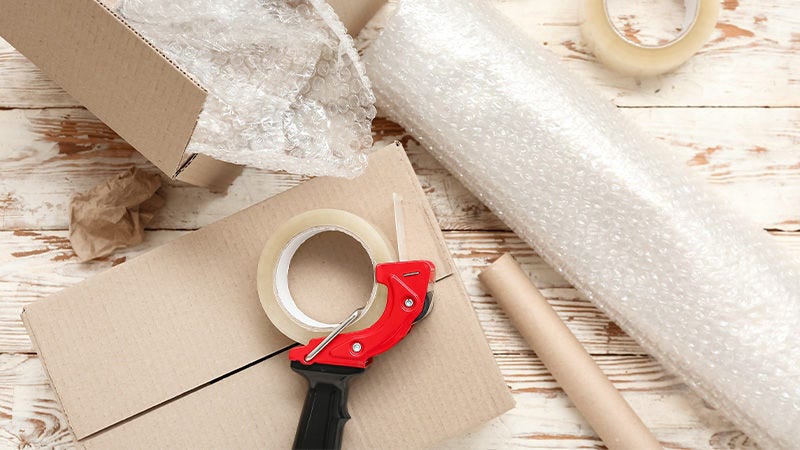
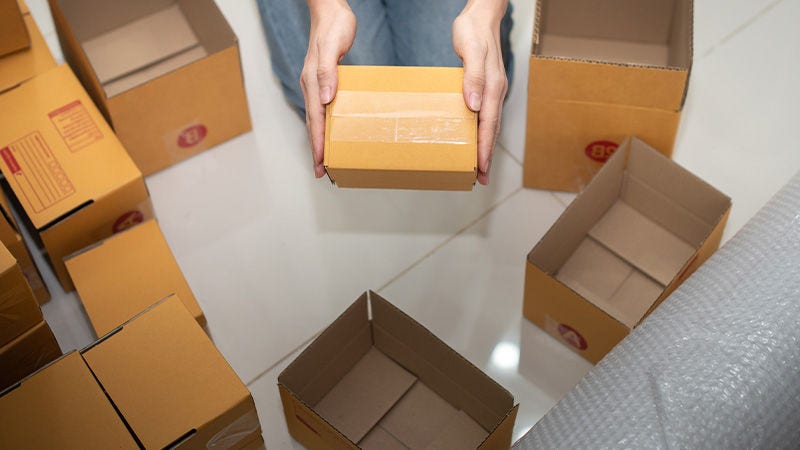
Every good shipment starts with a new corrugated cardboard box rated for the weight inside. Single-wall boxes suit light products; double-wall boxes are the choice for heavy, fragile or valuable items. Check the box maker's stamp on the bottom, which states the box strength and maximum load.
Avoid reusing supermarket boxes. They lose rigidity after the first trip, and an old barcode can confuse automated scanners at sorting hubs. Cardboard also weakens in humidity, which matters in much of Brazil: if the box will wait in a warehouse or travel through a humid route, choose sturdier board and add a desiccant sachet for moisture-sensitive goods.
The inner material depends on what you ship. The table sums up the most common options:
Material | Job | Best for | Environmental impact |
Crumpled kraft paper | Blocking and cushioning | Heavy parts, B2B shipments | Low, recyclable |
Honeycomb or corrugated paper wrap | Wrapping the item | Glass, cosmetics | Low, recyclable |
Air pillows | Filling gaps | Light items in larger boxes | Medium |
Starch-based loose fill | Loose filling | Light items | Low, dissolves in water |
Moulded fibre inserts | Custom fit | Electronics, bottles | Low, recyclable |
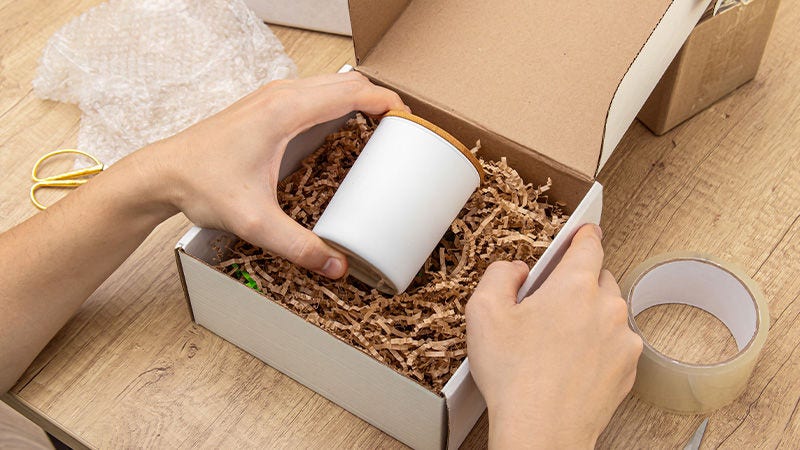
Durable, soft or already boxed products can travel in a single box with cushioning. For fragile, valuable, sharp or irregularly shaped items, use the two-box method: pack the product securely in a smaller box, then place it inside a larger outer box with at least 6 cm of cushioning on every side.
Wrap each piece separately before it goes in. Sharp items need extra care: they must have no chance of piercing the packaging, for the sake of the product and of everyone who handles the parcel along the way.
Put heavier items at the bottom and lighter ones on top, without loading one corner. Keep fragile items away from the edges and corners, which take the knocks on conveyor belts.
Before taping, close the flaps and give the box a gentle shake. If you hear or feel movement, add more filler. A half-empty box also caves in when another is stacked on top, and the damage comes from crushing, not from the drop.
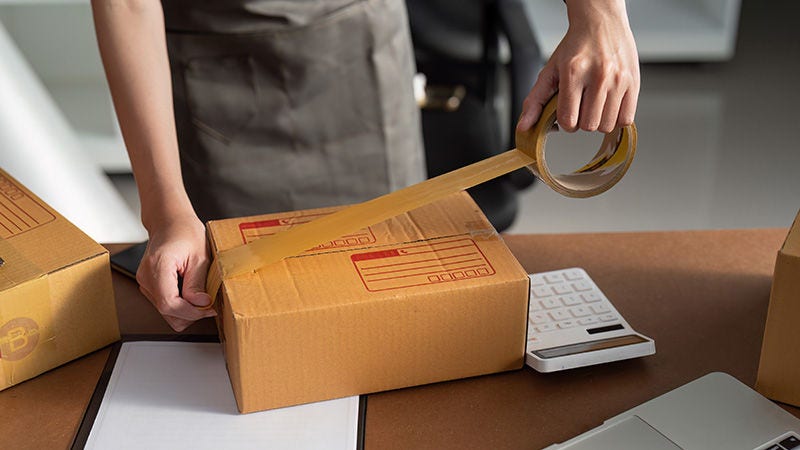
Use strong packing tape made for shipping. Masking tape, duct tape, string and twine will not hold a box together on a sorting line. Apply the H-tape method: one strip along the centre seam and one across each edge seam, on the top and the bottom.
If the box will sit somewhere hot, choose tape with a heat-resistant adhesive. Tape that peels off on day three of the journey opens the box in the worst possible place.
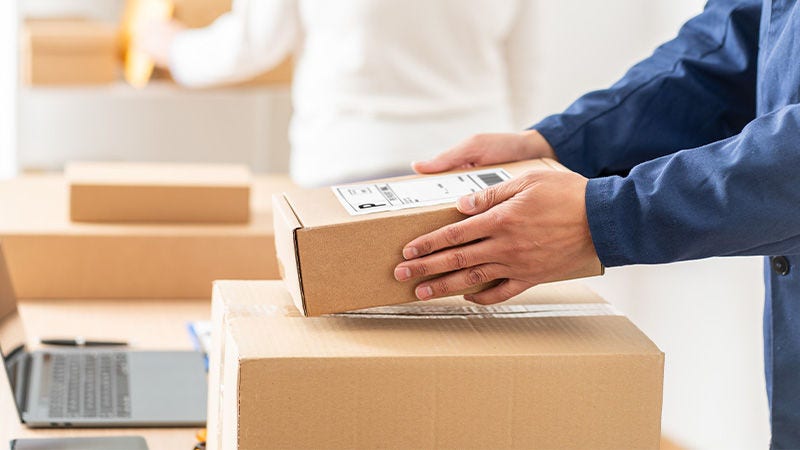
Every piece needs its own transport label, the waybill, firmly attached. Place it on the top or side, never over a corner or seam, and do not cover the barcode with tape, plastic film or straps: it is scanned at every stage of the trip. If you reuse a box, remove all old labels. This guidance comes from the DHL Express Brazil Service and Rate Guide 2026.
For an international shipment, three documents travel with the goods:
On the Brazilian side, exports are registered in a DU-E (Declaração Única de Exportação, Brazil's single export declaration) on the Portal Único Siscomex, the government's foreign trade portal. For express shipments, the declaration is filed by the international express company hired by the exporter. Source: Receita Federal (Brazil's federal revenue service), Portal Único export manual, updated November 2025. With DHL Express Paperless Trade, the invoice can travel electronically instead of being taped to the box.
If you are unsure what paperwork the destination requires, MyGTS, DHL's free online tool, helps you find the HS code, estimate duties and see the documents each country asks for.
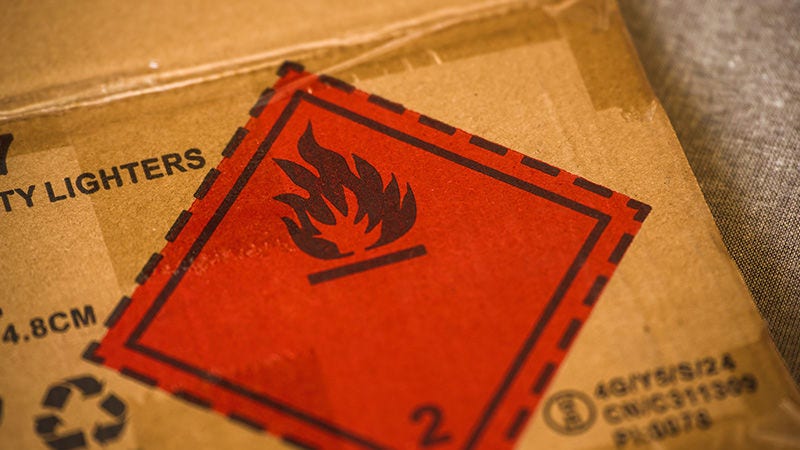
Lithium batteries, perfumes, aerosols and certain chemicals may be classed as dangerous goods, with their own packaging, labels and declarations. Before you pack, read the guide to shipping dangerous goods internationally and check the destination country's restrictions, which vary from market to market.
Weight changes the rules too. Any single piece over 70 kg must go on a pallet; a shipment of four 25 kg boxes does not need one, according to the DHL Express Brazil Service and Rate Guide 2026. For large freight, see how to palletize cargo.
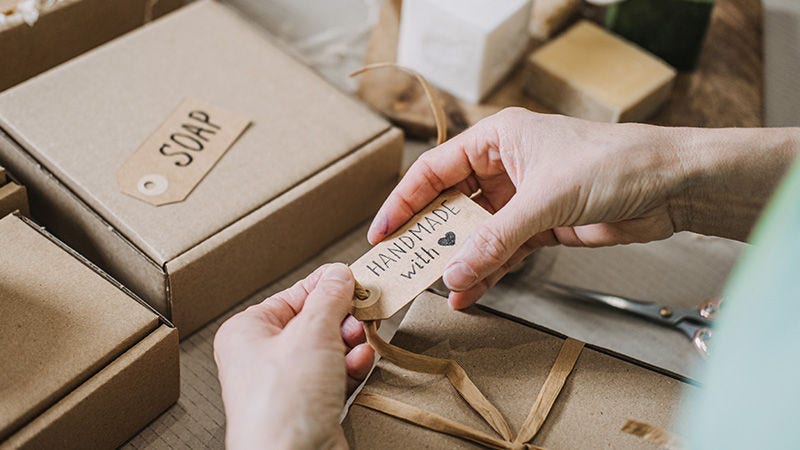
For an online store, the box is the shop window that reaches the customer's door. Tissue paper, a sticker, a handwritten thank-you card or a sample of your next launch cost little and make customers want to photograph the parcel.
With high-value goods, the logic flips on the outside: a plain outer box, with no logo or description of the contents, draws less attention in transit. Keep the branding inside. And no finish makes up for weak protection.
If you sell online to customers in Brazil, they can withdraw from the purchase within 7 days of receiving it, and any amounts paid must be refunded immediately, adjusted for inflation. Source: Brazil's Consumer Protection Code (Código de Defesa do Consumidor), Law No. 8,078/1990, article 49. Customers abroad follow their own country's rules, and an international return comes back into Brazil as an import.
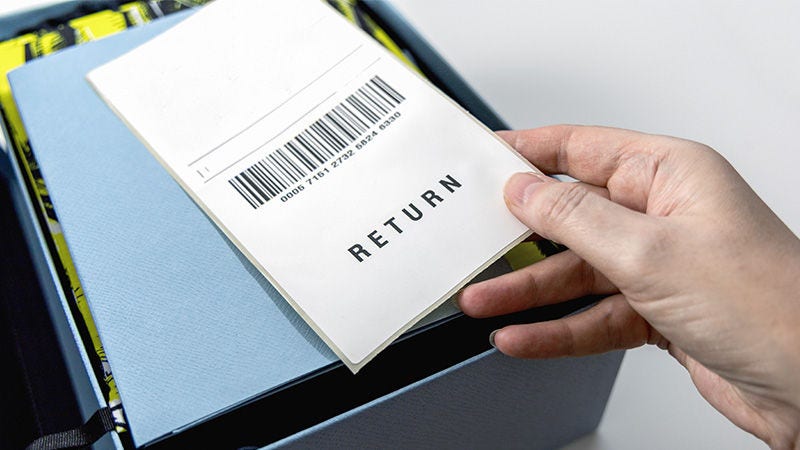
A box with double-sided tape or a tear strip, which the customer can open and reseal without damage, removes friction. Printed return instructions inside and, where it makes sense, a ready-made return label complete the kit.
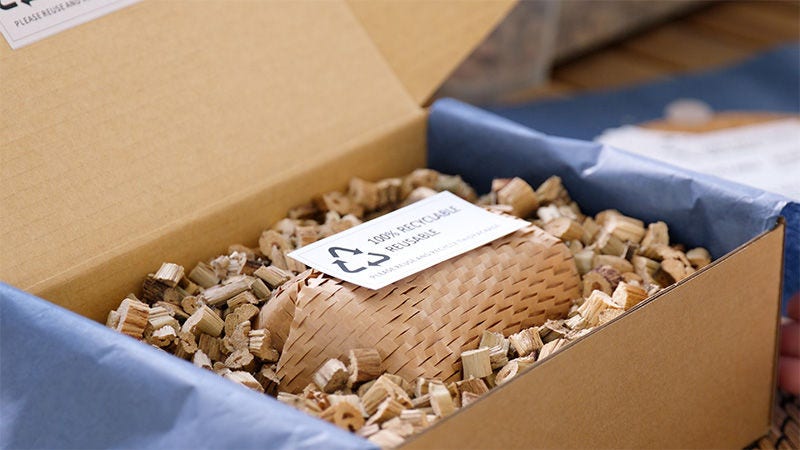
Less packaging means lower costs. A box sized to the product cuts volumetric weight, and swapping plastic bubble wrap for corrugated paper wrap works in most cases. FSC-certified cardboard and tape show that the fibre comes from responsibly managed forests.
When shipping abroad, check the destination's packaging rules as well: materials such as expanded polystyrene (EPS) are restricted or being phased out in some countries. Switching to a recyclable alternative now saves you from redoing the process later.
NIMF 15 (the Brazilian name for ISPM 15, the international phytosanitary standard) requires treatment of wooden packaging and supports, such as pallets, crates and raw-wood boxes, used in international trade. In Brazil, the rules are set by MAPA (the Ministry of Agriculture and Livestock) Ordinance No. 514 of 8 November 2022, which revoked the former IN No. 32/2015. Source: Ministry of Agriculture and Livestock, Ordinance No. 514/2022.
Treatment can only be carried out by a company registered or accredited by MAPA, and the wood then receives the IPPC mark: the wheat-ear symbol, the country code (BR), the company code assigned by MAPA and the treatment code. Ordinary cardboard boxes are outside this rule: NIMF 15 only comes into play when your packaging uses raw wood. The table shows what changes by material:
Material | Needs NIMF 15? | What to check |
Raw-wood pallet or crate | Yes | IPPC mark with HT or MB code |
Wood 6 mm thick or less | No | Thickness of every piece |
Plywood, MDF, particle board | No | That it is processed wood only |
Corrugated board or plastic | Not applicable | Strength and sealing |
HT stands for heat treatment (forced hot air, kiln drying or pressure chemical impregnation) and MB for methyl bromide fumigation. An unmarked pallet can be rejected by plant health inspectors in the destination country, and the cargo waits with it.
Check that the product can enter the destination country, whether it needs a licence or certificate, and that the invoice description matches what is actually in the box. Vague descriptions ("parts", "gift") and wrong HS codes are among the most common reasons for customs holds.
Measure each piece once the box is sealed. A piece whose longest side exceeds 100 cm, or whose second-longest side exceeds 80 cm, is treated as oversized and carries an extra charge. Source: DHL Express, Brazil Service and Rate Guide 2026. Sometimes splitting the load into two boxes solves it.
Finally, agree with the buyer who pays duties and taxes on arrival. That choice, set by the Incoterm you negotiate, keeps parcels from sitting in customs waiting for payment. If you are new to selling abroad, the guide to exporting from Brazil walks through the steps, documents and rules.
A new corrugated box, double-wall for heavy or fragile items, with at least 6 cm of cushioning around the product and sealed with the H-tape method. For very fragile items, use two boxes, one inside the other.
Yes, if it is rigid, dry and free of any old labels or barcodes. A dented, damp or much-travelled box loses strength and raises the risk of damage.
No. NIMF 15 applies to raw-wood packaging and supports, such as pallets and crates. Cardboard, plastic, plywood and wood up to 6 mm thick are exempt under MAPA Ordinance No. 514/2022.
Multiply length, width and height in centimetres and divide by 5,000, the divisor in the DHL Express Brazil rate guide. You are charged on whichever is higher, that figure or the actual weight.
For fragile items, at least 6 cm of protective material between the product and each side of the box. The practical test is to shake the closed box: if anything moves, add more filler.
With the right packaging and your paperwork in order, what remains is a partner that gets the box to its destination with tracking from pickup to delivery and customs clearance handled by people who know both sides of the border.
To send samples, orders and business shipments from Brazil to more than 220 countries and territories, open a DHL Express business account.
Share