



Compared to other aspects of your business, packaging your products to be shipped to your customers may seem simple. But when you break it down, there is a lot to consider and a number of important decisions to make, especially if you’re shipping items internationally from the United Kingdom. If you’re wondering how to properly wrap and pack a parcel for safe and efficient delivery, this guide will take you through the basics.
Assessing your product
Before you even begin packing your parcel, you should first determine what type of packaging and wrapping your item needs. This will help you choose the right materials and methods to ensure your parcel arrives safely. How do you do this? Just ask yourself these simple questions:
How much does the item weigh?
How fragile is the item?
How valuable is the item?
Does the item need controlled conditions, like regulated humidity?
Are there any special packaging regulations around the item, as with foodstuffs?
The last three questions are especially important to ensure that your package is delivered without a hitch
Choosing appropriate packaging materials
There are basically two types of packaging — external and internal. Unless your product requires specialised packaging, like liquids or powders, the external packaging is usually some form of cardboard box.
Best practice is to use a high-quality corrugated cardboard box and avoid re-using old boxes as they might have lost their rigidity and cannot withstand the rigours of shipping, especially if you're shipping something from Britain to, say, Australia or Asia.
You will also need to choose the right type of cardboard box. For heavier or more fragile items, double or triple-wall boxes are more appropriate. To determine if a box is durable enough, you can refer to the manufacturer's stamp, which tells you more about the strength and durability of the box. If this is not available, you can consult your box supplier.
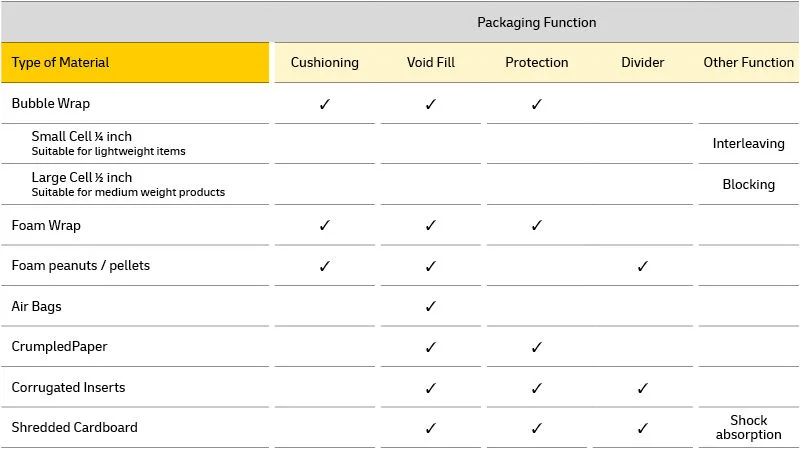
Internal packaging is used to cushion your product and fill gaps inside the box to stop the goods from moving around. There are many different types of internal packaging materials with different suitability levels. Here is a simple chart showing some of your packaging options and what they are best used for.
Protecting your goods
Not all cardboard boxes are the same, and you need to choose the right type for your external packaging. For heavier or more fragile items, double or triple-wall boxes are more appropriate. There should be a manufacturer stamp which tells you more about the strength and durability of the box or, failing that, consult your box supplier.
For internal protection, biodegradable air peanuts are a greener alternative to styrofoam. Bubble wrap also does a good job of cushioning and protecting your product but, again, this is a traditional plastic-based packaging material and corrugated bubble wrap is a lot greener. Foam wrap, air pillows, crumpled paper, corrugated inserts and shredded cardboard are all other alternatives for protecting your goods – you just need to decide which is most suitable
Top tips on how to best wrap items in a parcel
Whether you're shipping items from London to Edinburgh or sending an order across the globe, it's important to know how to wrap your goods. Here’s how to wrap your parcel items for a smooth delivery:
Wrap items individually
It is best to wrap each item individually for maximum protection from shocks and vibrations during transit. This is especially important for fragile items such as glassware, ceramics, and electronics.
Use dividers
Dividers prevent your items from bumping into and damaging each other. You can use purpose-made cardboard dividers or improvise with sturdy materials like corrugated cardboard or foam sheets. This is particularly useful when packing multiple items of varying sizes and shapes.
When picking a divider material, ensure that it won't damage the items it's meant to protect. You should also consider the weight of your items, as flimsy dividers won't offer much protection for heavier objects.
Keep items from moving around
Loose items are more likely to get damaged during the shipping journey, so you should always fill empty spaces within your box to prevent them from moving around during transit.
Place items in the middle of the box
Position your items in the middle of the box, ensuring there's sufficient cushioning on all sides. This helps to protect them from impact and prevent them from coming into contact with the walls of the box, which could lead to damage.
Marketing and personalised packaging
While packaging’s primary purpose is to protect your product so it can be safely delivered, creative packaging is a powerful way of encouraging customer loyalty and repeat purchases.
Packaging can be a powerful marketing tool, allowing communication with your customer when they’re feeling most positive towards your brand — when their order arrives. At its most basic, you can use packaging to bolster your brand image using consistent colours, logos, messaging, typography and other brand elements. While your outer packaging may be a cardboard box, it needn’t just be plain brown! You can explore using packing tape in your brand colours and custom-designed labels to create a memorable unboxing experience for your customer.
You can also synergise your packaging with your advertising. For example, if you’re running a social media campaign using a particular headline, why not look into adding it to your packaging? You can also cross-promote your social media campaign by adding a hashtag.
Other opportunities include: tying in your packaging with particular events — for example, Valentine’s Day or Christmas; including a personalised, handwritten thank-you card (perhaps with a personal discount code); and adding free samples of related products. You can even incorporate designs or messaging that celebrate local UK events, like a special sticker for Bonfire Night or a themed ribbon for the King’s birthday to emphasise your brand's origin. This can be particularly effective if your brand identity is strongly tied to British values or traditions.
Packaging for quick and easy returns
Returns are a fact of life in the age of e-commerce. While offering free returns has cost implications for your business, many customers will only shop from retailers who operate a free returns policy. It’s a dilemma you have to weigh up and make a decision about. It is important to understand that processing returns from local UK customers is generally cheaper than handling returns from international customers.
Whatever you decide, strangely enough, a return is actually another opportunity for your business. By making it as hassle-free and simple as possible, you will encourage the customer to buy from you again, even though this particular purchase hasn’t worked out. So always include clear instructions and a returns label.
In terms of the packaging itself, choose a box that is easy to open, such as one with a perforation or tear strip for quick access, and ideally, easy to re-use and re-seal, maybe even including an adhesive strip for added convenience. By putting some thought into it, you can make the returns process a positive customer experience and a way of differentiating yourself from your competitors.
Sustainable packaging
Make no mistake, sustainability is a huge issue among consumers now, and using sustainable packaging could be crucial to the popularity of your brand.
Sustainable, green or eco-friendly packaging are terms that mean the same thing: packaging that has the lowest possible impact on the environment. This low impact is achieved in three basic ways: by limiting packaging waste, by using materials that are recyclable or biodegradable, and by the use of renewable energy in the production of the packaging.
So, what can you do? Most obviously, cut back on waste by using packaging that’s the right size for whatever product you’re sending. Sending a small product in a big box annoys recipients so much that, in the past, they’ve taken to social media to shame companies who do so.
As for packaging materials, biodegradable packaging peanuts, corrugated cardboard bubble wrap, air pillows, and cornstarch-based materials can be used instead. If only plastic will do, there are now biodegradable and recycled plastics. Organic ecological textiles are also becoming more popular, including organic cotton wool for cushioning, linen and poplin anti-scratch covers, and tape made from hemp.
And finally, try to source cardboard boxes and paper that have been recycled or certified to support sustainably managed forests.
For more details, read our article on green packaging.
Other considerations when shipping overseas
Of course, knowing how to package a parcel and taking the time to pack it properly are important. But, no matter how much thought you put into it, it could end up pointless if customers are disappointed by a needless delay to their shipment or annoyed by surprise additional costs.
When shipping from the UK, we can help you navigate international trade by enabling you to calculate your customs duty, tax and other fees so you can pay them upfront. Plus, you can get the correct HS (Harmonized System) codes and check your shipment’s compliance with any country’s import and export regulations.
You can do it all using our free Global Trade Services toolkit.
Packaging Basics Checklist
• Assess your product
• Choose appropriate packaging materials
• Ensure your goods are protected
• Use your packaging as a marketing tool
• Make sure it’s returns-friendly
• Choose green packaging alternatives
• Navigate customs with our Global Trade Services toolkit
So, your packaging will ensure your shipment arrives at its destination in one piece, but what about on time? That’s where DHL has you covered. With a DHL Express Business Account, you’ll have access to a range of expedited shipping solutions to help you meet your customers’ expectations.


 Share
Share

Similar Stories