

Every year, logistics providers and delivery companies transport 25 billion packages1 around the world. It all runs like clockwork on a carefully coordinated network of air, land, and sea transport. But the hardest part—and the most crucial part for businesses like yours—is the ‘last mile’.
Here we explain why the last mile is so challenging, what decisions you can make to improve last-mile delivery, and what the future looks like for this vital final leg of the logistics process.
What is last-mile delivery?
Last-mile delivery—also known as the “final mile”—refers to the process of transporting goods from a distribution hub to their final destination, typically a customer’s home or business address.
While global logistics networks efficiently move billions of parcels via air, sea, rail, and road, the last mile is often the most complex and challenging stage. Unlike long-distance transport, which relies on structured routes and large-scale operations, last-mile delivery lacks the same level of consistency, control, and efficiency.
Delivery drivers must navigate unpredictable factors such as traffic congestion, road closures, route optimization issues, and changing weather conditions—all of which can impact delivery times.
From a logistics perspective, last-mile delivery is also the most resource-intensive part of the supply chain. Drivers make multiple short stops, often delivering single parcels, which reduces efficiency compared to bulk transportation methods. At the same time, they represent the only direct interaction with the customer, making this stage critical for customer satisfaction and overall delivery experience.
Challenges facing last-mile delivery
- E-commerce continues to grow, meaning more packages to be delivered
- Shortage of delivery employees
- Naturally inefficient: traffic, mechanical failure, and only one drop off at a time
- Customers now expect next day, same day, or even 1- or 2-hour deliveries
It’s partly why last-mile delivery accounts for 41% of the total cost of delivery2. Despite these challenges, even the smallest of retailers must now compete with the high standards set by global providers who have made next-day delivery the norm and same-day delivery viable.
So how can I get ahead in last-mile delivery?
You do have choices. You can choose a delivery firm that offers services that keep your costs lower while also giving your customers the seamless service they want and expect.
How to improve last mile delivery
Here are four factors you need to consider:
1. Take advantage of localized storage and dark stores
Many businesses are strategically distributing their stock among small regional warehouses, focusing on popular and seasonal items to reduce the distance for final delivery. According to Roy Hughes, EVP Network Operations Europe, DHL Express, several 'power cities', such as New York and Beijing, are "facilitating and driving this localization trend".
SMEs may lack the resources for their own warehouses, but some logistics firms offer access to unused temporary storage. This enables e-commerce brands to store inventory and offer same-day delivery to local customers.
2. Use ad hoc resources for faster delivery
Localization has in turn raised the demand for freight services, transporting goods to consumers on the day they order them. This is where ‘crowdsourced delivery’ comes in. Extending beyond taxi and food drop-offs, crowdsourcing works with local pre-qualified drivers who can choose to pick up a pending delivery and drop it off to the customer.
It’s a great solution to the age-old capacity problem: if you have too many parcels and not enough vans and drivers, what do you do?
Collect when it suits the customer: the rise of lockers
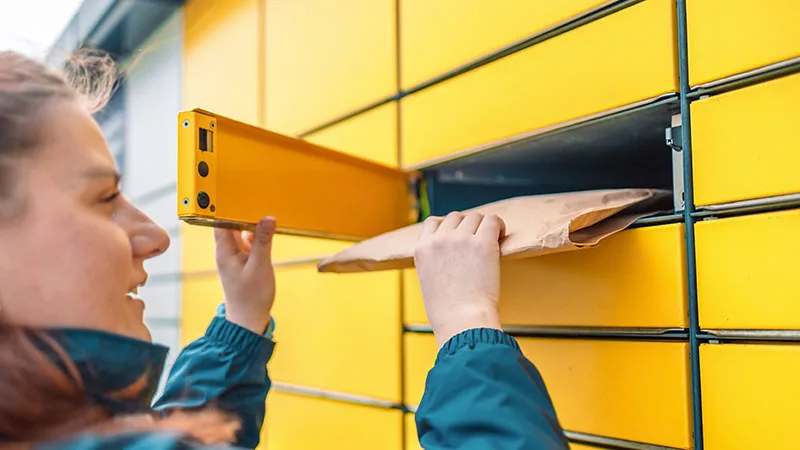
Other on-demand options include service points and storage lockers, able to accept a delivery on behalf of your customer and pushing the move towards urban localization. DHL’s Packstation, which was launched back in 2001, offers a network of automated all-day booths across more than 3,500 locations in Germany alone.
3. Using AI and analytics for better routes and greener deliveries
The crowdsourcing solution is still not ideal for transporting more expensive, bulkier packages, which is when you will probably want to use a more established shipper. However, such deliveries present their own issues, with trucks having to find a suitable unloading spot or navigate smaller inner-city roads. As out-of-route miles account for 3-10% of a driver’s total mileage, inefficient route planning can add a hidden cost to already expensive services.3
The answer is better route planning
Some sources suggest4 that couriers and courier route planning staff could be spending 3-4 hours a day manually planning their routes.
As these new technologies continue to play an expanding role in improving the last mile, Mei Yee Pang, Head of Innovation, Asia Pacific DHL Customer Solutions and Innovation, reiterated that it is vital now to be taking “a data-driven approach in servicing customers.”
No room for humans?
In the distribution centers, AI and robotics are coming together to automate repetitive tasks, But does that mean humans are no longer needed? Tim Tetzlaff, Global Head of Accelerated Digitalization, DHL Supply Chain: “The more we can use robots to complete repetitive or distant tasks in highly predictable, structured environments, the more we free up our employees to leverage their unique human capabilities.” AI and robots are another tool to help humans—not to replace humans.
Perhaps most importantly, route optimization AI can reduce carbon emissions from a last-mile road fleet by as much as 25%. Software company Descartes’ route optimization tools have been shown to reduce CO2 emissions by over 552,000 tons and decrease fuel usage by 5% to 25%5. That’s a huge impact, all achieved by simply finding the best route.
Deliver your goods via drone or robot
Innovative last-mile delivery solutions are rapidly evolving, with alternative options such as smart lockers in high-traffic locations—like supermarkets and urban centers—growing in popularity each year.
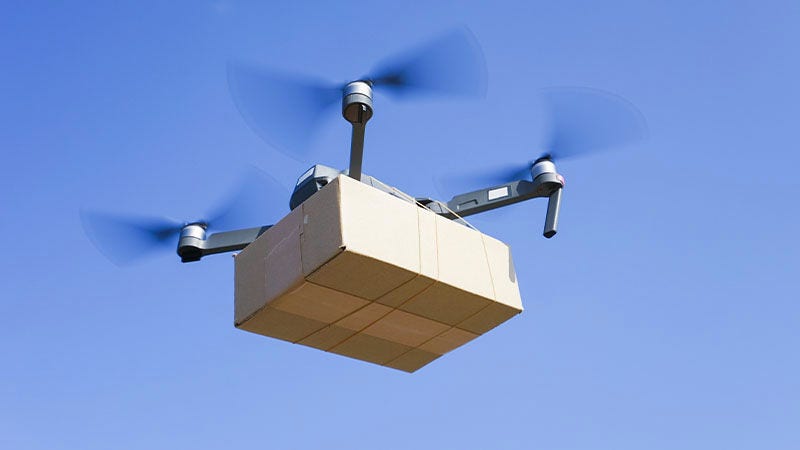
In addition, companies are increasingly exploring drone and autonomous robot deliveries. Drones are already being used to transport high-value and time-sensitive items such as medical supplies and blood, and ongoing technological advancements are expanding their role in modern logistics. These solutions help reduce pressure on supply chains caused by rising e-commerce demand, urban congestion, and driver shortages.
Drones delivery in action
DHL has successfully tested its Parcelcopter in Reit im Winkl, demonstrating a fast and efficient delivery system. Customers simply place parcels into a “Skyport” docking station, allowing the drone to handle delivery—especially useful for remote or hard-to-reach areas.
Other companies are also advancing drone logistics. Dronamics, a start-up in Bulgaria has developed a fixed-wing cargo drone capable of carrying up to 350 kg over long distances for same-day delivery, while Cloudline is testing autonomous airships for carbon-free deliveries in remote regions.
In the United States, Zipline has expanded its operations after receiving federal certification to support e-commerce and healthcare logistics.
Mind that delivery robot…
Ground-based autonomous delivery robots are also transforming last-mile logistics. These small, self-driving vehicles act as secure mobile lockers, traveling along predefined routes to customers. Once they arrive, recipients are notified and can easily collect their parcels.
Industry forecasts suggest that autonomous delivery solutions could soon dominate the last mile, with growing consumer acceptance of drone and robot deliveries. As these technologies mature, they are set to improve delivery speed, efficiency, and sustainability across global logistics networks.
The price problem
While these new solutions may come with an initial hefty price tag, 48%7 of consumers will pay more for next-day delivery, and 23% of consumers are willing to pay significant premiums for same-day delivery, rising to 30% among younger consumers.
As this younger demographic becomes the dominant consumer spending group, a delay in receiving a package of just 12 hours can become an important differentiator in saturated markets—and one you’ll want to avoid.
Businesses should make gradual adjustments when looking to cater more toward these higher expectations, balancing cost with quality considerations for the future.
The future of last-mile deliveries
While the general move is towards localized, digitized fulfillment to improve the last mile, this industry is continually developing and moving forward.
When asked to make a prediction, Lee Spratt, CEO of DHL E-commerce Americas, stressed the importance of “being more agile in adjusting to market trends, maintaining an openness towards learning and reinvention, and promoting a newfound flexibility as a baseline for the transport industry.”
Last mile delivery FAQs
How does last mile delivery work?
Last mile delivery, also known as final mile delivery, is the very last leg of your item’s journey: from local distribution center (either your own or your logistics partner’s) to the end consumer. Last mile delivery aims to deliver the packages as affordably, quickly, and accurately as possible. This is achieved via road (van, or sometimes car or bike), or at a drop-off point such as a local supermarket or parcel locker. New methods are already being trialed, such as autonomous robots and drones.
How long does last-mile delivery take?
This varies depending on the location of the distribution hub, the final delivery destination, traffic conditions, weather, and the efficiency of the delivery process. Customers are increasingly looking for rapid delivery, but reliability and traceability (last-mile tracking) are also high on the list of consumer priorities.
How customer expectations are transforming last-mile delivery
Customer demand for faster, more affordable, and reliable delivery is reshaping last-mile logistics. Speed, cost, and service quality are now key factors that influence purchasing decisions and brand loyalty.
In e-commerce, the delivery stage is often the only direct interaction a customer has with a business, making the delivery driver an extension of the brand experience. As a result, providing a positive and professional delivery service is essential.
To meet evolving expectations, businesses should offer a range of flexible delivery options, including next-day, same-day, scheduled (named-day), and eco-friendly delivery. Offering choice not only improves customer satisfaction but also helps businesses stay competitive in a rapidly changing market.


 Share
Share

Similar Stories