The global landscape of consumer expectations is shifting dramatically. According to a 2024 PwC Voice of the Consumer Survey of over 20,000 consumers across 31 countries, 46% say they are buying more sustainable products as a way to reduce their impact on the environment, while more than four-fifths (80%) of consumers say they are willing to pay more for sustainably produced or sourced goods1. For small and medium-sized enterprises (SMEs), this presents both a challenge and a significant opportunity.
Contrary to what many SMEs might believe, sustainability is not reserved for big corporations with deep pockets. It is not only entirely achievable but essential for SMEs to stay competitive. Done right, sustainability strategies can help you stand out in crowded markets while actually reducing your operational costs.
This guide will provide you with a practical roadmap for building an eco-friendly business from the ground up. Whether you're just starting out or transforming your existing operations, learn how to create a sustainability plan to attract Singapore's growing segment of eco-conscious consumers.
1. Building a sustainable foundation: Sourcing & operations
True sustainability begins long before your product reaches your customer, in the earliest stages of your business process. This foundation determines not just your environmental impact, but also your credibility when you eventually tell your green story to the world.
Ethical sourcing and production
Your suppliers are an extension of your brand, so selecting partners who demonstrate a genuine commitment to eco-friendly practices is crucial for building an authentic, sustainable supply chain. Seek out suppliers who are transparent about their processes, certifications, and environmental policies. Ask specific questions about their operations: How do they manage waste? What's their energy source? Do they have documented sustainability standards? Request evidence of their environmental commitments—certifications, audit reports, or sustainability policies—to ensure their practices align with the values you're building into your business.
Prioritize local or regional suppliers whenever possible.
For SMEs in Singapore, sourcing from within Southeast Asia can create a greener supply chain while supporting regional economic growth. This approach delivers multiple benefits: reduced transportation emissions, stronger relationships with your supply chain partners, and the ability to verify sustainability claims firsthand. Plus, shorter supply chains mean greater control and faster response times when issues arise.
Implement waste-reduction processes throughout production.
Examine every stage of your operations through a sustainability lens. This might mean investing in equipment that uses resources more efficiently, training staff in waste-reduction techniques, or redesigning products to require fewer materials. Remember, these initiatives often deliver immediate cost savings alongside environmental benefits, reducing waste means reducing costs, creating a win-win for bootstrapping SMEs.
The circular economy
Next, shift from linear to circular thinking. The circular economy represents a fundamental shift from the traditional "take-make-dispose" strategy. Instead of viewing products as having a linear lifecycle, sustainable businesses have started to embrace repairing, refurbishing, reusing, and ultimately recycling materials. This approach keeps resources in circulation for as long as possible, reducing waste while creating new value from materials that would otherwise be discarded. Here's how you can apply circular principles to your business:
Design products and processes that keep resources in use for as long as possible.
Focus on creating products that are easier to repair or upgrade, with components that can be separated for recycling at end-of-life. For example, if you're a furniture maker, consider modular designs where customers can replace individual cushions or legs rather than discarding the entire piece. If you run an electronics business, offer trade-in programs where old devices are refurbished and resold, or their components harvested for spare parts. If you're in fashion, design garments with easily replaceable buttons and zippers, or create a take-back program where worn items are transformed into new products. Even simple changes, like using screws instead of glue, or standardizing component sizes, can dramatically extend product lifecycles and reduce waste across any industry.
Conduct a waste audit and turn discarded materials into resources.
Beyond product design, look at the materials you're already discarding. Many forward-thinking SMEs are discovering innovative ways to create "closed-loop" systems where yesterday's output becomes tomorrow's input. For example, fabric offcuts might be used as packaging filler or be shredded for insulation, and food waste might be composted to grow ingredients or donated to urban farms. Even wastewater from manufacturing can often be filtered and reused for cleaning or irrigation.
Adopting circular economy principles isn’t just environmentally sound, it's financially smart. By maximizing the value you extract from every resource, you reduce purchasing costs while building a future-proof business model. This efficiency becomes a compelling part of your story when you're ready to communicate your sustainability efforts to customers.
2. Share your green story: Branding & communication
You've built sustainable operations; now it's time to communicate them effectively. This is where many SMEs stumble, but with authentic storytelling and transparency, you can showcase your sustainability efforts into something that resonates with eco-conscious consumers.
Communicating your commitment
Sustainable branding means integrating your sustainability story across your website, social media channels, product packaging, email communications, and even your physical store if you have one. This consistency reinforces your commitment and ensures customers encounter your values regardless of how they interact with your brand.
Leverage third-party certifications to build trust
Certifications provide objective, independent validation of your sustainability efforts—something no amount of self-promotion can match. Consider pursuing relevant certifications based on your industry and practices: Fairtrade for ethical sourcing, FSC certification for paper and wood products, B Corporation status for holistic sustainability, or Singapore's Green Business certification for local credibility.
Display them prominently on your website, product packaging, and marketing materials, and explain what each one means in plain language.
Gaining customer trust through authenticity
While certifications provide crucial third-party validation, building deeper customer trust requires transparent communication that goes beyond logos and labels. The key is demonstrating authenticity in everything you say about your sustainability efforts—and that starts with avoiding the greenwashing trap.
Greenwashing, or making misleading or unsubstantiated environmental claims, is the fastest way to destroy customer trust. Singapore's eco-conscious consumers are increasingly savvy and can spot vague, empty statements instantly. To build genuine trust, share the "why" behind your decisions: What motivated you to prioritize sustainability? What challenges have you overcome in building your green supply chain? What measurable impact are you making?
Back up every claim with specific, verifiable information
Specificity is your shield against greenwashing accusations and your strongest tool for building credibility. Every sustainability claim you make should be supported by concrete data or evidence. Instead of saying "We use sustainable packaging", provide the full picture: What materials you're using, how much of your packaging contains these materials, and the measurable impact this creates.
If you're working toward a goal you haven't achieved yet, be honest about that too: "We're transitioning to 100% renewable energy by 2025, currently at 65%." This level of transparency demonstrates genuine commitment to sustainable business practices and shows customers you're on a real journey, not just making marketing claims.
Sustainable logistics: Closing the loop
Your logistics strategy is the final, and highly visible, proof point of your commitment to sustainable business practices. Here’s how you can make every aspect of your delivery reinforce the green values you've built into your business.
Eco-friendly packaging
- Prioritize lightweight, recycled, or biodegradable materials. Choose materials that minimize environmental impact while still protecting products during transit. Consider recycled cardboard, biodegradable mailers, or innovative materials like mushroom packaging or seaweed-based alternatives. Eco-friendly choices signal your commitment and become part of your brand story.
- Right-size your packaging to reduce waste and costs simultaneously. Use packaging that fits your product snugly without excess space or unnecessary filler. This approach reduces material usage, cuts down on waste, and decreases dimensional weight charges from carriers, trimming your shipping costs while lowering emissions. Many SMEs discover that optimizing packaging design pays for itself quickly through reduced shipping expenses, proving once again that sustainability strategies often align with profitability.
- Lastly, design packaging that extends your sustainability narrative. Think beyond protection and consider how your packaging itself communicates your environmental values. Can it be repurposed by customers as storage or gifting boxes? Does it include clear recycling instructions? Can you print your sustainability commitments or tips for responsible disposal directly on the packaging?
Green transportation and distribution
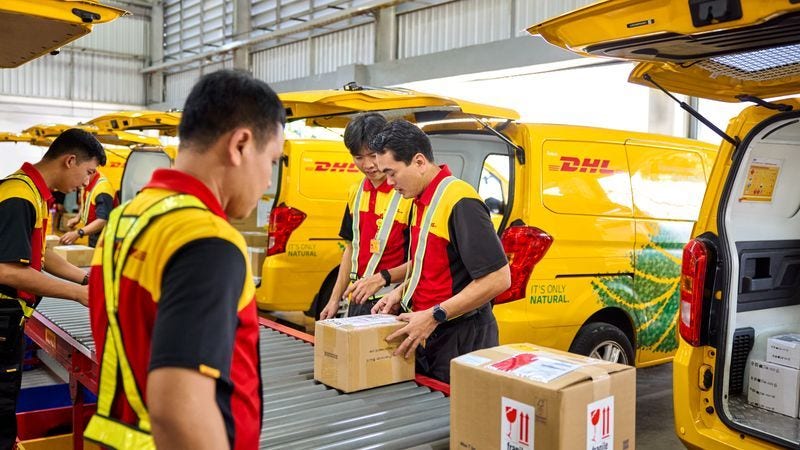
Creating a truly green supply chain requires partnership with logistics providers who share your sustainability values. While eco-friendly packaging addresses what arrives at your customer's door, green transportation determines how it gets there. This is where partnering with a sustainability-focused logistics provider like DHL Express becomes essential to completing your end-to-end sustainable business.
With concrete commitments to using sustainable aviation fuels (SAF), expanding electric delivery fleets internationally, and DHL’s GoGreen Plus (GGP) services, DHL Express helps amplify your own environmental efforts. These services allow you to reduce carbon emissions from your shipments through investments in climate protection projects and sustainable aviation fuel. GGP’s carbon reporting also provides transparent data on your shipping emissions, enabling you to track progress and communicate specific metrics to customers, turning your logistics into a powerful proof point for your sustainability claims.
The path to a greener business
Building a sustainable business may seem overwhelming, but it's an achievable goal that leads to a more resilient, profitable, and meaningful business. The full-circle approach, from ethical sourcing and circular economy practices to transparent branding and sustainable logistics with a partner like DHL Express, can transform your SME into a competitive force that attracts eco-conscious consumers, reduces operational costs, and positions you as a sustainability leader in Singapore's marketplace.

Start your journey towards a more sustainable supply chain today. Open a DHL Express business account to gain access to our sustainable logistics solutions and expert guidance.
Open an Account


 Share
Share
Similar Stories