

If you’re expanding your Brazilian e-commerce storefront or SME internationally, knowing what documents are needed for export and import is integral to your survival.
Without the right cross-border paperwork, your cargo risks being held up at customs terminals like Guarulhos or Viracopos—or worse, seized altogether by the Receita Federal (Brazilian Federal Revenue).
To help your business avoid catastrophic logistics delays, cargo abandonment, or expensive administrative fines, this comprehensive guide breaks down the essential international shipping documentation required to clear customs smoothly.
What is the key export and import documentation for international shipping?
When shipping internationally from Brazil, the two most common documents you will encounter are the air waybill and the commercial invoice.
Submitting full, exact, and accurate data on these forms is crucial because it helps customs officials quickly verify your shipment, drastically reducing the risk of border delays. Mismatched information across these digital records is the primary reason why local cross-border logistics face structural bottlenecks.
Let’s take a closer look at each foundational file.
Air Waybill (AWB)
An air waybill is a mandatory transport document that contains critical logistics details, including:
Full corporate names and physical addresses of both the shipper and recipient
An accurate physical description and the declared commercial value of the goods
The contract terms and conditions of the international transport agreement
The air waybill serves several important functions in your supply chain. First, it acts as a legally binding contract between the shipper and the carrier, outlining the carrier's explicit agreement to transport goods from the point of origin in Brazil to the final destination.
Because the waybill is attached securely to the exterior of the shipping package, anyone handling the cargo has immediate access to its routing information. Furthermore, every waybill contains a unique tracking ID, meaning your international packages can be monitored in real time across digital networks.
Commercial Invoice
A commercial invoice is the primary accounting and legal document used in international trade to calculate customs duties. Created by the seller as an international bill of sale, it includes key information such as:
Complete seller and buyer corporate details (including localized tax numbers like your CNPJ or CPF)
A precise, plain-language description of the commodities
The specific Nomenclatura Comum do Mercosul (NCM) or international Tariff Classification Code(s)
Declared item values and the designated transaction currency
Total package weight and clear dimensions
Authorized terms of sale, universally known as Incoterms
The global Harmonized System (HS) Code(s) matching your cargo
Customs brokers rely directly on the Commercial Invoice information to prepare the official customs declaration submitted to border authorities. It’s absolutely essential to provide complete and accurate Commercial Invoice data to avoid severe customs delays, cargo inspections, or heavy administrative penalties.
What additional import and export documentation does Brazil require?
To clear customs for international shipments operating within the Brazilian market, you must secure specialized forms that go beyond the basic transport bill, depending on your commodity category and destination regulations. Additional documents are extra forms that go beyond the usual Commercial Invoice and Air Waybill needed for international transport. The exact paperwork depends on the regulatory requirements of the export and/or import countries, and factors like the type of goods, where they’re being sent, who is involved in the shipment, and the particular services chosen.
For Brazilian SMEs integrating with global routes, pay close attention to these four common compliance files:
Certificate of Origin (Certificado de Origem): This official document indicates the exact country where your commercial goods were manufactured or produced. It is required by foreign customs to grant preferential tariff treatment under regional free trade pacts, such as Mercosul agreements.
ATA Carnet: This international passport enables the temporary, duty-free, and tax-free import or export of commercial samples, professional tools, or exhibition equipment. Administered locally by the National Confederation of Industry (CNI), it is valid for up to one year under strict regulatory requirements.
Sanitary and Phytosanitary Certificates: These regulatory forms confirm that your products meet strict health, safety, and environmental protection standards. They are legally mandatory for food items, organic components, supplements, and cosmetics to prevent biological contamination, requiring authorization from local bodies like ANVISA or MAPA.
Export and/or Import Permits and Licenses: Certain regulated or restricted goods require explicit, pre-approved permission from government agencies before they can cross borders. This applies to controlled items like medical devices, consumer electronics, or hazardous chemicals, and specific permits vary widely by destination country.
How can paperless shipping protect your business from border delays?
DHL's Paperless Trade service lets you prepare, generate, and electronically transmit your customs documents seamlessly—without the need to print and physically attach paperwork to your shipments.
This fully online system streamlines the export process by sending documents directly to customs authorities, speeding up clearance and reducing errors caused by handwritten or misplaced forms.
If you run your storefront on digital platforms like VTEX or Nuvemshop and pull automated billing data from local ERPs like Bling or Tiny, Paperless Trade digitizes your entire logistics dispatch:
Commercial Invoices: Create accurate, customs-compliant electronic invoices directly within our digital system using pre-saved NCM classification data.
Proforma Invoices: Prepare preliminary invoices effortlessly for commercial samples, product tests, or non-commercial marketing assets.
Certificates of Origin: Generate and transmit the necessary compliance proofs required to clear foreign destination borders swiftly.
This offers a faster and more sustainable option for your business growth. Paperless Trade is fully integrated into online shipping applications like MyDHL+ and the MyDHL API. You only need to activate Paperless Trade once within your company profile; thereafter, the option will automatically appear whenever you organize your international shipments.
MyGTS: Your gateway to easy international shipping from Brazil
Navigating the complex maze of required customs documents can be one of the biggest challenges in international shipping—especially for growing Brazilian SMEs expanding globally. Fortunately, you do not have to handle the administrative workload manually.
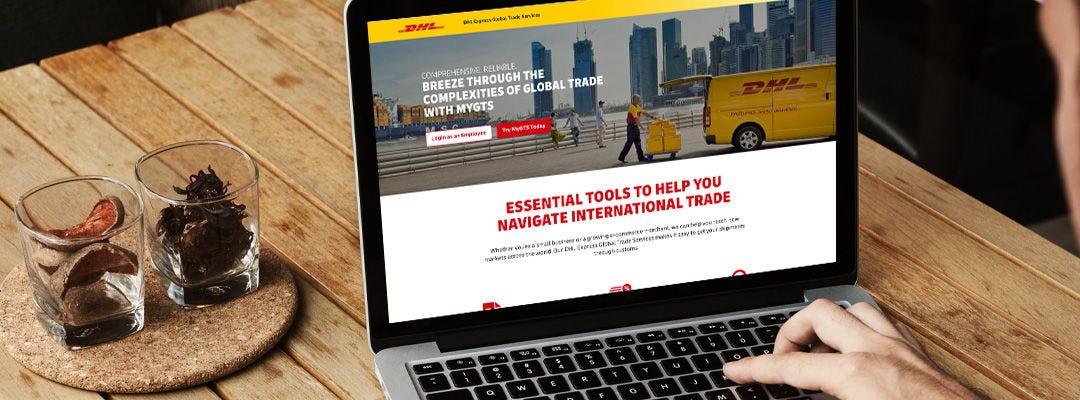
DHL Express developed MyGTS (My Global Trade Services) as a free, easy-to-use platform to guide you through some of the critical documentation you’ll need for cross-border shipping, helping you get your shipments cleared smoothly.
By leveraging this integrated system, your business gains significant strategic advantages:
AI-Powered Tariff Classification: MyGTS leverages AI to assist you with potential classification options for your goods, helping you cross-reference Brazilian NCM codes with international HS directories.
Pre-Shipment Compliance Planning: A dedicated pre-shipment planner helps you research destination import and export restrictions before you assemble your inventory.
Landed Cost Calculator: Estimate comprehensive shipping costs, target duties, and local foreign sales taxes upfront to structure transparent pricing strategies for your global customers.
Bespoke Customs Documentation Templates: Access clear examples of the verified customs forms required for your specific destination market to eliminate compliance errors before dispatching.
By understanding core transport files like the Air Waybill and Commercial Invoice, organizing necessary health or trade permits, and utilizing automated digital trade solutions, your enterprise is better equipped to grow confidently across borders.
Remember that it is essential to keep up to date with the import and export regulatory requirements of the countries where you ship from/to, and consult with customs experts when necessary to ensure compliance with the regulations.
For fast international shipping, open a DHL Express Business Account.
Navigating international shipping can be complex, but with the right documentation and tools, you can ensure a smoother, faster customs process. By understanding the core documents like the Air Waybill and Commercial Invoice, preparing for special cases, and leveraging digital solutions like Paperless Trade and MyGTS, your business is better equipped to grow confidently across borders.
It’s essential that you keep up to date with the import and export regulatory requirements of the countries where you ship from/to, and consult with customs experts or legal advisors when necessary to ensure compliance with the regulations.
Whether you're new to global trade or looking to refine your shipping operations, DHL is here to support you every step of the way.
For fast international shipping, open a DHL Express Business Account


 Share
Share