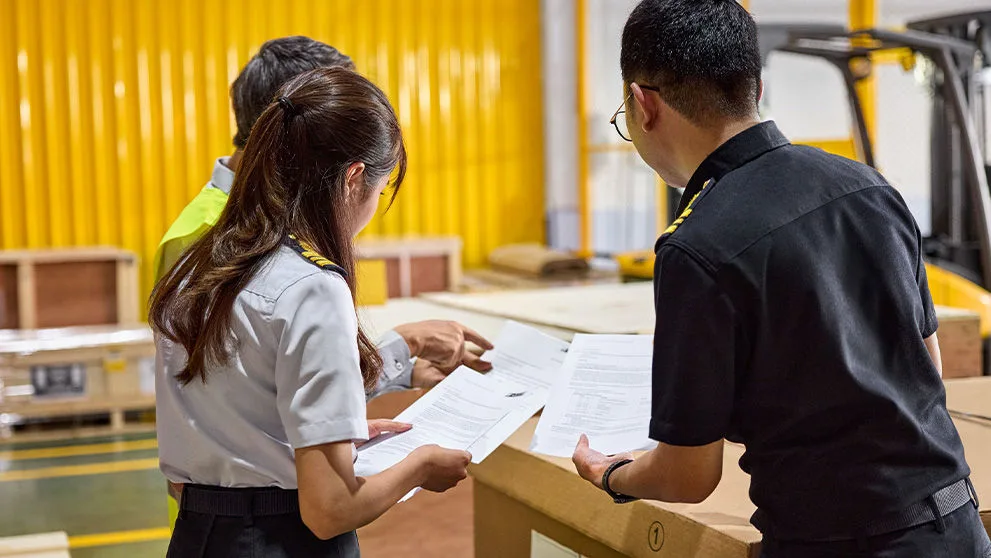



When shipping internationally, understanding the documentation required for both export and import procedures is essential. Incomplete, incorrect, or missing paperwork can lead to customs delays, additional costs, or even the seizure of your goods. To help you avoid any delays or fines, this guide breaks down the key things you need to clear customs smoothly.
The key export and import documentation for international shipping
The two most common documents when shipping internationally are the air waybill and the commercial invoice. Submitting full and accurate data on these documents is important as it helps customs officials quickly verify your shipment, while reducing the risk of delays at the border.
Let’s take a closer look at each one.
Air Waybill
An air waybill includes important details, such as:
- Names and addresses of the shipper and recipient
- Description and value of the goods
- Terms and conditions of the transportation
The Air Waybill (AWB) is an important shipping document that serves several purposes. It acts as an agreement between the shipper and the carrier, confirming that the carrier will transport the goods from the origin to the destination. It also contains key shipment details and helps with tracking and customs clearance throughout the shipping journey.
The waybill is attached to the exterior of the shipment, so that anyone handling it has easy access to the information. Waybills contain tracking ID, meaning the shipment can be monitored in real time.
Commercial Invoice
A commercial invoice is one of the most important documents used in international shipping. It’s created by the seller and includes key information such as:
- Seller and buyer details
- A description of the goods
- The goods' Tariff Classification Code(s)
- Values and currency
- Weight
- Terms of sale (incoterms)
- The goods’ Harmonized System (HS) Code(s)
- A series of additional information
Customs brokers use the Commercial Invoice information to prepare the customs declaration to authorities. It’s essential to provide complete and accurate Commercial Invoice information, to avoid potential customs delays, fines or penalties.
Other documents for export & import
Now that you’re familiar with the most common export and import documents, let’s explore some of the additional documentation that may be required for international shipments.
Additional documents are extra forms that go beyond the usual Commercial Invoice and Air Waybill needed for international transport. The exact paperwork depends on the regulatory requirements of the export and/or import countries, and factors like the type of goods, where they’re being sent, who is involved in the shipment, and the particular services chosen.
Some examples are shown below.
- Certificate of Origin: This document indicates the country where the goods were manufactured or produced. It is often required for preferential tariff treatment under free trade agreements.
- ATA Carnets: These typically enable temporary duty-free and tax-free import of samples, professional equipment, or goods for exhibitions, usually valid for up to one year, as per the country’s regulatory requirements. However it is not accepted in Egypt.
- Certificates (e.g., Sanitary/Phytosanitary): These certificates confirm that the goods meet specific health and safety standards, particularly for food products, animals, and plants, to prevent the spread of pests or diseases.
- Export and/or Import Permits and Licenses: Certain goods require official permission from government agencies before they can be exported and/or imported. They may include medicines or hazardous materials. Specific permits or licenses may vary by country, as well as the potential for additional documentation depending on the nature of the goods.
Paperless shipment with DHL
As we have touched upon, it is essential that you always submit full and accurate data when completing international shipping documentation.
To help the process, DHL's Paperless Trade service lets you prepare, generate, and electronically transmit your customs documents – without the need to print and physically attach paperwork to your shipments. This fully online system streamlines the export process by sending documents directly to customs authorities, speeding up clearance and reducing errors caused by handwritten or misplaced forms.
- Commercial Invoices: Create accurate, customs-compliant invoices directly within the system.
- Proforma Invoices: Prepare preliminary invoices for goods not sold commercially or for samples.
- Certificates of Origin: Easily generate official documents verifying the origin of your goods.
A faster and more sustainable option for your business!
Paperless Trade is integrated into DHL’s online shipping applications: MyDHL+ and MyDHL API. You only need to activate Paperless Trade once; thereafter the option of Paperless Trade will be shown automatically as you prepare your shipments.
MYGTS: Your gateway to easy international shipping
If the information in this article seems overwhelming, don’t fret! We know that navigating the maze of required customs documents can be one of the biggest challenges in international shipping – especially for SMEs.
That’s where DHL Express’ MyGTS (My Global Trade Services) steps in to simplify the process. This free, easy-to-use platform will guide you through some of the critical documentation you’ll need for cross-border shipping, helping you get your shipments cleared smoothly.
Benefits of MyGTS include:
- Examples of documents you may need for customs clearance.
- Support with Tariff Classification Codes: MyGTS leverages AI to assist you with potential classification options for your goods.
- Guidance on a country’s export and import requirements before you ship – to avoid goods potentially being held up at borders.
- A pre-shipment planner to help you plan your international shipments.
Start your partnership with a global leader in international shipping and reach new cross-border markets, seamlessly.
You can log in to MyGTS with your existing DHL Express account, or register for a new MyGTS account. Click below for your options.
International shipping can seem complex, but having the right documentation and processes in place can make customs clearance faster and more efficient. By understanding key documents such as the Air Waybill and Commercial Invoice, preparing for any additional requirements, and taking advantage of digital solutions like MyGTS, you can reduce delays, stay compliant, and confidently expand your business across international markets.
It’s essential that you keep up to date with the import and export regulatory requirements of the countries where you ship from/to, and consult with customs experts or legal advisors when necessary to ensure compliance with the regulations.
Whether you're new to global trade or looking to refine your shipping operations, DHL is here to support you every step of the way.
For fast international shipping, open a DHL Express Business Account


 Share
Share