

When shipping internationally, a properly completed Commercial Invoice helps ensure fast and hassle-free customs clearance. Here, Marcelo Godoy Rigobello, DHL Express’ Global Trade and Customs Compliance Expert, explains why “good” (i.e. complete and accurate) data is so important – and shares tips on getting it right.
Thousands of SMEs and larger enterprises rely on DHL Express each day to ensure their shipments reach customers worldwide swiftly and reliably. But you may be surprised to hear what one of the biggest obstacles to that is. It’s not border closures or labor shortages or even the weather…it’s bad data.
Businesses shipping cross-border with DHL Express are required to provide Commercial Invoice information electronically. But incomplete and inaccurate data – such as the Goods Description – can cause big problems. It means your shipment risks being delayed by Customs Authorities until the issue is resolved – and that of course will have a knock-on effect on your end customers, who may receive their goods late.
In fact, “Good Data Quality” is so important, that we’ve made it a key piece of advice we highlight to any business shipping internationally with DHL Express.
What is a Commercial Invoice?
A Commercial Invoice is a key document that provides detailed information about goods being shipped internationally, including the specifics of the trade transaction, such as:
- Names, addresses and contact details of the shipper/exporter and receiver/importer
- Identification Number, if applicable
- Goods Description
- Harmonized System (HS) Code, preferably the complete Tariff Classification Code
- Country of Origin
- Values & Currency
- Weight & Quantity
- Incoterms
- Reason for Export
The Commercial Invoice information is used by the customs broker to prepare the Customs Declaration for authorities, who can then determine if the goods can move in and out of the country (i.e., are they safe, legal and compliant?) The information also enables the customs authorities to calculate the taxes and duties due.
So, what does good data quality mean in practice?
Accurate and complete electronic data on the Commercial Invoice plays a critical role in efficient customs processing. Here are three key areas that require special attention:
1. The Goods Description is very important
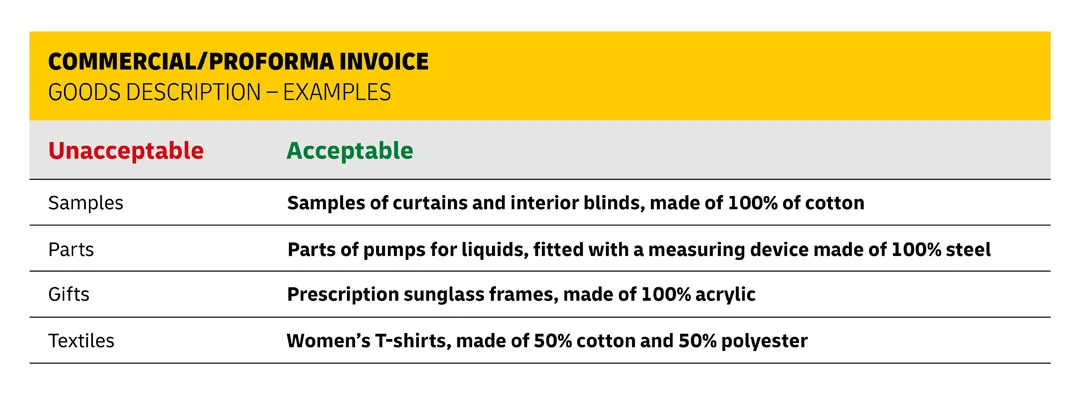
One of the primary purposes of the Goods Description is to enable customs authorities to identify restricted or prohibited items and conduct accurate risk assessments for safety and security purposes. However, many shippers do not provide enough detail at this step. Putting “samples” or “parts”, for example, is not an adequate Goods Description. In such scenarios, DHL may stop the shipment, and call the receiver/importer of the goods in order to request further clarification – which may delay the end-to-end shipment and your end customer’s experience.
A clear, accurate and detailed description for each of the items being shipped is needed for fast customs clearance, as the example below shows. In addition to Goods Descriptions, shippers should also provide the corresponding Tariff Classification Code. DHL’s MyGTS (My Global Trade Services) tool can help shippers identify potential options for the Export and Import Tariff Codes of their goods.
2. Be honest and accurate about the goods value, or risk delays at customs
On the Commercial Invoice, you will be asked to declare the true value for each of the goods being shipped – this is usually the price actually paid by the buyer to the seller of the goods (along with the currency), in alignment with the WTO Customs Valuation rules. Customs authorities use this value to calculate what duties and taxes are due.
Some shippers are tempted to undervalue the goods, which is illegal and can lead to serious consequences. For example, authorities may hold the shipment and ask you for evidence of the goods value you’ve declared, and request payment of the additional Duties and Taxes owed (and potential fines and penalties). They may even contact the receiver – that is, your end customer – for the information, which will damage their experience with your business.
Furthermore, authorities in certain countries may escalate the undervaluation situation to an instance of ‘tax evasion’, which is a serious offense, where fines, penalties, and legal implications may follow. For this reason, it is important to always be fully transparent about the goods value provided in the Commercial Invoice, as well as the additional cost elements – if applicable – which are part of the customs value, e.g., insurance, freight, and other costs.
3. Be compliant with the regulations
Customs regulations differ from one country to another, creating challenges for businesses shipping goods across multiple international markets. Before shipping internationally, it is essential that the shipper conduct its own research to be familiar with the key export requirements of the origin country, import requirements of the destination country, and/or request regulatory advisory from its own tax/legal advisors.
One of the tools that shippers can use is DHL’s MyGTS (My Global Trade Services). This free, user-friendly platform is designed to help SMEs navigate international shipping regulations – including examples of a country’s import and export requirements that may be applicable.
Providing complete and accurate information on the Commercial Invoice is an essential element to ensure a smooth customs clearance, and a positive experience for your end customer(s).
"Regulatory Authorities across the globe are moving towards a fully data-driven environment to enable efficient and risk-based clearance processes. Complete & accurate Commercial/Proforma Invoice line item data is the key enabler for fast & compliant clearance processes, avoiding delays, fines & penalties." - John Pearson, CEO DHL Express
A step-by-step guide to complete a Commercial Invoice
A complete and accurate Commercial Invoice is essential for a fast customs clearance. DHL Express Global Customs Customer Guidelines will advise you on every step of the form to ensure the data you submit is clear, accurate and complete.
By following these guidelines, you may avoid potential issues due to wrong/missing data, e.g.:
- Customs clearance delays and shipments held in bond storage
- Unnecessary customer service contact to request missing information
- Shipments stopped, returned, potentially confiscated, or even issued penalties by authorities
DHL Express makes every effort to ensure that information from external sources is accurate at the time of publishing. However, details from outside agencies can change without notice. Please read our disclaimer here.


 Share
Share

Similar Stories