Globalization has reached a new record despite higher tariffs, geopolitical conflicts and continued uncertainty. This is one of the key findings of the latest edition of the DHL Globalization Tracker, commissioned by DHL and authored by researchers from New York University’s Stern School of Business.
Based on more than 30 million data points, the Tracker analyzes international flows of trade, capital, information and people, providing an extensive, a data-driven view of globalization and global trade trends.
AI boom drives global trade growth despite tariffs and geopolitical conflicts
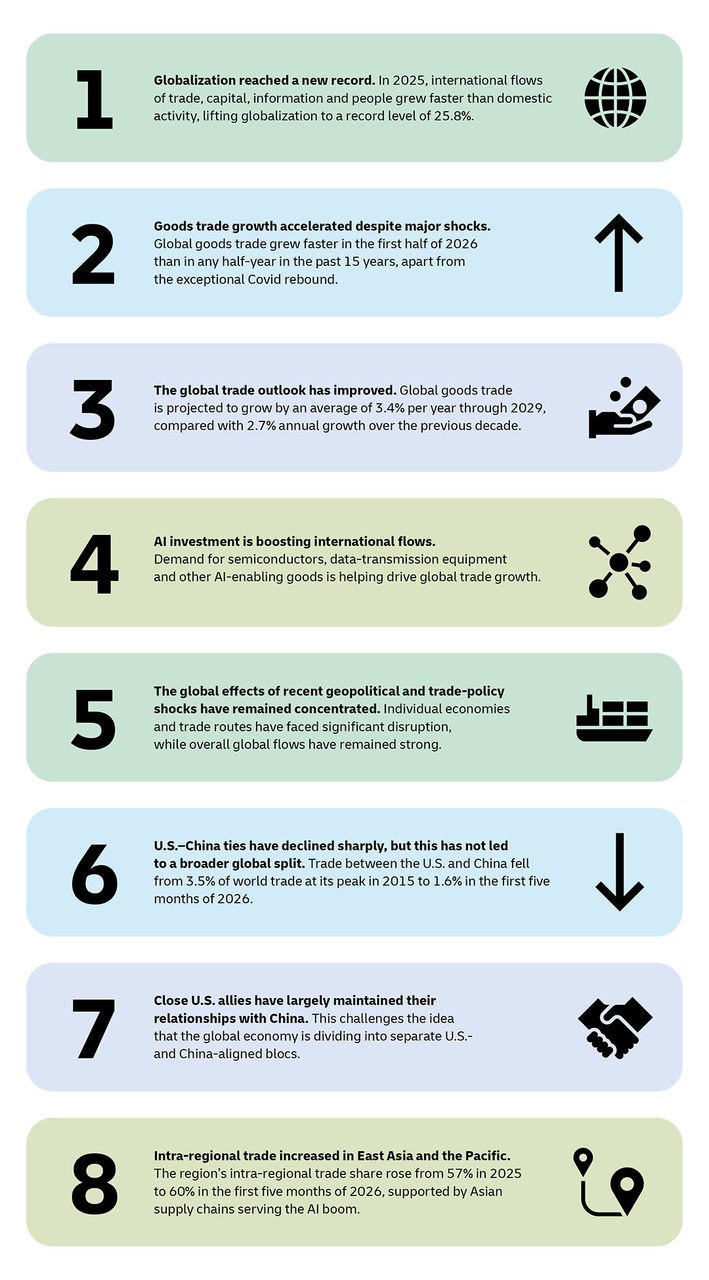
The global race to build infrastructure for artificial intelligence is giving world trade strong momentum at a time of higher tariffs and geopolitical conflicts. Global goods trade grew faster in the first half of 2026 than in any half-year in the past 15 years, apart from the exceptional Covid rebound. A major driver was strong demand for goods used to build AI infrastructure, such as semiconductors and data-transmission equipment. Trade in AI-enabling goods drove 42% of goods trade growth in 2025, rising to 76% during the first quarter of 2026.
At the same time, the Iran war and the closure of the Strait of Hormuz disrupted important trade routes, although their overall effects on global trade remained concentrated. U.S. tariffs on global trade also reached their highest levels in decades, but their global impact was limited. The U.S. accounted for only 13% of world imports in recent years, and roughly half of U.S. imports were exempt from the tariff increases as of August 2026. Most countries also refrained from broad retaliation, with many instead seeking access to alternative markets through new trade agreements.
The global trade outlook has improved. Global goods trade is projected to grow by an average of 3.4% per year through 2029, compared with 2.7% annual growth over the previous decade. East Asia and the Pacific recorded the strongest trade growth, with the value of its trade rising 24% in the first five months of 2026 compared with the same period in 2025. Europe followed with 12% growth and Sub-Saharan Africa with 11%.
Beyond trade, the DHL Globalization Tracker measures the broader development of globalization through international flows of trade, capital, information and people. In 2025, globalization reached a record level of 25.8%, with all four categories reaching higher levels of internationalization. And while U.S.–China ties have weakened significantly, close U.S. allies have largely maintained their relationships with China – challenging the idea that the global economy is splitting into separate rival blocs.
8 key takeaways from the DHL Globalization Tracker
The DHL Globalization Tracker can help businesses better understand global trade developments and explore trends by region and country. DHL Express can support businesses looking to turn international opportunities into growth.
Open a DHL Express Business Account for fast international shipping to more than 220 countries and territories, with support from our global experts.


 Share
Share

Similar Stories