The global healthcare landscape is seeing a shift towards more patient and consumer-centric approaches, a transformation particularly relevant in Japan's rapidly aging society.
This evolution in patient care, moving beyond traditional hospital settings, highlights the critical need for advancements in medical supply chain capabilities. This has led to the welcome introduction of "direct to X" supply chain models as a key enabler for personalized medicine and effective home-based care across Japan.
This article aims to explore these evolving healthcare supply chain models in detail, delving into their unique requirements and the specific challenges and opportunities they present within the Japanese market. Understanding these dynamics is crucial for businesses aiming to secure a robust healthcare logistics framework, to truly support the future of patient care and treatment delivery in Japan.
Understanding “Direct to X”: The evolving Japanese healthcare supply chain
"Direct to X" supply chains represent a transformative approach to healthcare logistics, encompassing models that range from direct-from-manufacturer delivery to hospitals and pharmacies, all the way to direct-to-patient services originating from various points.
This surge is driven by the nation's aging population — accounting for a record-high of 29.3% of Japan’s population as of September 2024¹ — a significant push for home-based care, and robust digital health initiatives from the Ministry of Health, Labour and Welfare (MHLW). These combined factors are fundamentally reshaping how medical logistics are managed in Japan, moving towards more personalized and efficient medicine delivery.
Bypassing traditional distribution channels
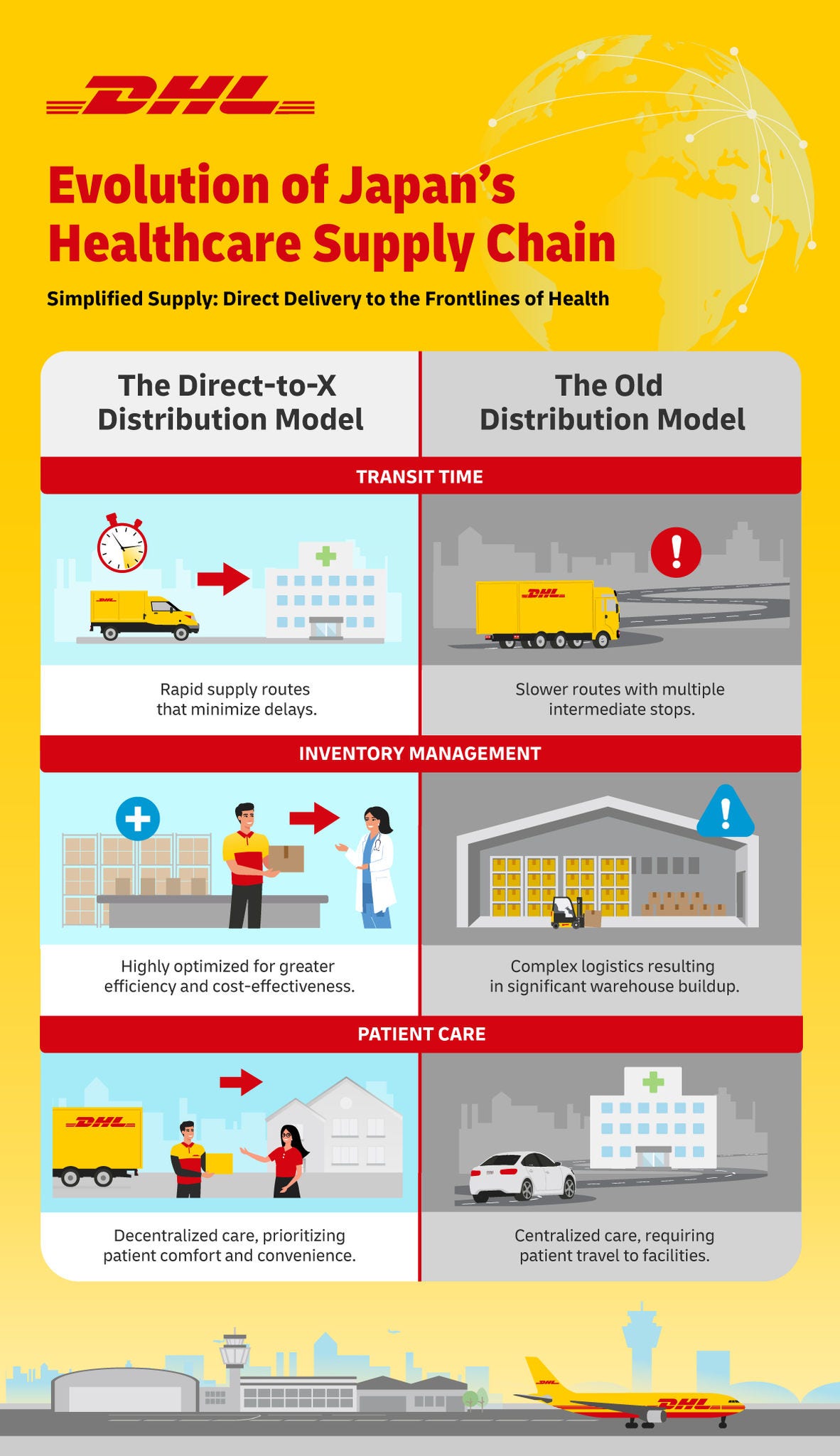
Direct models like these fundamentally transform the healthcare supply chain by offering more rapid supply routes to hospitals and pharmacies. This streamlined approach minimizes transit times and allows for significant inventory optimization. This can be especially beneficial for the efficiency and cost-effectiveness of business operations.
Direct-to-patient delivery
The landscape of medicine delivery is undergoing a significant transformation, with a notable expansion of treatments and products delivered directly to patients' homes.
This shift aligns perfectly with an increasing focus on decentralized care, prioritising patient convenience and access within the healthcare supply chain. Such direct-to-patient logistics models are also vital for ensuring timely and personalized care, enhancing patient comfort and treatment adherence.
Core requirements for successful “Direct to X” models in Japan
To truly succeed with “Direct to X” medical logistics in Japan, businesses must focus on these key operational pillars:
High levels of service and adaptability for Japanese healthcare providers
- Flexible delivery options: Ensuring treatments reach their destination on time — whether it’s a major hospital, local clinic, or an individual patient's home — demands flexible delivery options, allowing for streamlined and effective patient care pathways within the healthcare supply chain.
- Bespoke "White Glove" services: This refers to a premium, highly specialized service for the most sensitive or personal deliveries, typically involving dedicated couriers and enhanced security. This ensures irreplaceable items, such as patient-specific treatments, receive meticulous, personalized handling beyond standard delivery protocols.
Real-time visibility and status updates across Japan
In Japan's demanding healthcare landscape, immediate insights into shipment status and expected arrival times are critically important. Real-time visibility empowers providers to meticulously plan for patient treatments and manage their inventories with precision, upholding high standards of service and operational excellence. This level of transparency is vital for effective supply chain management in healthcare and for optimizing medical logistics nationwide.
Navigating Japanese complexities: Compliance data security and inventory
Successfully operating "Direct to X" healthcare supply chain models in Japan requires meticulous attention to the nation's strict regulatory and unique cultural environment. Some key areas demanding precise management include:
Regulatory compliance and product integrity in Japan
Navigating Japan's stringent regulatory landscape is crucial for "Direct to X" healthcare supply chain models. This demands careful management to ensure adherence to Japanese regulations, including MHLW guidelines and robust GDP compliance. Additionally, preventing the theft or contamination of high-value pharmaceuticals and medical devices is paramount, often requiring specialized oversights like pharmacist sign-offs where mandated.
Data privacy and security sensitivity for Japanese patients
The handling of patient data in "Direct to X" healthcare supply chain models requires extreme sensitivity and robust security measures. Order information, which often contains individual contact details and specific details about medication, is highly confidential. This calls for stringent data protection measures that are fully compliant with Japanese privacy laws, ensuring complete patient confidentiality and trust in the medical logistics process.
Inventory management and omnichannel distribution for Japanese makers
For Japanese pharma companies and medical device makers, managing inventory effectively across evolving supply chain models presents a significant challenge. They often need to balance traditional bulk orders with new direct-to-patient models, requiring "omnichannel" facilities. These advanced distribution hubs must seamlessly handle bulk orders, consolidated physician/pharmacy requisitions, and individual patient-specific items, ensuring efficiency across the entire healthcare supply chain.

The logistics backbone enabling “Direct to X” supply chains in Japan
For "Direct to X" models to truly flourish in Japan, agile and specialized medical logistics providers are indispensable. They offer essential capabilities such as:
Specialized handling and delivery capabilities across Japan
- Precise handling and temperature control: The need for precise handling is paramount, especially for products requiring diverse temperature control options. Solutions span from chilled (2-8°C) and frozen (-20°C) to ultra-deep frozen (-196°C) conditions, maintaining product integrity throughout the healthcare supply chain.
- Shipping large or heavy equipment: Specialized services are crucial for shipping large or heavy items, such as complex medical machinery, across Japan. This ensures the secure and efficient transport of high-value capital equipment to hospitals and clinics, seamlessly integrating into their operations.
- High security and time-critical delivery: Secure transport and time-critical delivery are essential for high-value and sensitive medical logistics products. Robust security measures and expedited services ensure these vital treatments reach their destinations promptly and safely across Japan.
DHL Express' network and last-mile expertise
- Strategically located logistics centers: DHL Express' established infrastructure includes strategically located logistics centers across Japan. These hubs are crucial for optimizing delivery routes and ensuring efficient distribution of medical logistics products.
- Extensive delivery capabilities: With strong global and local delivery capabilities, DHL Express ensures secure and timely last-mile delivery, whether to major hospitals in Tokyo or individual patients' homes in more remote areas. This extensive reach is vital for a healthy and comprehensive healthcare supply chain.
Ensuring regulatory adherence with logistics partners
- Familiarity with local regulations: Partnering with a medical logistics company like DHL Express, who is deeply familiar with the local healthcare regulations and GDP standards in Japan, is essential. This expertise helps maintain compliance throughout the healthcare supply chain, avoiding costly delays.
- Compliance support: DHL Express actively supports businesses in navigating complex regulatory landscapes. This proactive approach ensures adherence to evolving guidelines, bolstering the healthcare supply chain management and securing efficient cross-border movement.
The future of healthcare logistics in Japan
Ultimately, "Direct to X" models hold transformative potential for patient-centric care in Japan, fundamentally reshaping the healthcare supply chain and the future of medical logistics. These evolving approaches promise to bring personalized medicine and home-based care to the forefront, enhancing patient access and overall well-being across the nation.
To successfully implement these complex models, strong partnerships between Japanese pharma companies, healthcare providers, and expert logistics partners are essential. This is where DHL’s logistics solutions come in, providing robust support for enhanced patient access and personalized care. To get started with their medical delivery or international shipping services, create a DHL Express business account today, or visit the DHL website to find out more.


 Share
Share
Similar Stories