
No. The regulation can cover both B2B and B2C transactions, provided they involve commodities or derived products in scope that are placed on the EU market or exported from it.


 Share
Share
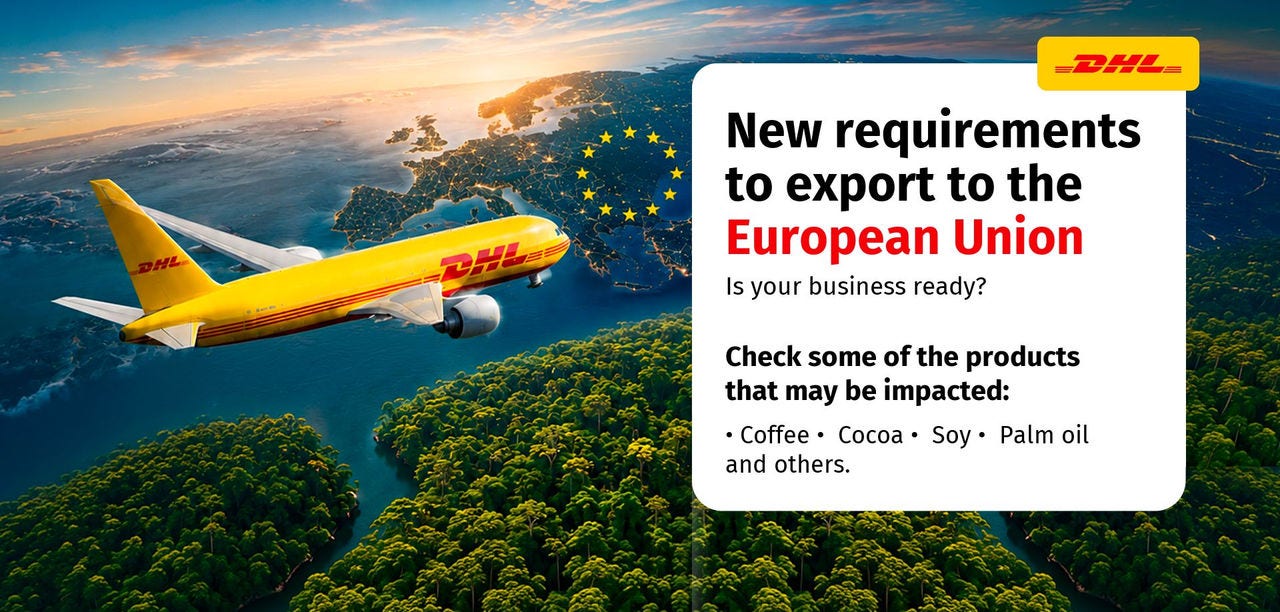
The EUDR is the European Union regulation that requires proof that seven commodities and their derived products do not come from land deforested after 31 December 2020. It applies from 30 December 2026 to medium and large operators, and from 30 June 2027 to micro and small ones.
Does your company ship coffee, cocoa, soy, timber, rubber, palm oil or cattle products to Europe? Then this is not a distant, theoretical change. It starts in the goods description field of your invoice, the one almost everyone fills in on autopilot.
The market at stake is substantial. According to the trade balance published by Brazil’s Ministry of Agriculture and Livestock in January 2026, the European Union was the second largest buyer of Brazilian agribusiness in 2025, at US$ 25.2 billion and 14.9% of everything the sector exported.
This guide covers what the EUDR is, which deadline applies to whom, which products moved in and out of scope in 2026, why the HS code alone does not settle the question, and which data must be transmitted electronically so your shipment is not held at the EU border.
The EUDR (European Union Deforestation Regulation) is Regulation (EU) 2023/1115 on deforestation-free products. It entered into force on 29 June 2023 and prohibits placing on the EU market, or exporting from it, products linked to deforestation or forest degradation that occurred after 31 December 2020.
The European Commission’s stated goal is to reduce the bloc’s contribution to deforestation and forest degradation, with knock-on effects on greenhouse gas emissions and biodiversity loss.
The regulation targets seven commodities associated with agricultural expansion:
Products derived from these commodities, such as chocolate and furniture, may also fall under the regulation depending on tariff classification and composition. The closed list sits in Annex I to Regulation (EU) 2023/1115, which sets out the commodities, the derived products and their classification codes.
For products in scope, the regulation sets three conditions: they must be deforestation-free, produced in accordance with the legislation of the country of production and, where applicable, covered by a Due Diligence Statement (DDS) or the applicable declaration identifier registered in the EUDR Information System.
The duty to submit the DDS lies with the operator or trader placing the product on the EU market, normally your importer in Europe. That does not take you out of the picture. Your supply chain generates the origin data, the classification and the description that underpin their statement, and it is your shipment that stops if the data does not travel with it.
Application was postponed and simplified by Regulation (EU) 2025/2650, signed off by the Council on 18 December 2025 and published in the Official Journal on 23 December 2025. These are the deadlines in force today:
Operator or trader profile | Application date |
Medium and large operators and traders | 30 December 2026 |
Micro and small operators | 30 June 2027 |
Micro and small already covered by the EU Timber Regulation (EUTR) | 30 December 2026 |
On 4 May 2026 the European Commission published its EUDR simplification review and signalled that the regulation will not be reopened: the dates above stand. In practice, anyone shipping to Europe has until the end of December 2026 to get process, data and systems working together with the customer on the other side.
Mark the calendar with room to spare. When the deadline lands on peak season, whoever leaves the adjustment to November finds the problem at the worst possible point in their shipping cycle.
In scope are the seven commodities and the derived products listed in Annex I, identified by classification code. That is why the answer is never that an entire sector is exempt: it depends on the specific product, its code and its composition.
Scope did change in 2026. On 13 July 2026 the European Commission adopted a delegated act amending Annex I, together with an implementing act setting the technical rules for the Information System.
Movement | Products |
Removed from Annex I | cattle hides, skins and leather; retreaded tyres; soybeans for sowing; articles of vulcanised rubber; conveyor and transmission belts; aircraft and motor vehicle seats |
Added to Annex I | soluble coffee; certain palm oil derivatives; frozen cattle tongues |
Two caveats matter more than the list itself.
First: the delegated act was adopted on 13 July 2026 and went to the European Parliament and the Council for scrutiny before entering into force, with an initial deadline in September 2026 that can be extended. Until that closes, the previous Annex I is the one in force. If your product sits in the removed column, the relief is not official yet.
Second: according to the European Commission, the newly added products only become subject to the regulation from 30 December 2027. Soluble coffee exporters gained a year over green coffee exporters, and that gap changes the internal compliance timeline.
Because the EUDR combines two things: the HS code listed in Annex I and the commodity the product is made of or derived from. Two products under the same code can be treated differently, and the variable that separates them is the composition described on the invoice.
The example used in the guidance is HS 9401, which covers seats. Seats with a wooden frame may be in scope, while certain seats made of plastic or bamboo may fall outside. Same code, different regulatory outcomes.
That is where the concrete risk sits for exporters. A description that names a commodity potentially subject to the EUDR, but gives too little information to determine composition, can lead to the shipment being treated as in scope from the outset. Then come the requests for additional information, and every such request costs clearance time.
Still unsure how to reach the right code for your product? It is worth revisiting the complete guide to HS codes before you rewrite any descriptions.
Provide the correct HS code and a clear, specific description for every invoice line item. A generic description is the cheapest error to fix and the most expensive one to keep, because it hands customs the job of guessing what the product is made of.
Compare the two sides:
Generic description | Description that works |
Rubber | Natural rubber sheets, Brazilian origin, for industrial use |
Coffee | Green arabica coffee beans, not roasted, 2026 crop |
Wooden furniture | Chair with eucalyptus wood frame and fabric seat |
Chocolate products | Milk chocolate bar, 45% cocoa |
The same principle applies to products linked to soy, palm oil, cattle and timber. The question your description has to answer is simple: reading this, can anyone tell which commodity the product is made of?
Since description and classification live in the same document, use the review to check consistency between the code, the declared value and the Incoterm. The commercial invoice guide walks through it field by field, and it pairs well with what Incoterms are to align customs responsibilities with your European buyer.
When goods are subject to the EUDR, the applicable data element must be provided electronically to DHL Express. Depending on the situation, it can be one of these:
Data element | When it applies |
DDS Reference Number | shipment covered by a registered Due Diligence Statement |
Conventional DDS Reference Number | when the conventional statement is the applicable one |
Simplified Declaration Identifier (SDI) | when the simplified declaration is the applicable one |
EUDR TARIC Document Code | the TARIC code corresponding to the EUDR |
This information must be transmitted at invoice line-item level through the DHL Express electronic shipping solutions. It is not a single field in the shipment header: it is item by item.
The reason is operational. That data is what allows DHL to include the required information in the customs declaration presented to the EU authorities. Without it in the right place, the declaration cannot be completed.
One of the simplifications introduced by Regulation (EU) 2025/2650 helps here: the statement can now be submitted once rather than for every shipment, as long as the data remains valid. For anyone shipping the same product repeatedly, that changes the routine considerably.
When the applicable EUDR data element is not transmitted correctly at item level, the shipment may be stopped by customs authorities at the point of entry into the European Union. Missing information can also prevent the customs declaration from being completed and cause delays.
That is why DHL Express advises shippers to provide EUDR data in advance, rather than after a request for additional information arrives. A document missing at clearance rarely costs only the time it takes to produce it: it also costs your place in the queue.
It is worth understanding in advance how total shipment cost behaves when a customs issue leads to a return or a reshipment. The landed cost guide shows what goes into that calculation.
In MyDHL+, the data is entered alongside the invoice line item details. Dedicated fields are provided for it:
If you use an electronic integration such as EDI, make sure the data is transmitted in the corresponding fields of your own integration. Run a test with a real shipment before the deadline, not after: a field mapped incorrectly in EDI only shows up once the shipment is already moving.
On the European side, the statement is created in the EUDR Information System within the TRACES platform. That is where the operator enters product type, HS code, description, quantity and origin, the latter through coordinates or by drawing the plots on a map. The system reopened at the end of June 2026, with European Commission training resuming shortly after.
Before shipping products potentially subject to the regulation, run this sequence:
Arriving in December with those six points settled reduces the volume of information requests during clearance and the risk of delay at the EU border.
Why starting now matters: coffee is the most exposed line in Brazil’s export mix. According to the Brazilian Coffee Exporters Council (Cecafé), the European Union accounted for 47.1% of Brazilian coffee shipments between January and April 2026, against 42.4% in the same period of 2025. The greater the dependence on the bloc, the less room there is to learn the rule the hard way.
No. The regulation can cover both B2B and B2C transactions, provided they involve commodities or derived products in scope that are placed on the EU market or exported from it.
According to the guidance material, products sent for private use or consumption in a non-commercial transaction fall outside the scope. An example is a shipment from an individual outside the EU to another individual inside the bloc, provided it is not part of a commercial transaction.
According to DHL Express guidance, samples and products used for examination, analysis or testing are not in scope of the EUDR.
No. DHL Express does not determine operator or trader category, nor assess your company’s specific role in the supply chain. Assessing the obligations and complying with the legislation is the responsibility of the operator or trader, and anyone unsure about their specific situation should seek specialist advice.
The delegated act adopted on 13 July 2026 is still under scrutiny by the European Parliament and the Council before it enters into force. Until that process concludes, the previous Annex I applies, so the practical recommendation is to keep treating the product as before and follow the official publication.
The data must accompany every shipment subject to the regulation, at invoice line-item level. What Regulation (EU) 2025/2650 simplified is the statement itself, which can be submitted once while the data remains valid.
Reviewing classification, goods descriptions and data flows takes weeks once suppliers, systems and a customer across the Atlantic are involved. Starting now is what separates a planned adjustment from a scramble against the deadline.
If your company exports products potentially covered by the EUDR, open a DHL Express Business Account and count on support with customs clearance and on electronic shipping solutions that transmit the required data from the moment the shipment is created.
Important: this article is for information purposes and does not replace legal or regulatory advice. Check your company’s specific obligations under the EUDR and with the official European Union sources.
Share