Running a small business in Canada today means finding new ways to grow, connect, and deliver for your customers in a shifting landscape.
That’s why, through our Unboxing Borders initiative, we’re dedicated to helping businesses like yours overcome barriers, seize new opportunities, and keep growing in uncertain times. In this guide, we’ve compiled resources and expert insights to help you adapt, stay competitive, and keep your business moving forward. There’s room to grow today: only around 21% of what the world produces is sold outside its home country*.
As of August 29, 2025, the U.S. removed its US$800 de minimis threshold. Small shipments may now face duties, taxes, and added customs clearance steps.
Unpacking the Changes: Expert Insights from Our Webinar
Trade rules can change fast. So can currency, supply chain reliability, and landed costs. Our experts are constantly updating resources, including our recent article, Your Business, Imports, Tariffs, and the end of the U.S. De Minimis Exemption, to support you at every stage.
This information is for informational purposes only and does not constitute legal advice.
Your Action Plan: Best Practices for Smooth Customs Clearance
Staying resilient in today’s cross-border environment starts with a clear, simple plan. To avoid added costs, delays, or penalties, keep your commercial invoices and compliance processes airtight. Here’s an action plan so you can protect momentum and customer trust.
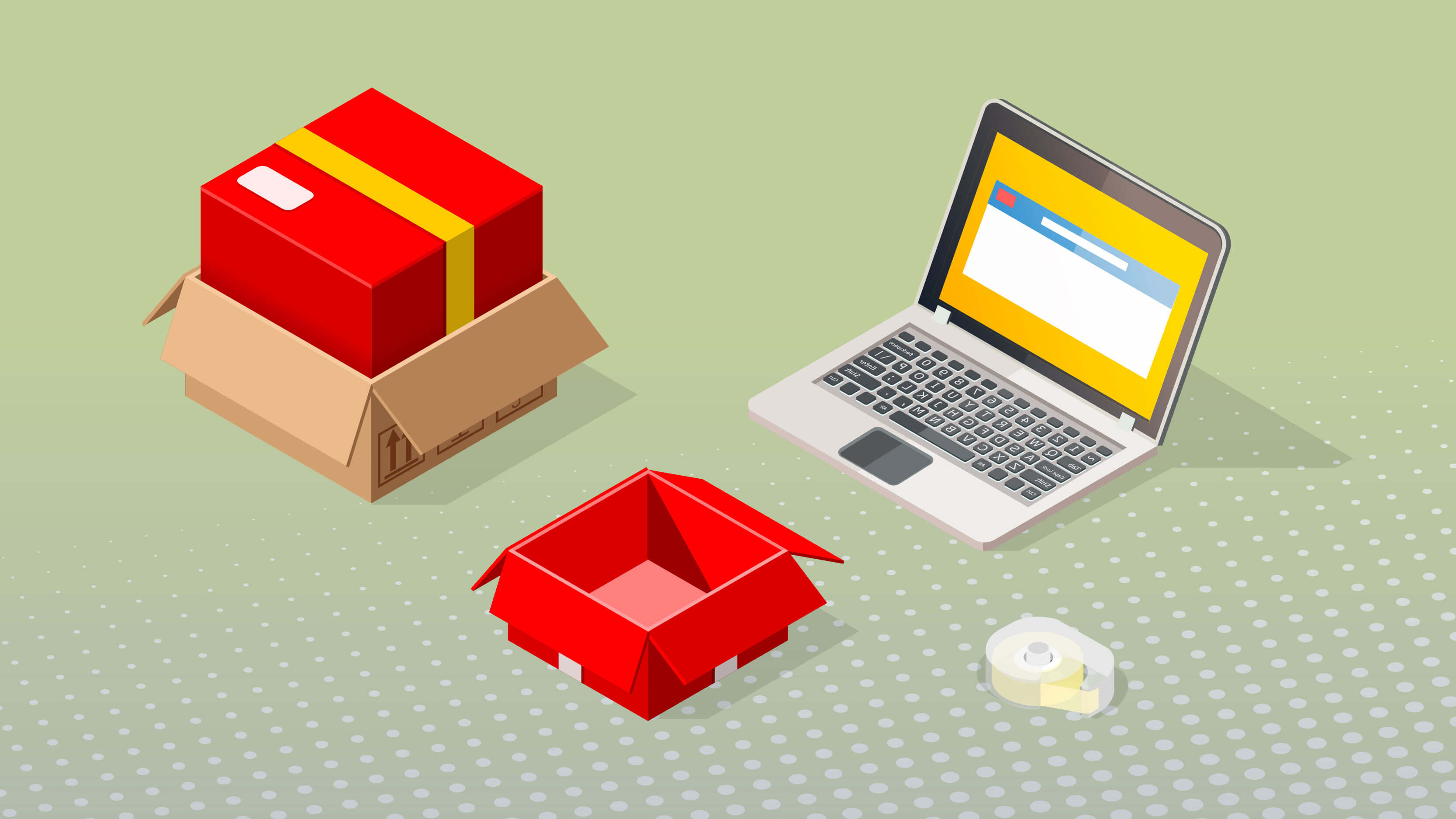
1. Ensure Your Documentation is Flawless
Complete and accurate information is essential. Pay close attention to these details on your Commercial Invoice:
● Goods Description: Describe the product clearly and accurately. Include what it is, what it is made of, and its intended use.
● Tariff Classification: Use the correct 10-digit HS/HTS code for the destination country. Base the code on your product’s specifications.
● Country of Origin (COO): Indicate where the goods were manufactured or substantially transformed, not where they are shipped from.
● Customs Value: State the price paid or payable for the goods as sold for export to the destination.
● Tax ID Number of Consignee/Importer: For formal entries, include the appropriate tax identifier as required by the destination market.
● Manufacturer ID (MID): This alphanumeric code identifies the manufacturer. If it’s unavailable, provide the full shipper name and address. This is especially important for textiles.
Pro tip: DHL’s MyGTS (My Global Trade Services) can guide you through the data needed to stay compliant and keep your shipments moving. The platform has been updated to reflect the new rules and provides accurate landed cost estimates to help you plan with confidence.
2. Implement Smart Shipping Strategies
Beyond paperwork, you can use practical solutions to streamline operations and enhance the customer experience.
● Recalculate Your Landed Cost: Factor in duties, taxes, and fees to understand your true costs. Adjust pricing to protect margins.
● Adopt DDP (Delivered Duty Paid): Make DDP your default shipping option. By including duties and taxes in the checkout price, you avoid surprise charges and help prevent cart abandonment.
● Communicate Transparently: Set clear delivery expectations and show any import costs upfront. Transparency builds trust and manages expectations.
● Leverage DHL Shipping Solutions:
○ Break Bulk Express (BBX): Consolidate multiple parcels into a single shipment to cut down on clearance costs.
○ DHL Fulfillment Network (DFN): Place inventory closer to customers in key markets to speed delivery and reduce per‑parcel clearance for domestic orders.

3. Thinking Beyond. Global Growth Opportunities.
When things change, opportunities surface. Take a look at international markets to explore high-potential regions that could offer simpler import rules and cost-effective shipping:
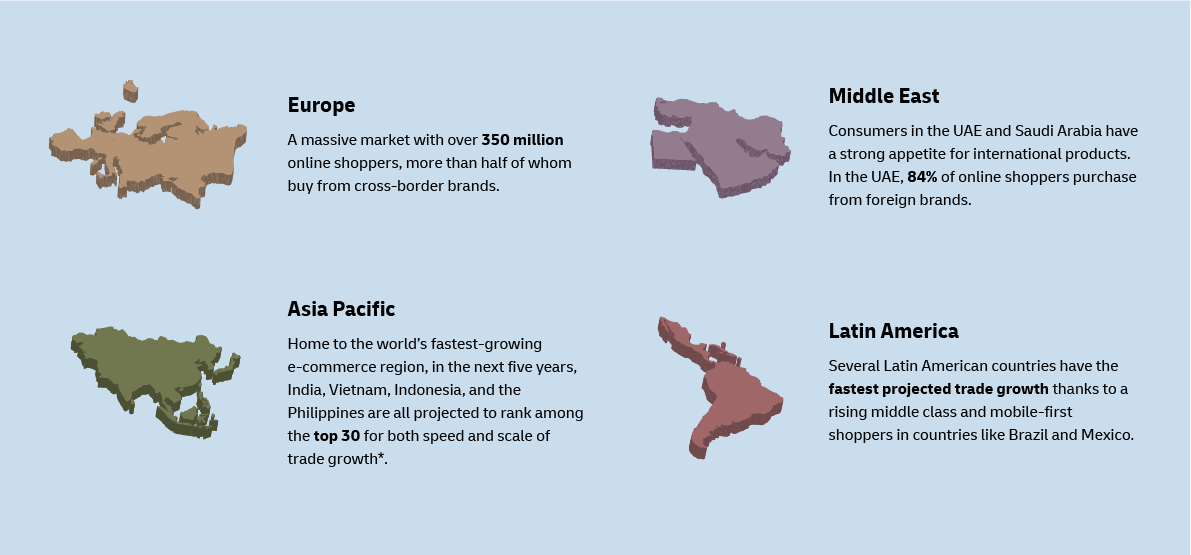
● Europe: A massive market with over 350 million online shoppers, more than half of whom buy from cross-border brands.
● Asia Pacific: Home to the world’s fastest-growing e-commerce region. In the next five years, India, Vietnam, Indonesia, and the Philippines are all projected to rank among the top 30 for both speed and scale of trade growth*.
● Middle East: Consumers in the UAE and Saudi Arabia have a strong appetite for international products. In the UAE, 84% of online shoppers purchase from foreign brands.
● Latin America: Several Latin American countries have the fastest projected trade growth thanks to a rising middle class and mobile-first shoppers in countries like Brazil and Mexico.
With decades of experience in more than 220 countries and territories, DHL can support you. We can give you traffic insights to identify where demand for your products is highest and pinpoint your most promising new markets through our partnership with SimilarWeb
We’re in This With You
Your business matters—not just to your customers, but to us. We’re more than a logistics company; we’re a partner who cares about the heart of what you do. That’s why we’re always finding new ways to offer guidance, tools, and encouragement as you move through the unexpected.
No matter how global the challenge, the support can still be personal. With each shipment, each solution, and each conversation, we’re here to help you unbox both the barriers and the world of opportunities ahead.
*Trade Atlas: https://www.dhl.com/discover/en-ca/news-and-insights/reports-and-press-releases/dhl-trade-atlas


 Share
Share
Similar Stories