At first glance, a commercial invoice may look like a simple bill. But don’t be fooled. It’s not meant for your customer. It’s meant for a customs officer: someone you’ll never meet, in a country you might never visit, who has only a few seconds to decide if your shipment moves or gets held up. You won’t get a chance to explain. The form does all the talking.
Each field on the invoice is a direct question. Most shippers answer what they think is being asked, not what’s actually being asked. That’s how shipments are delayed, unexpected bills land on your desk, or customers start calling to ask what’s happening.
So, let’s break down what these fields truly want to know.
“What is it?” is Not Just a Category
If you write “samples,” you haven’t described your goods. “Parts,” “clothing,” or “electronics” are just as vague. When DHL Express sees shipments stopped at customs, it’s often because the goods description is unclear. The customs officer isn’t trying to complicate things. They’re trying to identify your shipment and clear it against restricted lists. If you’re vague, they can’t do their job, so your shipment stops.
Instead, describe each item in detail: what it is, what it’s made of, and what it’s for. If you have a brand, model, or serial number, add that too. Don’t say “leather goods”. Say “men’s shoes made from bovine leather.” Not “clothing,” but “women’s cotton t-shirts for retail sale.” Clear, precise, and accurate. And make sure each line item on your invoice matches what’s on your waybill.

HS Code: Your Claim, Not a Guarantee
This is where many businesses slip up. The Harmonized System (HS) code is an international standard, with the first six digits set by the World Customs Organization.
Some countries, Kenya included, add extra digits for more detail. This code determines your duty rate; the amount you’ll pay.
But here’s the catch: the code you write is just a proposal. The customs authority can accept it or change it. If they decide your code is wrong, you could end up paying more duty, and the bill comes to you, not your carrier. DHL’s global customs guidelines make it clear: the Importer or Exporter of Record is responsible for duties and taxes, even if the HS code is changed.
So, don’t guess. Use Kenya Revenue Authority’s website or DHL’s MyGTS tool to look up the right code and estimate your costs before you ship.
Value Must Survive Being Checked
Declare the real transaction value; the actual price paid or payable, in the right currency, for each line item. Kenya follows WTO rules, so KRA assesses customs value based on the true amount paid.
Two common mistakes: First, treating declared value as a way to save on duty. Understating is illegal, and if you’re caught, customs can hold your shipment, demand proof, and slap on fines. Sometimes they’ll contact your customer directly. In some cases, this even escalates to tax evasion.
Second, honest mistakes happen when the invoice value doesn’t match the payment proof. Maybe you converted currencies differently, or included costs on one document but not the other. If the numbers don’t match, authorities may suspect undervaluation and charge extra duty or penalties. Break down all costs (protection, freight, packaging) and keep your documents consistent.
Remember: Value is never zero. Even free samples and warranty replacements have a customs value.

Country of Origin: Where Was It Made?
The country of origin is where your goods were manufactured, not shipped from. A container from Jebel Ali with Vietnamese products? The origin is Vietnam.
This field matters for more than just compliance. It can save you money. If your goods qualify for reduced duty under a trade agreement, the proof of origin statement can unlock those savings. If you leave it out, you pay the full rate.
For shipments to Kenya, new rules apply: From 1 July 2025, every consignment must have a Certificate of Origin from the exporting country’s competent authority, as per section 44A of the Tax Procedures Act. Full enforcement starts on 1 October 2025. KRA does allow for alternative documents in special cases, and lighter courier packages have separate rules.
Incoterms: Who Pays for What?
Your trade terms aren’t just small print at the bottom of the page. Incoterms determine who pays shipping, who covers insurance, and when risk passes from you to your buyer.
If you mess this up, the fallout isn’t about regulations but about relationships. Your customer could get a surprise duty bill, and suddenly they’re talking about your invoice, not your product. Always state the Incoterm and the location. Most terms are meaningless without it.
Why Is It Moving?
“Reason for export” tells customs the type of transaction: sale, gift, sample, repair, personal use. Each reason affects how your shipment is treated.
Choosing the convenient option over the correct one can turn a temporary export into a permanent import with added duties.
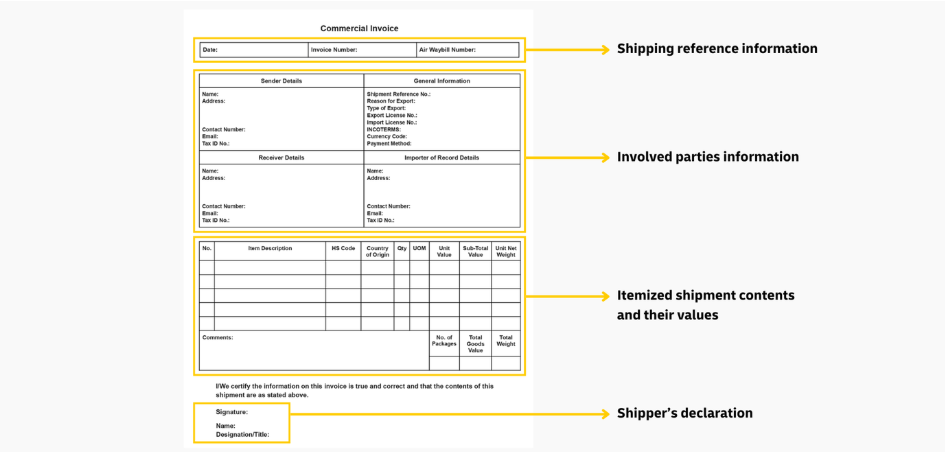
For every line item: a detailed description, a full HS code, the country of origin, declared value and currency, cost breakdown, gross and net weight, unit and quantity. Add the Incoterm and location, reason for export, full details for both parties, and proof of origin if needed.
Accuracy within each document matters, but so does consistency across all your documents. The invoice, waybill, and payment proof should all match. For sea shipments to Kenya from 3rd August, your commercial invoice is one of four documents needed to generate an Advance Cargo Declaration reference code before loading so it must be right and ready earlier.
Who Is Liable?
There’s one myth that needs clearing up: Customs liability always follows the Importer or Exporter of Record, not the carrier. DHL moves your shipment and submits the declaration using your paperwork, but you are responsible for duties and taxes. Outsourcing paperwork to a specialist can help, but it doesn’t shift the liability. The declaration is in your name, and the responsibility stays with you.
Make Every Invoice Count
This isn’t about ticking every box. Your commercial invoice is the only explanation customs will see. Every field answers a question that decides if your shipment moves or gets stuck.
Most delays aren’t about logistics but about paperwork. If a document is unclear, someone else has to guess, and that’s how hold-ups start.
Remember, your paperwork speaks for you. The declaration is in your name, and the responsibility is yours.
There’s no need to rely on guesswork. Free tools like MyGTS help you find the right HS code, estimate landed costs, and check import requirements. MyDHL+ walks you through the process of creating a compliant invoice, step by step. Both are free, and you can use MyDHL+ even without a DHL account.
If you take away one thing: Check your HS code and landed costs before shipping, not after your goods are held.
If you’re shipping regularly, a DHL business account can make life easier. You get better rates, your customers can reschedule deliveries, and you can reach more than 220 countries with a single setup.
For any Kenyan business that wants smooth, predictable shipping, a complete, accurate commercial invoice isn’t just paperwork. It’s your ticket to hassle-free trade.
FAQs
A commercial invoice is much more than a bill—it’s your shipment’s passport at the border. For Kenyan exporters, this document is essential: customs officials rely on it to identify what you’re sending, assess the right duties and taxes, and make sure you’re following all the proper import rules. If you get the product description wrong, use an incorrect HS code, or enter an inconsistent value, you’re likely to face delays at customs. That’s why it pays to double-check every detail. For Kenyan SMEs looking to master their export paperwork, take a look at Kenyan SMEs: Your Export Paperwork Checklist.
Start by making sure all your shipping documents tell the same story—consistency is key. Describe your goods clearly, pick the correct HS code, declare the true value, and always ensure your commercial invoice matches your waybill and any supporting paperwork. If you’re shipping from Kenya, using MyDHL+ can help you get it right the first time, reducing the risk of data entry errors before your goods even leave your hands. Want to take your Kenyan business global? Take Your Kenyan Business Global: Create Shipment with MyDHL.
DHL Express shipping rates are determined by a combination of factors related to the shipment's logistics and physical attributes:
Weight and Dimensions: Rates are calculated based on either the actual weight or the volumetric (dimensional) weight of the package — whichever is greater. Volumetric weight reflects the amount of space a package occupies on an aircraft or vehicle.
Origin and Destination: The distance between the sender and receiver, including whether the destination falls into a standard service zone or a specialized routing zone.
Service Level: The choice of delivery speed (such as time-definite express delivery services versus day-definite alternatives).
Surcharges and Optional Services: Additional fees may apply based on market fluctuations (like fuel surcharges), specific logistics constraints (such as remote area delivery or heavy/oversized piece handling), or premium add-ons (such as extended liability coverage or signature requirements).
For an accurate quote tailored to your shipment, get a rate and time quote
You can quickly check pricing and service options using one of the following methods:
Online via MyDHL+: Go to the MyDHL+ website and select the Get Quote option. Fill in the origin and destination addresses (or postal codes), specify whether you are shipping a document or a package, and input the exact dimensions and weight to receive a breakdown of available services and costs.
Through a DHL Business Account: If you are a registered business or frequent shipper, logging into your portal will display your customized contract rates and high-volume discounts.
Requesting a Custom Corporate Quote: For larger freight, specialized cargo, or recurring commercial shipments, you can schedule a consultation with a DHL specialist to evaluate your shipping profile and establish a customized pricing tier.


 Share
Share
Similar Stories