
#b2bAdvice


 Share
Share
An Essential Guide to Sustainable B2B Logistics and Eco-Friendly Shipping
4 min read
Share

Adopting sustainable practices is no longer an optional corporate initiative - it has become a core competitive advantage for companies navigating cross-border trade. Modern enterprise buyers expect environmentally responsible operations, making the transit process an ideal starting point. From deploying low-emission distribution fleets to implementing intelligent route optimization, we analyze the most effective methods to make your commercial operations highly efficient, eco-friendly, and cost-effective.
The Evolving Priorities of Corporate Procurement
Historically, B2B procurement decisions were almost exclusively driven by cost reduction. But a new consideration is increasingly influencing customers’ purchasing decisions: sustainable shipping.
According to a report by Bain & Company (1), 36% of B2B buyers would leave suppliers that don’t meet their sustainability expectations. It could be the difference between a customer choosing your business over a competitor’s – or worse, vice versa. Now is the time to review your supply chain practices to see where changes could be made. First up, shipping.
Benefits of offering sustainable shipping to B2B customers
Competitive advantage: Only 53% of B2B customers say the sustainable options they are offered by suppliers fully meet their expectations (2). This means there is a huge opportunity for businesses to leverage a sustainable shipping strategy to attract underserved prospects.
New business opportunities: Large corporations often require suppliers to comply with specific sustainability standards in order to support their ESG (Environmental, Social, and Governance) goals. As a result, sustainable shipping practices can help differentiate your business in procurement processes.
Cost savings: Improving shipping route efficiency, adopting eco-friendly packaging, and utilizing carbon offset programs can enable B2B businesses to reduce costs over time. In addition, energy-efficient transportation typically leads to lower fuel consumption and reduced emissions.
B2B v B2C shipping
With the explosive expansion of digital B2B e-commerce, corporate procurement managers now demand the same rapid timelines, convenience, and ecological responsibility they experience as standard consumers. Fortunately, the underlying structure of business-to-business logistics makes it uniquely compatible with sustainability strategies:

1. Shipment size & frequency
Direct-to-consumer fulfillment relies heavily on frequent, small-scale shipments—often single parcels—which naturally increases delivery miles and inflates the carbon footprint. Conversely, business distribution generally involves bulk cargo transported at structured intervals, facilitating massive emissions reductions through strategic route planning.
2. Predictive Delivery Timelines
Corporate shipments are almost always scheduled weeks or months in advance, providing ample flexibility for optimized, sustainable capacity management. In contrast, consumer expectations for near-instant fulfillment make emissions reduction far more challenging.

3. Order destination
Commercial shipments are dispatched directly to centralized nodes such as industrial warehouses or regional fulfillment centers rather than highly fragmented residential neighborhoods. This centralization allows for massive shipment consolidation, optimal route sequencing, and the elimination of last-mile delivery inefficiencies that typically drive up emissions.
Five Practical Steps for eco-friendly shipping
Transitioning to a low-carbon distribution architecture is not only beneficial for global ecology; it also enhances long-term operational efficiency, strengthens brand authority, and yields substantial financial returns. Here is a structured overview of the methodologies your company can deploy.
1. Adopt Advanced Renewable Aviation Fuels
Utilizing DHL’s innovative GoGreen Plus solution allows companies to directly reduce the greenhouse gas emissions linked to their international shipments via Sustainable Aviation Fuel (SAF). SAF represents an advanced biofuel synthesized entirely from renewable feedstocks, including organic waste products, plant oils, and agricultural residues. This technology cuts carbon output by up to 80% compared to conventional jet fuel. Crucially, this service can be activated for individual consignments, providing a highly flexible green alternative for a growing online store or smaller commercial operations.
2. Think Electric
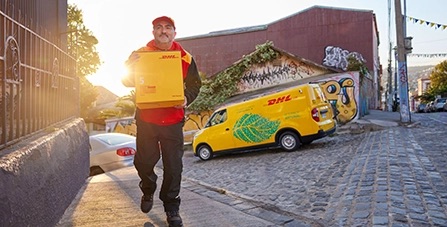
Electrifying your delivery fleet can have a significant impact on your emissions. DHL has a target to electrify 66% of its last-mile delivery vehicles by 2030, an initiative that aligns with its wider strategy to reduce logistics-related greenhouse gas emissions and achieve net-zero emissions by 2050. When you partner with DHL Express, you're not only cutting the carbon from your final-mile deliveries – you’re showing your customers that fast, reliable service can be sustainable too.
3. Route and Load Optimization
Implementing AI-driven dispatch and routing platforms represents a transformative step for corporate distribution. These software suites dynamically compute the most time- and fuel-efficient pathways, empowering distribution teams to complete multiple drop-offs through hyper-strategic sequencing. This minimizes fuel burn, slashes carbon output, and drastically improves delivery reliability. Furthermore, combining shipments bound for identical geographic regions maximizes total vehicle capacity and decreases overall transit needs.
4. Eliminate your failed delivery rate
Unsuccessful delivery attempts are an often-overlooked contributor to a firm's environmental footprint, as each redundant trip generates extra vehicle emissions and drains capital. To resolve this, DHL’s On-Demand Delivery (ODD) platform enhances the commercial client experience by providing real-time tracking and completely flexible delivery workflows. By supplying buyers with instant milestones and giving them the freedom to easily reschedule, reroute, or pick up cargo at a secure DHL ServicePoint, businesses can systematically eliminate failed deliveries while maximizing client satisfaction.
5. Measure, report and improve
Simply rolling out green initiatives is insufficient; auditing your exact environmental performance gains is critical. Leveraging analytical tracking software to calculate exact carbon output per cargo movement helps your business establish clear reduction benchmarks. Transparently presenting these verified sustainability datasets to your B2B customers strengthens commercial relationships and acts as a powerful differentiator during contract renewals.
Eco-conscious logistics has officially transitioned into a primary differentiator within cross-border commercial trade. Ready to transform your business? Open a DHL account today to access logistics services, exclusive DHL business discounts, and comprehensive online tracking features that support sustainable parcel service for SMEs.
Share