#b2bAdvice

Factory-to-Factory Logistics: Managing Cross-Border Machinery Relocation in APAC

Key Takeaways

  • Downtime Risks: Delayed machinery components disrupt your factory activation timelines and stall revenue.
  • Pre-Clearance Planning: Verifying tariff codes before you ship reduces friction at the border.
  • Battery Compliance: Industrial electronics must meet strict Watt-hour safety rules for any onboard batteries.
  • Financial Control: Centralised duty billing options streamline budget management when you're transferring factory assets.

Relocating a factory means juggling five jobs at once. You're the licensed customs broker, the safety officer, the project manager, and the firefighter, often all before lunch. Getting it done cleanly comes down to knowing exactly what to check, and when. Here’s how to navigate the customs frameworks, documentation, and compliance rules that keep a factory relocation on track.


What makes factory-to-factory logistics so challenging?

Relocating manufacturing assets across borders is risky: one missing permit can stall an entire production line and cost you real revenue. Import thresholds vary a lot by region, so unclear paperwork often means unexpected hold-ups at the border.

We help reduce these risks with Clearance Processing and Dedicated Pickup and Delivery, keeping your sub-assemblies, control units, and urgent replacement parts moving on schedule.

What downtime actually costs you

Unplanned downtime is a major risk in any large-scale manufacturing operation, stalling production and revenue.

To manage a factory transfer well, you need to know where the friction points usually show up. Capacity tightens fast during the Australian Christmas and New Year shutdown period.

The three biggest friction points to plan around

These are the ones that catch teams out most often:

  • Asset Protection: Industrial machinery contains sensitive electronic sensors and calibration tools that need precise handling during transit.
  • Timeline Metrics: Every day your equipment sits in a customs warehouse delays factory activation and idles your assembly teams.
  • Regulatory Variety: Each market in the Asia Pacific region applies distinct classification rules and import safety standards to industrial hardware.

For heavier machinery shipments, we also offer dedicated heavyweight freight options to keep those components moving too.


Which customs documents are required for industrial equipment?

The paperwork chase for heavy machinery is real. Governments want precise documentation to verify valuation, safety standards, and usage history. Temporary relocations need a different paperwork framework to permanent transfers, and getting it wrong can mean multi-day delays, administrative penalties, or even seizure by border authorities like the Australian Border Force (ABF).

How MyGTS and ATA Carnets simplify the process

My Global Trade Services (MyGTS) won't replace your compliance team's final sign-off, but it lets you work through tariff codes and harmonised system classifications while errors are still cheap to fix. We also support documentation readiness for temporary imports using the ATA Carnet system, which avoids paying duties you wouldn't otherwise owe.

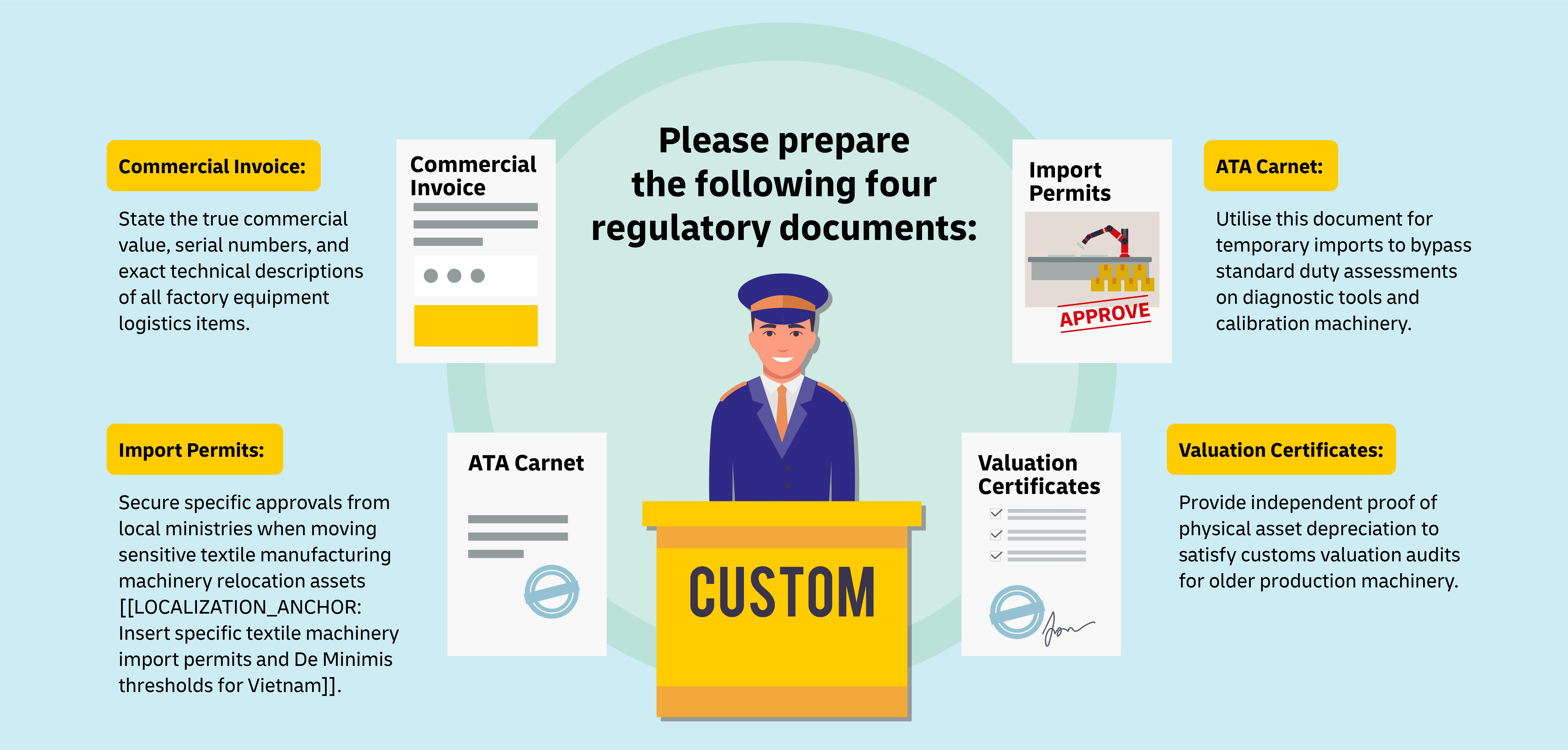
Four documents to have ready before you ship

Get these sorted early and customs will clear with a lot less friction. Here's what officials expect to see:

  • Commercial Invoice: State the true commercial value, serial numbers, and exact technical description of each item.
  • ATA Carnet: Use this document for temporary imports to avoid standard duty assessments on diagnostic tools and calibration machinery.
  • Import Permits: Be aware of biosecurity risks. For instance, importing used industrial or mining machinery into Australia requires permits and strict cleanliness checks to prevent soil and pest contamination, as mandated by the Department of Agriculture, Fisheries and Forestry. Always check the specific requirements for your destination market.
  • Valuation Certificates: Provide independent proof of physical asset depreciation to satisfy customs valuation audits for older production machinery.

How can you avoid customs delays for specialised components?

Complex machinery often contains specialised electronics, batteries, telemetry systems, or backup power supplies that trigger strict regulatory checks at the border. If you ship without the proper declarations, transport authorities can stop the shipment on the spot.

What DHL Express handles for battery-powered equipment

We provide Dangerous Goods handling for equipment containing lithium batteries under sections like PI967 and PI970 Section II, subject to a contractual agreement. You'll need the right shipper certification in place first. We help make sure your paperwork meets international air transit regulations, though your compliance status remains your own responsibility.

IATA dangerous goods regulations measure batteries by Watt-hour (Wh) rating, and that rating determines your packing instructions and restrictions. You should verify that your packaging meets the safety standards of the relevant aviation authority, such as Australia's Civil Aviation Safety Authority (CASA).

How each component type is handled

Here's how these regulatory challenges map to our support:

Component Type

Regulatory Challenge

DHL Express Support

Industrial Telemetry

Internal lithium-ion batteries trigger strict aviation safety reviews.

Handling under PI967 and PI970 Section II, subject to contractual agreement.

Electronic Control Units

Complex HS code classification creates valuation disputes at customs.

Classification support via My Global Trade Services (MyGTS).

Pneumatic Actuators

Residual pressure or chemical trace testing requirements stall clearance.

Clearance Processing and permit verification.


How do regional trade thresholds affect your shipping costs?

Taxes and duties can make up a bigger chunk of your relocation cost than you expect. That cost escalates fast if you miscalculate the tax liabilities on incoming components.

How DHL Express keeps duty costs predictable

We support this with Duty Tax Paid solutions, which let you bill duties centrally instead of leaving your receiving facility to handle cash payments on the spot. MyDHL+ also gives you visibility into estimated duties and taxes before you schedule the shipment.

Three tax factors that shift by market

These variables can change how you route your shipments, so keep them in mind for your destination market:

  • De Minimis Limits: For goods being imported into Australia, shipments valued at AUD 1,000 or less are generally exempt from duties and taxes, according to the Australian Border Force. Thresholds vary significantly by country, so always check the rules for your destination.
  • Temporary Relief: Destination markets often waive duties if you can prove the machinery is a temporary export and will return to its origin country within a specified timeframe.
  • Localised Tax Rates: Industrial machinery often attracts specific luxury, environmental, or manufacturing taxes depending on the destination.


How do you keep your project on track when a replacement part goes missing?

You've just found out a critical part didn't survive the move. Now the clock is running on an idle factory floor. Every hour spent waiting delays activation, and you can't afford to wait weeks for ocean freight when downtime is costing you revenue.

The DHL Express options built for this

DHL Express Worldwide and time-definite options like DHL Express 12:00 deliver urgent replacement components fast. We pick up critical parts from engineering hubs and get them straight to your factory floor. If your assembly engineers work through the weekend, Saturday Delivery in select markets keeps your timeline on track.

Transit times vary by lane, but you'll find exact details in our service guides. If you're managing outbound freight from a major hub like Western Sydney, early digital customs submission is well worth doing.

Four steps to get a replacement part moving fast

Work through these in order:

  • Identify Parts: Isolate the exact serial numbers and engineering diagrams for the missing components.
  • Select Service: Choose a time-definite air express option such as DHL Express Worldwide or DHL Express 12:00 depending on your morning assembly schedule.
  • Verify Compliance: Use My Global Trade Services (MyGTS) to confirm that your replacement electronics do not violate local import rules or require special government agency permits.
  • Deploy Tracking: Use the DHL Express Mobile App to follow your urgent freight in real time from the supplier to the factory gate.


Keep your commissioning schedule on track

Get the documentation and transport right, and a factory relocation stops feeling like a slow-motion emergency and starts feeling like a project that's under control. We support that with tools like My Global Trade Services (MyGTS) for tariff classification, Clearance Processing for customs readiness, and time-definite options like DHL Express 12:00 for urgent replacement parts.

If you're already in the middle of a relocation, speak to a DHL Express specialist today. If you're still planning, bookmark this for when the paperwork starts piling up.


Frequently Asked Questions

Manage this by aligning your transit schedule with your destination's customs rules and using My Global Trade Services (MyGTS) to verify tariff codes before you ship. An ATA Carnet cuts border friction for temporary shipments, and an express specialist keeps urgent components moving.

The main challenges are operational downtime, missing import permits for specialised equipment, and border delays from incorrect tariff classifications. Add in the risk of transit damage to sensitive electronic sensors, and our Clearance Processing and Dedicated Pickup and Delivery services help keep those risks in check.

You'll need a detailed commercial invoice with accurate serial numbers, asset valuations, and correct HS codes, plus specific import permits from local authorities depending on your destination market. For example, used machinery may face strict biosecurity checks. Temporary relocations can use a different framework, like the ATA Carnet system, to reduce duties you might not otherwise owe.

Reduce delays by identifying built-in lithium batteries and complex electronics before your freight reaches the border. Make sure your team holds the right dangerous goods shipper certification. We support compliance under rules like PI967 and PI970 Section II, subject to a contractual agreement.

Time-definite international air express gets critical components straight to your factory floor. Options like DHL Express Worldwide and DHL Express 12:00 are built for exactly this. Saturday Delivery is also available in select markets, so your weekend reassembly teams aren't left waiting.