#SmallBusinessAdvice

Rules of Origin: How to Calculate Regional Value Content and Protect Your Trade Discounts

Key Takeaways

  • RVC Metrics: Calculate your regional value content to prove the origin of your goods.
  • Tariff Qualification: Shift your product classifications to unlock lower cross-border tariff rates.
  • Audit Protection: Keep detailed material logs to reduce the risk of retroactive penalty duties.
  • Digital Checks: Check regional thresholds before shipping to protect your global margins.

Every Taka paid in unnecessary customs duties is a direct impact on your operating margin. These additional duties can often be traced back to a single component: an unverified material that disqualifies your entire production from free trade agreement discounts, resulting in you paying the full tariff rate. At DHL Express, we help compliance teams across Bangladesh check these calculations before a shipment is dispatched. Here is our guidance on how to calculate your regional value content and keep your valuable trade discounts intact.


How do you calculate regional value content?

Regional value content, or RVC, represents the percentage of a product's value that originates from within a specific trade zone. The higher this percentage, the more likely it is that your goods will qualify for lower tariffs. If your products fall short of the threshold set by your trade agreement, customs authorities will charge you the standard import duty instead.

Why small errors turn into big problems

If this check is overlooked, even small inaccuracies in your material records can accumulate into significant costs. Should customs authorities audit your files at a later date, these same inaccuracies could change your product's origin status and eliminate the trade benefit you had planned for.

This is precisely where a tool like My Global Trade Services (MyGTS) proves its value. Since every trade agreement establishes its own RVC threshold, MyGTS allows you to check the specific rule for your country and product combination before you ship, rather than performing a manual calculation.

Four ways to break down your material value

Whichever method of calculation you choose, it is essential to have clear visibility into every input within your supply chain. If you are tracking material costs from a manufacturing base like the Dhaka Export Processing Zone (DEPZ), you will want to check every input closely. Each approach below examines cost from a different perspective:

  • Transaction Value: Work out what share of the final sale price comes from materials that do not originate in the trade zone.
  • Net Cost: Break down your factory costs into materials, labour, and overhead to see what is genuinely local.
  • Origin Mapping: Get formal declarations from your vendors to check where every component comes from.
  • Currency Shifts: Monitor how exchange rates alter your regional value content metrics over time.

Even a minor error in this area can lead to substantial financial consequences. A cost variance of 6,150 BDT per unit might appear trivial on its own, but when multiplied across a full year of production, it becomes a considerable sum.


What is a tariff shift, and how does it affect your components?

A tariff shift is a concept that is simpler than it sounds: it means your imported materials are processed sufficiently in your factory to earn a new classification code. If a component enters your production process under one code and the finished product exits under a different one, that change is what demonstrates to customs authorities that substantial manufacturing occurred in your country.

Where this catches manufacturers out

An incorrect classification of complex industrial components can be costly, especially for businesses operating in major manufacturing hubs.. If an imported part enters your factory and leaves under the exact same classification code, customs will treat it as non-originating, regardless of the extent of processing it has undergone.

MyGTS can help you work through the classification codes involved, though your team is still responsible for the final determination on classification and origin.

Four steps to confirm a valid tariff shift

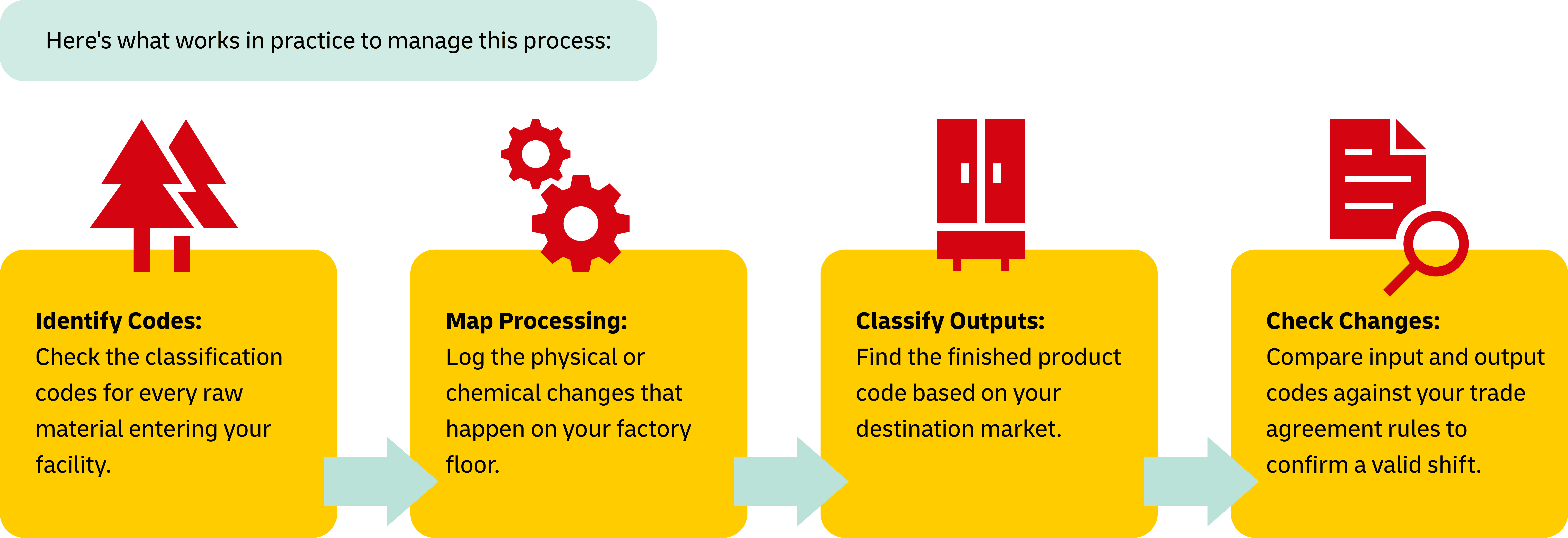
We recommend working through these four steps in order:

  • Identify Codes: Check the classification codes for every raw material entering your facility.
  • Map Processing: Log the physical or chemical changes that happen on your factory floor.
  • Classify Outputs: Find the finished product code based on your destination market.
  • Check Changes: Compare input and output codes against your trade agreement rules to confirm a valid shift.

What happens if you get an origin claim wrong?

Should you make an incorrect origin claim, the consequences can be severe: you may lose your preferential trade status, be blacklisted by customs, and face fines applied retroactively. Customs agencies can also audit your trade records for up to five years after a shipment has cleared the border, as required by The Customs Act, 1969 , and if your claim is not substantiated, they will seek payment for the unpaid duties.

How one mistake snowballs

A single clerical error can be multiplied across hundreds of past shipments. Furthermore, a formal trade investigation can slow down your shipping operations for all your cargo, not just the single shipment in question.

The pre-clearance features within MyDHL+ check your documents line by line before you ship, helping to catch missing data before it ever reaches the border.

Where most compliance gaps show up

It is advisable to review these common gaps before you file your declarations:

Origin Risk Area

Operational Threat

Recommended Action

Missing Records

High risk of preference denial

Use mandatory origin certificates in all supplier contracts

Outdated Codes

Medium risk of customs delays

Check your product catalogue against destination updates annually

Transit Routing

High risk of origin disqualification

Use Bonded Transit options where available to help protect cargo

Inadequate Archives

High risk of retroactive fines

Keep secure manufacturing records for at least five years

Maintaining careful oversight of these areas will help protect your cash flow. Please make sure your documentation meets the standards set by the National Board of Revenue (NBR) before you file your export declarations.


Protect your trade discounts today

Successfully managing rules of origin is dependent on performing correct value calculations and classification shifts every time. DHL Express supports this process with tools like MyGTS for threshold and classification checks, and MyDHL+ for pre-clearance document review, helping to ensure fewer surprises at the border.

Please speak to a DHL specialist today to review your material logs and ship with greater confidence.


Frequently Asked Questions

RVC is the percentage of your product's value that originates from within a trade zone, and it is the key evidence that proves your goods qualify for a lower tariff. If you fall short of your trade agreement's threshold, customs authorities will apply the standard rate of duty instead.

A tariff shift concerns the change in classification code of your imported materials as a result of local manufacturing. In contrast, an RVC calculation is about the actual monetary value you add through local materials, labour, and overhead. Customs authorities may use either method to determine your product's true country of origin.

Yes, customs authorities can audit your trade records up to several years after your goods clear the border. If they find errors in your past filings, they can reverse your trade discounts and demand you pay the duties you originally owed, sometimes on shipments from a long time ago.

MyGTS displays the specific origin thresholds and rules for your regional trade zone before you ship. This allows your team to identify available preferential rates and catch potential classification errors early, well before they can become a problem at the border.

DHL Express provides support for documentation readiness and essential compliance checks through tools like MyGTS and MyDHL+. However, your internal compliance team remains responsible for verifying the final classification and origin figures. Our tools should be treated as a valuable check, not a replacement for your internal processes.