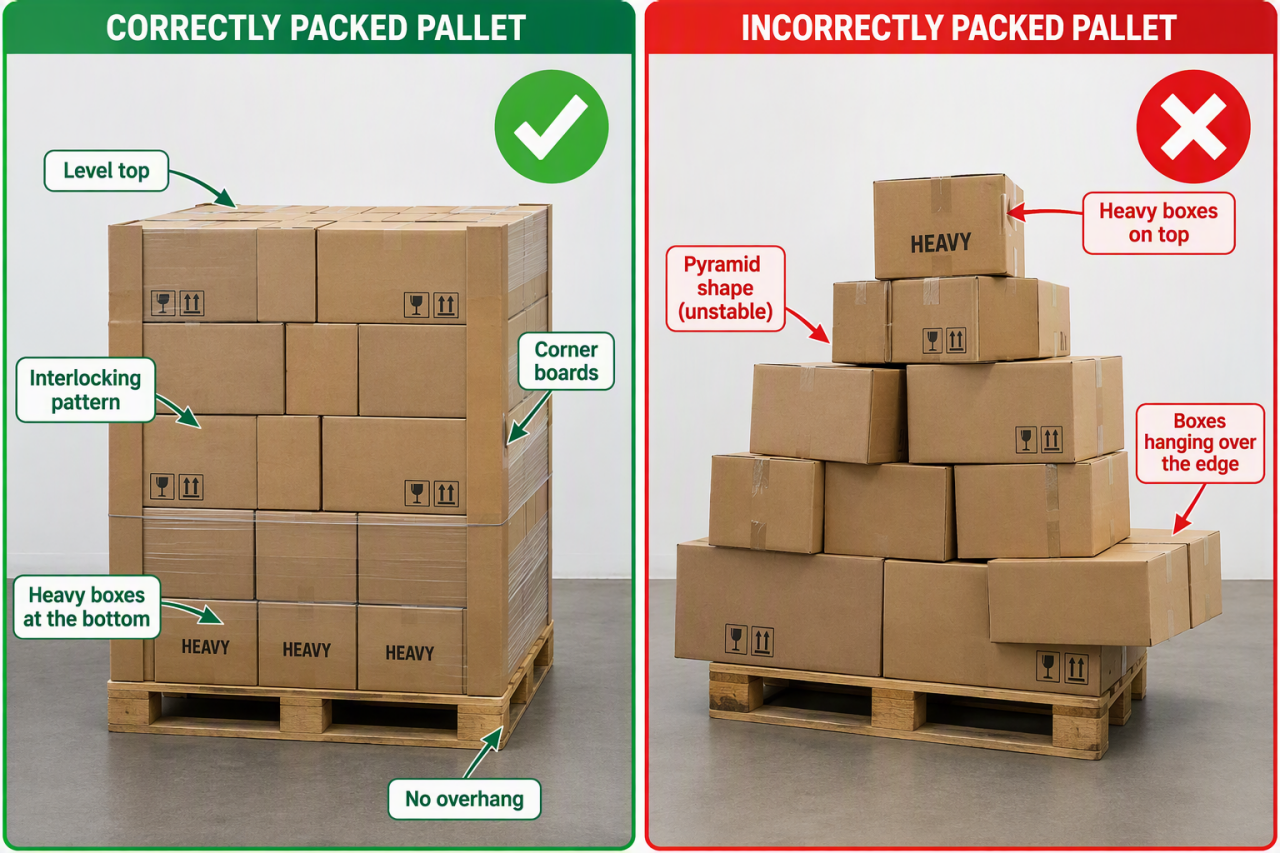
A few extra materials along the edge of the pallet’s load and between in its layers can go a long way to protect the items you’re shipping:
Corner boards: These protect the vertical edges of your load.
Tier sheets or slip sheets: Placed between layers, these spread the weight and add stability.
Pallet collars: Useful for loose or irregular goods. If they're wooden, they need an ISPM-15 mark too.
How to wrap and strap a pallet securely
Stretch wrap and straps turn a stack of boxes into a single, secure unit. Even a perfectly stacked pallet can shift if it isn't secured properly.
Strapping
Straps add extra security for heavy or tall loads, or goods likely to shift. You can choose from:
Heavy-duty plastic straps: Strong and practical for most palletised loads
Steel straps: Best for very heavy or dense loads
Ratchet straps: Adjustable and reusable
Use at least two straps running perpendicular to the pallet base, threaded through the pallet so the load is tied to it. For taller loads, add cross-strapping.
Stretch wrapping
Follow these steps for a tight, secure wrap:
Anchor the end of the film to a corner of the pallet base.
Wrap the base at least three times, making sure the film covers the pallet itself so the load is anchored to it.
Work upwards, overlapping each layer and keeping the film under tension.
Wrap the top at least three times, then cap the top of the load.
Try a simple tightness check. If you can slide your hand between the film and the boxes, the wrap is too loose.
Order of work
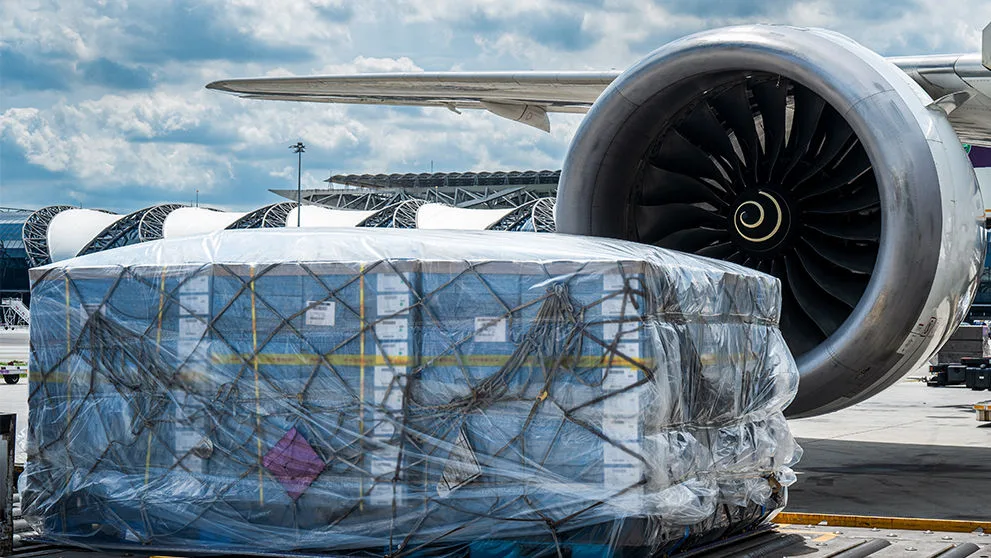
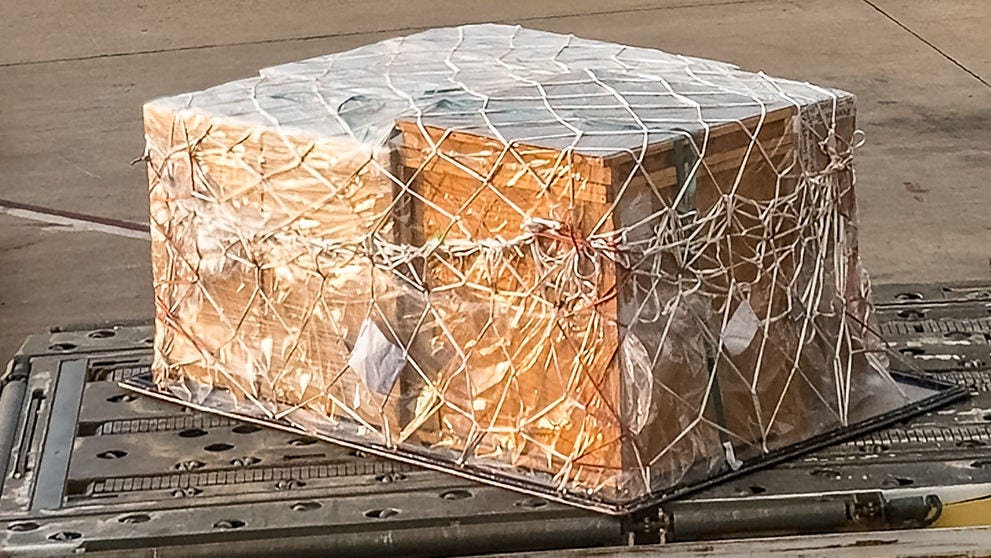
Secure your pallet in three stages: corner boards, then straps, then stretch wrap.
Fit the corner boards first, so the straps press against the boards rather than cutting into the edges of your boxes.
Next, strap the load firmly to the pallet.
Finish with stretch wrap, which holds everything in place, straps included, and stops the load from shifting during handling.
Once you're done, check that your barcodes and labels are still clearly visible.
Stackable vs non-stackable pallets
Whether your pallet can bear weight on top affects both cost and handling. It's worth knowing which category your shipment falls into before you book.
Stackable pallet: Has a flat, level, strong top that can safely support another pallet.
Non-stackable pallet: Has a fragile, irregular, or pointed top, or contains goods that can't bear weight.
Non-stackable pallets take up space that other freight can't use, so a logistics provider may apply a surcharge for odd-shaped or non-stackable items.
To make your pallet stackable where possible:
Level the top layer so it sits flat.
Add a top board or cap to spread the weight.
Avoid pyramid stacking.
Keep everything within the pallet footprint.
Always declare stackability accurately. A pallet declared as stackable that can't take weight could end up damaged, and it may still incur a non-stackable surcharge. If your pallet can't be stacked, add a 'DO NOT STACK' label (see the labelling section).
How to measure and weigh a pallet for shipping
Accurate measurements help you get the right quote and avoid adjustments later. Measure and weigh the pallet once it's fully loaded and wrapped.
Use a reliable tape measure and scale, and measure:
Length, width, and height at the longest, widest, and tallest points
The pallet base as part of the height, and any overhang as part of the length and width
Then weigh everything together: pallet, goods, and packaging.
Understanding volumetric weight
Carriers look at space as well as weight. DHL Express charges on the greater of a shipment's actual weight or volumetric weight.
To calculate volumetric weight, multiply length × width × height in centimetres, then divide by the carrier's volumetric divisor. DHL Express uses a divisor of 5,000 for centimetres and kilograms.
For example, a loaded EUR pallet measuring 120 × 80 × 150 cm has a volumetric weight of 288 kg. If the actual weight is 200 kg, you'll be charged 288 kg. Keeping your load compact helps keep costs down.
You can check rates and volumetric weight when you get a rate quote.
Why accuracy matters
DHL Express may verify the declared weight and dimensions of your shipment, and additional charges may apply if there are discrepancies. Measuring carefully before you book helps you avoid re-weighing, re-rating, and unexpected fees.
Labelling a pallet and preparing shipping documents
Clear labels and complete paperwork help your pallet move through the network and customs without delay. Here's how to get both right.
Labels
DHL Express recommends attaching shipping labels and handling markings to all sides and the top of the pallet. Also make sure to:
Keep barcodes flat, visible, and clear of stretch wrap.
Use handling labels such as 'FRAGILE', 'THIS WAY UP', and 'DO NOT STACK' where they apply.
Add heavy-package labels showing the weight, so handlers know what they're lifting.
Number each pallet in a multi-pallet shipment, for example '1 of 3', '2 of 3', and '3 of 3'.
Attach a clear, self-adhesive document pouch to the outside of the pallet to hold any paperwork that needs to travel with it.
Documents
International pallets usually need:
For a full explanation of each document, read what documents you need for international shipping.
Make sure your packing list matches exactly what's on each pallet. Your invoice should also match the contents of your shipment and the details on the waybill.
Shipping pallets overseas from Ireland
The processes associated with international pallet shipping from Ireland changes depending on whether your pallet stays within the EU or leaves it. Knowing which rules apply helps you plan the right paperwork from the start.
Within the EU, most goods can move freely between EU countries without customs declarations, thanks to the EU Single Market.5 Goods in free circulation aren't subject to customs supervision, although VAT (value-added tax) obligations still vary depending on what you're selling and to whom. ISPM-15 doesn't generally apply either.
Once goods leave the EU, customs formalities apply. According to Ireland's Revenue Commissioners, you'll need to register for customs with an Economic Operators Registration and Identification (EORI) number and submit customs declarations.6 You'll also need the correct Harmonised System (HS) code for your goods. This code determines the import duty rate and any restrictions, while duties and taxes are set by the destination country's authorities. For practical tips, read this customs advice for first-time shippers.
Before you ship, agree Incoterms® (International Commercial Terms) with your buyer. These set out who is responsible for each part of the journey, including who provides the necessary documentation and who pays the duties and taxes. Under FCA (Free Carrier) Incoterms®, for example, you deliver the goods to an agreed named place and handle export clearance, and the costs and risk pass to the buyer from there.
Finally, choose between express and freight. Express shipping suits time-critical pallets within the carrier's weight and size limits, while freight forwarding is better suited to full-container or oversized loads.
DHL Express international pallet shipping
DHL Heavy Weight Express is designed for palletised and heavy shipments, combining the speed of express delivery with the capacity for larger loads. Here's what a DHL Express pallet shipment can take.
DHL Heavy Weight Express handles shipments from 50 kg up to 3,000 kg, with individual pallet pieces of up to 1,000 kg. Pallets can measure up to 300 × 200 × 160 cm, and DHL Express asks for any piece over 70 kg to travel on a pallet. Shipments can reach their destination in as little as one to three days.
Customs clearance and door-to-door delivery are included in the price, while duties and taxes are charged separately. That means DHL Express international pallet shipping covers the whole journey.
Pallet shipping checklist before collection
A final check before collection can save time, money, and stress. Run through this list once your pallet is ready:
Pallet is in good condition, with the ISPM-15 mark visible on wooden pallets leaving the EU.
Load sits within the pallet footprint, with heavy boxes at the bottom.
Corner boards are fitted, and straps and wrap are tight.
Stackability is declared correctly.
Dimensions and weight are measured, including the pallet.
Labels are on all sides and the top, with barcodes clear of the wrap.
Handling labels and pallet numbers ('1 of 3') are in place.
Documents are in a pouch on the pallet and match your booking details.
Photos are taken from several angles.
Pallet is fully prepared and accessible for loading when the courier arrives.
If you ever need to make a claim, photos show how well your pallet was packed. That matters, as shipping insurance typically excludes damage caused by unsuitable packing. Learn more in this quick guide to shipping insurance.