#ShippingWithDhl

Shipping in Kenya During Public Holidays

Paul Makolosi
Paul Makolosi
Country Manager Kenya
6 mins
Shipping in Kenya
This article covers:
How Kenya’s public holidays affect shipping and delivery times
How to set order cut-offs and schedule pickups
How to choose the right DHL service and keep customers informed

Your customer counts calendar days. Your delivery provider counts working days.

Most weeks, the difference is small. Then a public holiday arrives, and a parcel handed over on the wrong afternoon may sit for three or four days. Meanwhile, your customer is checking their phone and wondering why the order has not moved.

The answer is simple: plan early.

This guide explains Kenya’s public holidays, the rules that can shift them and the knock-on effect they have on deliveries. It also shows you how to set order cut-offs, schedule pickups and give customers delivery dates you can keep.


Kenya’s Public Holidays: What Businesses Need to Know

Kenya’s public holiday calendar is less predictable than it first appears. Eight holidays fall on fixed dates each year. Four follow religious calendars, so their dates change. Other holidays may be declared through a gazette notice, sometimes with only a few days’ warning.

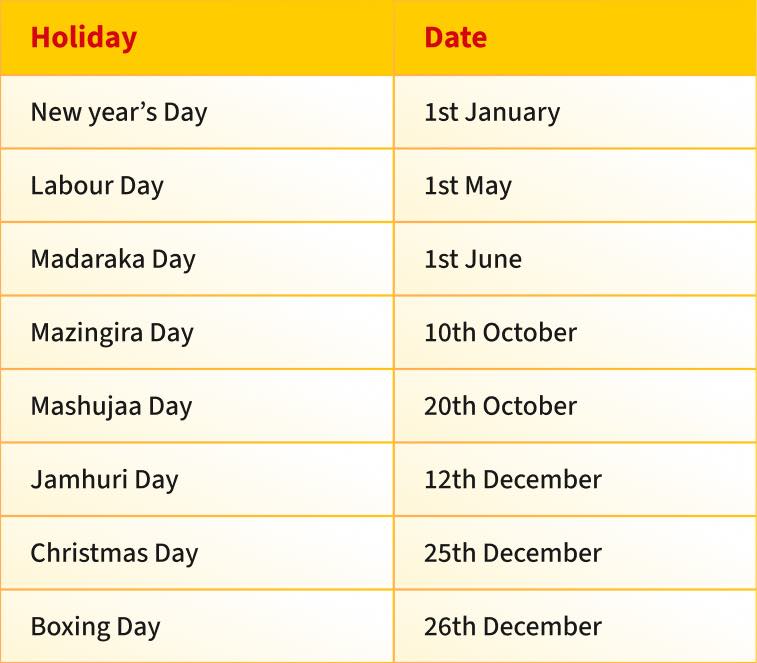
For businesses, these changes affect working days, dispatch schedules and delivery commitments. Under the Public Holidays Act, the eight fixed-date holidays are:

Holiday calendar.

Good Friday and Easter Monday follow the Easter calendar. Idd ul-Fitr and Idd ul-Adha depend on the sighting of the moon, which means their exact dates may only be confirmed shortly before the holiday. Businesses should also keep three important rules in mind.

A Sunday Holiday Moves to Monday

When a public holiday falls on a Sunday, the following Monday becomes a public holiday. If it falls on a Saturday, it does not automatically move.

That distinction matters when you are calculating transit times or promising a delivery date.

Extra Holidays May Be Declared at Short Notice

The Cabinet Secretary for Interior can declare an additional public holiday through a gazette notice. These announcements may leave businesses with little time to rearrange collections, staffing and deliveries.

General Election Days Are Public Holidays

Election days should be included in your operating plans, particularly if they affect opening hours, road access or the availability of customers to receive deliveries.

Holiday names can change too. The 10th October holiday was previously known as Moi Day and later Utamaduni Day before becoming Mazingira Day following a 2024 amendment.

For delivery planning, focus on the date rather than relying on the holiday’s name or last year’s calendar. Always check current official notices before confirming dispatch schedules and customer delivery dates.

/content/dam/kenya/shipping-with-dhl/getting-started/Public Holiday Shipment.jpg

Why One Public Holiday Can Delay a Shipment for Several Days

A public holiday removes one working day from the week. The actual disruption can last much longer.

Offices close. Some customers travel upcountry. Regular pickups and deliveries may pause. Parcels that miss the final collection before the holiday wait for the next available working day.

The timing of the holiday makes a big difference.


Holidays Next to Weekends

Consider a Friday public holiday. If your parcel misses Thursday’s cut-off, it may not move again until Monday.

This becomes more noticeable during the festive season, when several holidays fall close together. Christmas, Boxing Day and New Year’s Day can create consecutive periods with fewer working days and heavier shipment volumes.

Closed Delivery Locations

Deliveries to offices, schools, shops and other businesses may fail when nobody is available to receive them.

Some organisations also close for the entire period between Christmas and New Year, rather than shutting only on the official public holidays. A parcel can reach its destination town on time and still be delayed because the receiver is unavailable.

Higher Volumes Before and After the Holiday

Shipments tend to bunch up on the working days immediately before and after a public holiday. Customers place last-minute orders, businesses rush to dispatch stock, and orders made during the break all enter the network at once.

This is why delivery estimates are usually stated in working days.

When shipping with DHL, check the estimated delivery date in MyDHL+ using the actual date you intend to send the shipment. It is more reliable than counting calendar days and hoping for the best.


How to Set Holiday Order Cut-Offs

An order cut-off is the latest time a customer can place an order and still receive it before a particular date.

The easiest way to set one is to work backwards from the customer’s deadline.

1. Start With the Required Delivery Date

If a customer needs a Christmas gift before the holiday, the target should be the final available delivery day before Christmas. Do not use Christmas Day itself as the deadline unless the selected service specifically operates on that day.

2. Subtract the Route’s Transit Time

Suppose the route takes two working days by road. Confirm the actual transit time when booking, as it may vary by origin, destination and service. Count backwards by working days only, excluding public holidays and non-operating days. This gives you the latest collection date.

3. Allow Time for Collection

The shipment must be packed, labelled and ready before the scheduled pickup window. If it is not ready when the courier arrives, you may miss the final dispatch before the holiday.

4. Set Your Customer’s Order Deadline Earlier

If your team needs one working day to process and pack an order, move the customer cut-off back by another day. Repeat the calculation for every region you serve. A delivery within Nairobi may have a different cut-off from one going to Kisumu, Eldoret, Mombasa or a more remote location.

Once the dates are clear, publish them where customers will see them. Add the deadline to your website, share it on WhatsApp and pin it on your social media pages.

Keep the message direct:

Order by Monday, 21st December for delivery before Christmas. Clear dates create urgency and reduce the number of “Will it arrive in time?” calls and messages your team has to handle.

Choose the Right Service for Each Shipment

Your shipping service affects how late you can accept an order.

DHL Domestic Select, a road-based service, is suited to planned shipments. It can work well for branch restocking, routine deliveries and customer orders placed before the published cut-off.

DHL Domestic Premium uses air transport and may be more suitable for urgent orders that arrive after the road cut-off but still need to reach their destination before the holiday. The practical approach is to keep both options available. Send planned orders by road and reserve air services for genuinely time-sensitive shipments. That way, you avoid paying premium rates for every parcel while still having a faster option when the pressure is on.

Apply the same planning to stock. If December is your busiest month, arrange for goods from suppliers to arrive before the holiday rush. Waiting until reduced working days are already squeezing transport schedules leaves no room for delay.

/content/dam/kenya/shipping-with-dhl/getting-started/Booking Pickups.jpg

Booking Pickups During Holiday Weeks

Many small businesses depend on one rider, courier or parcel office. That arrangement may work well during an ordinary week. Around a public holiday, it can become risky.

If the rider takes the day off or the parcel office closes early, your shipments wait. In many cases, the business only discovers the delay when a customer calls.

Booking a pickup in advance gives you more certainty. Through MyDHL+, you can request collection from your address and select from the dates and time windows available in your area.

A few practical steps can keep your holiday dispatches on track.

  • Book early. Once you know your expected order volumes, schedule the final pickup before the holiday. Do not leave it until that morning.

  • Combine the final dispatch. Prepare all orders due before the break and hand them over in one organised collection.

  • Keep someone on site. Make sure a member of your team is available throughout the pickup window. A collection cannot happen if nobody is there to release the parcels.

  • Prepare for the first day back. Orders placed during the holiday will be waiting. Schedule your first post-holiday pickup early, especially if you expect a backlog.

If your shop or website continues taking orders on the public holiday, tell customers when those orders will leave. A simple notice such as “Orders placed today will be dispatched on the next working day” prevents confusion.

Set Delivery Expectations Customers Can Trust

A shipment that arrives on the promised date feels reliable, even if the journey takes several days. A shipment that arrives one day after a vague promise feels late.

Specific communication makes the difference.

State delivery estimates in working days and explain that public holidays are excluded. If the delivery is going to an office, school or shop, confirm that someone will be there to receive it. This matters most during the Christmas and New Year period. Share the tracking link as soon as the shipment is booked. Customers are less likely to call or send a WhatsApp message when they can see the parcel moving for themselves.

It also helps to give customers control over the final delivery. With DHL On Demand Delivery, a customer who is travelling during the holiday may be able to reschedule or redirect the parcel. That can prevent an attempted delivery to an empty address and the delays that follow.

Make Public Holidays Part of Your Delivery Plan

Most public holidays are known months in advance. Even holidays based on religious calendars or official declarations are announced before they take effect.

Use that time.

Check estimated delivery dates before publishing your cut-offs. Book pickups ahead of busy weeks. Match each shipment to the right road or air service. Track every consignment and keep customers informed.

A public holiday should be a date in your plan rather than a gap in your deliveries.

Open a DHL business account to check delivery estimates, arrange pickups and manage shipments through MyDHL+.

Frequently Asked Questions

A pre-holiday rush can stretch every part of your operation, from stock management and packing to customer service and dispatch. Preparing early helps you spread the workload across the weeks leading up to your shipping cut-off, rather than leaving your team to handle everything during the final few days.

Usually, yes. Deliveries to rural and remote parts of Kenya often take longer under normal circumstances, and public holidays can add further delays. Consider setting earlier order cut-offs for these locations and review your delivery setup to make rural shipping more reliable throughout the year.

It can be. Imports are affected by two calendars: Kenya’s and your supplier’s country. A public holiday at either end may slow production, customs processing or transport. Check both calendars before ordering stock for a busy season. If your goods need to arrive within a specific timeframe, a time-definite import service can give you greater control over the delivery window.

Returns often rise after the busiest shopping period, which means many December sales may come back in January. Set a clear returns window and process before the festive rush begins, and make sure customers know what to expect. It also helps to review your returns data afterwards. Frequent issues may point to product descriptions, sizing information or packaging that should be improved before the next peak season.