
DHL Globalization Tracker: Globalization has reached a new peak despite rising tariffs, geopolitical tensions and ongoing uncertainty. This is one of the key insights of the latest release of the DHL Globalization Tracker, developed by DHL and written by researchers from New York University’s Stern School of Business.
Based on over 30 million data points, the Tracker examines global flows of trade, capital, information and people, providing a clear, data-driven view of globalization and global trade trends.
AI investment drives global trade expansion despite tariffs and geopolitical conflicts
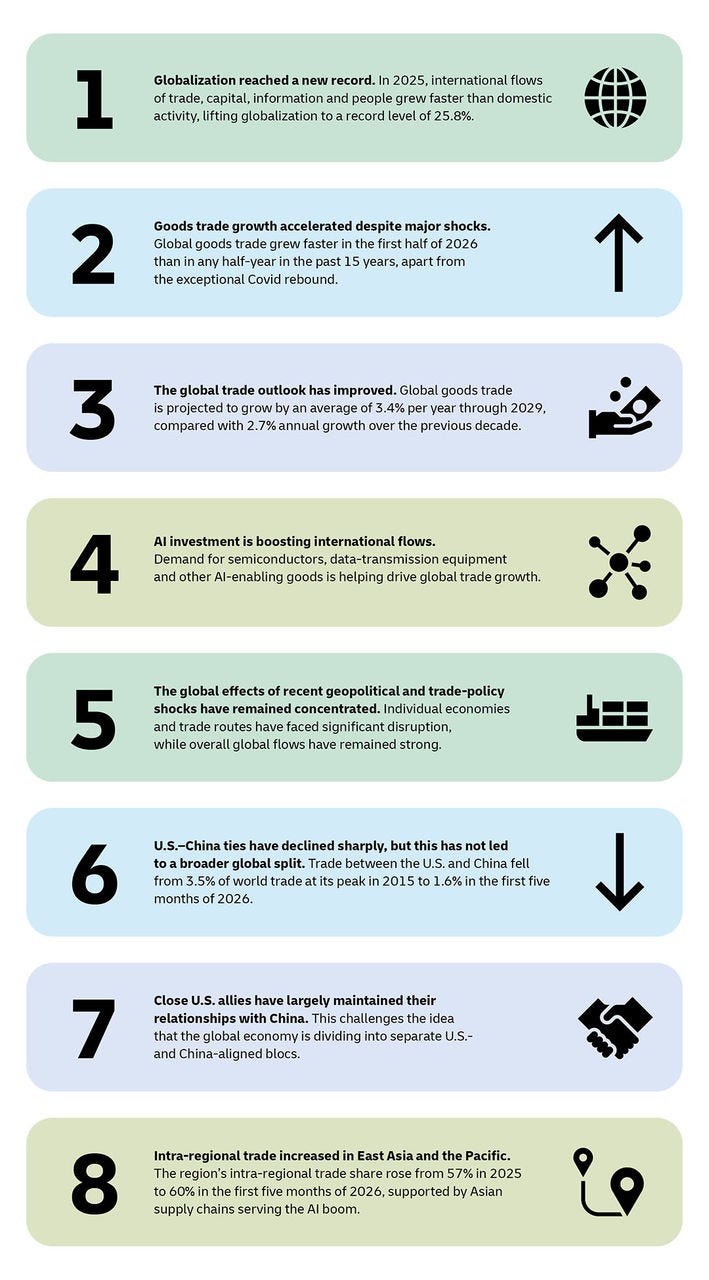
The worldwide race to build infrastructure for artificial intelligence is giving international trade strong momentum at a time of higher tariffs and geopolitical conflicts. Global goods trade expanded faster in the first half of 2026 than in any half-year over the past 15 years, aside from the exceptional Covid recovery. A key driver was strong demand for products used to build AI infrastructure, such as semiconductors and data-transmission equipment. Trade in AI-enabling goods accounted for 42% of goods trade growth in 2025, climbing to 76% during the first quarter of 2026.
At the same time, the Iran war and the closure of the Strait of Hormuz affected major trade routes, though their overall effects on global trade remained localized. U.S. tariffs on international trade also reached their highest levels in decades, yet their global effect was limited. The U.S. represented only 13% of global imports in recent years, and approximately half of U.S. imports were exempt from the tariff hikes as of August 2026. Most nations also refrained from widespread retaliation, with many instead pursuing access to alternative markets through new trade agreements. The global trade forecast has improved. Global goods trade is expected to grow by an average of 3.4% annually through 2029, compared with 2.7% yearly growth over the prior decade. East Asia and the Pacific posted the highest trade growth, with the value of its trade increasing 24% in the first five months of 2026 compared with the same timeframe in 2025. Europe followed with 12% expansion and Sub-Saharan Africa with 11%. Beyond trade, the DHL Globalization Tracker evaluates the broader evolution of globalization through worldwide flows of trade, capital, information, and people. In 2025, globalization reached a record level of 25.8%, with all four categories achieving higher degrees of internationalization. And while U.S.–China relations have weakened significantly , close U.S. allies have largely preserved their relationships with China – challenging the notion that the global economy is dividing into separate rival blocs.
8 key insights from the DHL Globalization Tracker
The DHL Globalization Tracker can help companies better understand global trade shifts and examine trends by region and country. DHL Express can assist businesses seeking to turn global opportunities into growth.
Open a DHL Express Business Account for fast international shipping to over 220 countries and territories, with guidance from our global experts.


 Share