IMF World Economic Outlook, April 2026, via Empower Africa
Netcash, Top Digital Payment Trends Shaping South Africa in 2026
SARS Official Notice on Customs Code 70707070; SARS, Customs and Excise notices
South Africa’s role as a gateway to African commerce has never been stronger, and the numbers prove it. The country now stands as Africa’s largest economy by nominal GDP, with a projected 2026 GDP of around US$443.6 billion, comfortably ahead of Egypt (about US$399.5 billion) and Nigeria (about US$334.3 billion). Nigeria’s recent slide to third place is largely due to the naira’s sharp devaluation, which has squeezed its dollar-denominated output.
When it comes to individual prosperity, South Africa keeps climbing the ladder. GDP per capita reached roughly US$6,900 in 2025, among the highest in Sub-Saharan Africa, just trailing Botswana and slightly ahead of Namibia.
Population-wise, the country continues to grow at pace, with approximately 65 million people calling South Africa home as of 2026.
South Africa’s digital marketplace is surging. The B2C e-commerce market hit an estimated $7.72 billion in 2024 and is expected to exceed $8.48 billion by the end of 2025. Looking further ahead, the market could reach US$10.77 billion by 2029, with growth stabilising at a healthy 8.5% to 9.9% CAGR. What’s powering this? A new generation of mobile-first shoppers, who now account for over 71% of all e-commerce transactions, especially in township communities where affordable smartphones have become a lifeline.
South Africans aren’t just shopping more, they’re spending more per person. Average revenue per user (ARPU) is now forecast to climb to US$644.20 by 2029, the highest among major African markets.

The local digital shelf is as competitive as ever.
Takealot remains South Africa’s most visited online marketplace, drawing about 13 million monthly visits as of March 2026. But the landscape is shifting fast, Chinese giant Shein has surged into a solid second place, ahead of well-known locals like Makro, Checkers, and Dis-Chem. Superbalist, once part of the Takealot Group, was sold to Blank Canvas Capital in September 2024.
South Africans love choice at checkout. Cards, EFT, and digital wallets are still core payment methods, but two newer options are changing the game:
PayShap: The real-time payments system from the South African Reserve Bank is transforming instant bank-to-bank transfers and forms a key part of the 2025 Payments Ecosystem Modernisation initiative.
Buy Now, Pay Later (BNPL): Services like PayJustNow and Payflex are booming, giving shoppers more power to split payments and manage budgets.
The days of pandemic-driven online booms are behind us. Today’s South African shopper is mobile-first, value-driven, and spoilt for choice, thanks to the rise of global players like Shein, Temu, Amazon, and Walmart entering the local scene. BNPL options are drawing new customers, especially younger buyers looking for flexibility. And in the townships, mobile commerce is opening worlds of possibility, as more people get online with affordable smart devices.
If you’re importing goods as a private individual using Customs Code 70707070, there’s a strict annual cap: ZAR 150,000 per calendar year. As of late 2025, SARS enforces this with automated validation, once you hit the threshold, further declarations are instantly rejected unless you’re registered. For imports involving advance foreign exchange payments over ZAR 50,000, you’ll also need to submit an Advance Payment Notification (APN) via eFiling.
Retailers like Zara, Abercrombie & Fitch, and Boohoo continue to charge return fees, a reminder that even as online shopping expands, the fine print still matters.
Fresh from the SARS Trade Statistics portal, here’s where things stand as of May 2026:
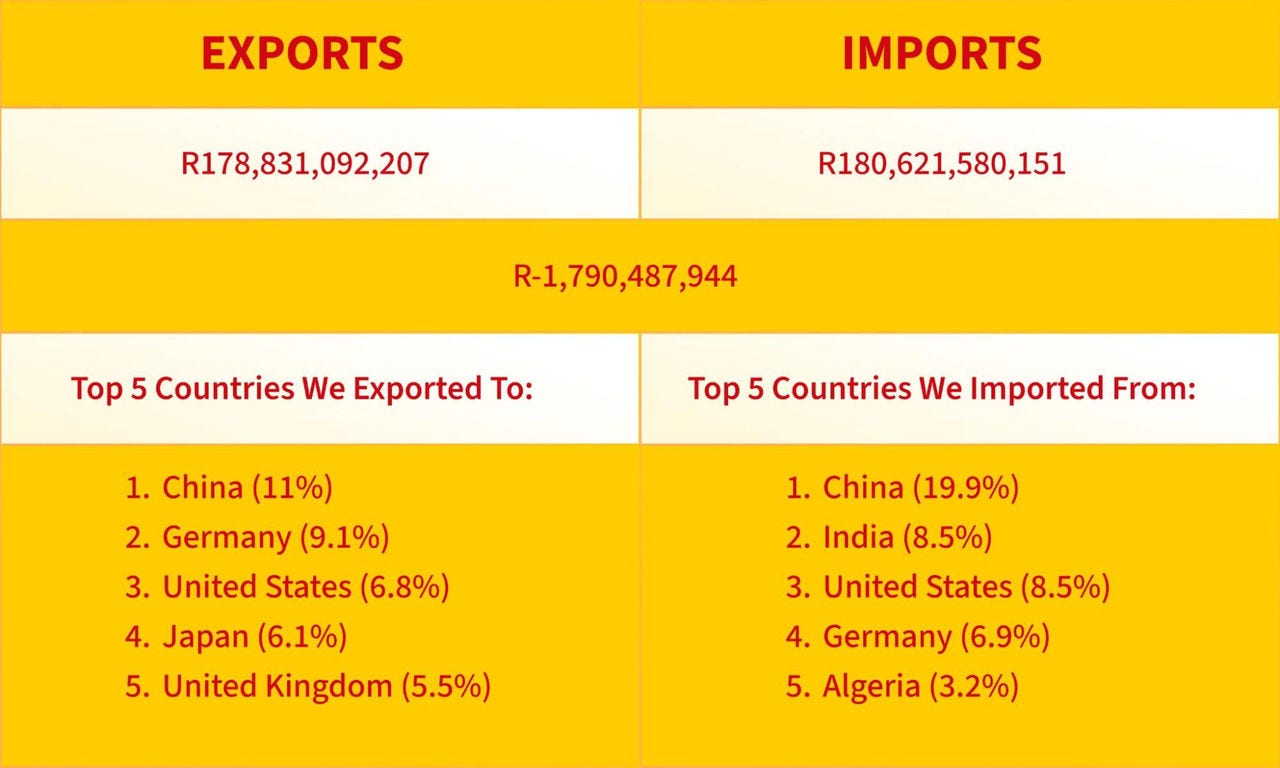
Exports: R178,831,092,207
Imports: R180,621,580,151
Trade Balance: R-1,790,487,944
Top Five Export Destinations:
China (11%), Germany (9.1%), United States (6.8%), Japan (6.1%), United Kingdom (5.5%)
Top Five Import Sources:
China (19.9%), India (8.5%), United States (8.5%), Germany (6.9%), Algeria (3.2%)
South Africa is a market on the move, digitally savvy, globally connected, and open for business. For exporters, the real opportunity is in understanding these new drivers and adapting fast. The numbers have changed, but the story is as compelling as ever.
IMF World Economic Outlook, April 2026, via Empower Africa
Netcash, Top Digital Payment Trends Shaping South Africa in 2026
SARS Official Notice on Customs Code 70707070; SARS, Customs and Excise notices


 Share
Share