2 - Department of Foreign Affairs and Trade
3 - Australian Taxation Office, June 2024
4 - Australian Taxation Office, May 2024

Importing into Australia has never offered more strategic upside—but only for businesses that know how to navigate it.
The global trade landscape has matured significantly in recent years. Supply chains have been rebuilt, shipping routes have stabilised, and Australian businesses are increasingly looking outward—sourcing materials, components, and finished goods from international markets to stay competitive at home and abroad. A maturing network of free trade agreements, including the EU-Australia Economic Partnership (ECTA) and the Australia-UK Free Trade Agreement (A-UKFTA), has further opened the door to higher-quality materials from key international markets at a lower landed cost than previous generations of importers could have accessed.
For Australian businesses, this isn't just a logistical opportunity; it's a competitive one. Sourcing smarter means stronger margins, broader product ranges, and supply chains built for resilience. But the benefits don't arrive automatically. To unlock preferential duty rates, streamlined customs clearance, and genuine cost advantages, businesses need to understand the compliance requirements that sit behind them. This guide covers exactly that—not what importing requires of you, but how to optimise every step of the process.
Getting goods across the Australian border efficiently isn't simply a matter of finding a supplier and arranging freight. The difference between an optimised import operation and a costly one often comes down to a handful of technical decisions made before the shipment even leaves its origin country.
Getting this right comes down to a handful of critical steps. Here's where to focus.
Few decisions in the import process carry more financial consequences than the one most businesses treat as an afterthought: HS code classification. The Harmonised System (HS) is a globally standardised, six-digit numerical framework that customs authorities use to identify goods, apply relevant duties, and determine eligibility under trade agreements. And the margin for error is narrower than most importers realise.
Consider the stakes: the difference between a 0% duty rate and a 5% "nuisance" tariff can come down entirely to sub-classification. That distinction is worth getting right before your goods leave the supplier, not after they've arrived at the border. Misclassification can result in not only overpaid duty, but it can also trigger interest on back-payments, delays at customs, or in serious cases, seized goods. The risk is avoidable, but only if classification is treated as a priority.
Preferential duty rates under agreements like ECTA and A-UKFTA don't apply by default—they have to be claimed, and claiming them requires the right documentation. Specifically, businesses need to provide proof that their goods genuinely originate from the qualifying country. The form that proof takes depends on which agreement applies.
Under ECTA, businesses importing from EU member states lodge an import declaration through the Australian Border Force to claim preferential treatment¹. The Certificate of Origin (COO) supporting that declaration must be issued by a body licensed under Australia’s Free Trade Agreement Certificate of Origin (FTA CoO) Recognition Scheme, typically the Australian Chamber of Commerce and Industry (ACCI) or the Australian Industry Group (Ai Group). For UK imports under A-UKFTA, the process is somewhat more flexible. Businesses may rely on a Declaration of Origin (DOO) or "Importer's Knowledge", a self-declaration supported by manufacturer data, removing the need for a formally issued certificate in many cases².
Whichever route applies to your business, the principle is the same: secure your documentation before the shipment departs. Attempting to obtain proof of origin retrospectively is significantly more complex, and in some cases, it may disqualify the shipment from preferential treatment altogether. Build the COO or DOO into your standard procurement process, and the duty savings become a reliable, repeatable outcome rather than an occasional win.
Cash flow is one of the most underappreciated levers in import management, and the Australian Taxation Office offers a mechanism that businesses importing at volume should not overlook. The Deferred GST (DGST) Scheme allows eligible businesses to avoid paying the standard 10% GST upfront at the border3. Instead, it’s deferred to their monthly Business Activity Statement (BAS), effectively creating an interest-free cash-flow buffer between the point of importation and the point of payment.
For businesses managing high-frequency shipments, this deferral can represent a meaningful improvement in working capital. Rather than tying up funds in border fees and clearance charges, that capital remains available to the business until the BAS falls due.
It’s worth noting that imports valued under AUD $1,000 don’t incur customs duty at all, with the exception of specific regulated categories such as alcohol and tobacco4. For businesses operating in that sub-threshold range, the primary compliance focus shifts away from duty and toward accurate GST reporting. For those above it, applying for the DGST Scheme with the ATO is a straightforward step that delivers ongoing financial benefit. The application process is manageable, and for most registered businesses with a clean compliance history, approval is accessible.
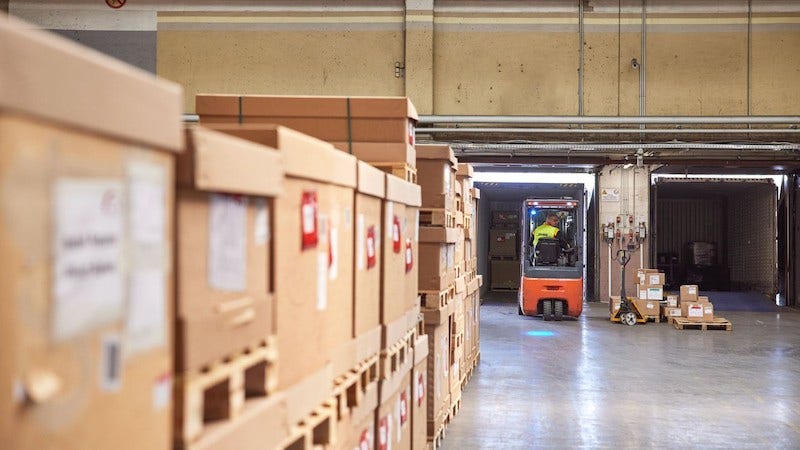
Although Australian Customs doesn’t require import licences, permits are still required to clear the goods. The required documentation to clear customs is:
Another aspect of clearing imported goods from customs control is the Import Declaration. The primary purpose of this declaration is to collect details about the importer, how the goods are transported, the tariff classification, and the customs value. Depending on these factors, you may need to file one of these three declarations:
Optimising an import operation involves a lot of moving parts, and the businesses that do it well are usually the ones with the right partner behind them. DHL Express is built to be exactly that: not a courier that picks up where your planning ends, but an end-to-end logistics partner that works across every stage of the process.
Through MyDHL+, HS code and Certificate of Origin data are integrated directly into the clearance workflow, removing the friction that typically slows shipments at the border. Before a consignment moves, DHL's landed cost tools provide full visibility over applicable duties, GST, and processing fees upfront, so billing surprises never get the chance to erode your retail margins. For businesses navigating ESG reporting obligations in 2026, GoGreen Plus goes one step further by letting you opt into Sustainable Aviation Fuel directly within your shipping dashboard and turning every shipment into a measurable, certifiable step toward your emissions targets.
The expertise is global. The process is seamless. And the outcome is a supply chain that works harder for your business without demanding more of your time. Ready to import into Australia smarter? Open a DHL Express account and start putting MyDHL+ to work today.
DISCLAIMER:
Any regulatory information contained herein is for informational purposes only and DHL assumes no responsibility for the accuracy of the information. DHL does not provide specific regulatory or legal advice to the public and you are encouraged to seek your own legal or compliance counsel.
2 - Department of Foreign Affairs and Trade
3 - Australian Taxation Office, June 2024
4 - Australian Taxation Office, May 2024


 Share
Share