
What does the future of B2B e-commerce hold, and where are the biggest opportunities in today’s digital revolution? Read on as we explore the trends shaping B2B e-commerce growth – including the rising impact of AI.
The evolution of B2B e-commerce: old trends vs new trends
Pre-COVID, buying and selling between businesses looked very different – slower, more manual, and far more dependent on face-to-face relationships. Today, thanks to digital platforms, evolving buyer expectations, and global logistics infrastructure, B2B e-commerce development is accelerating rapidly.
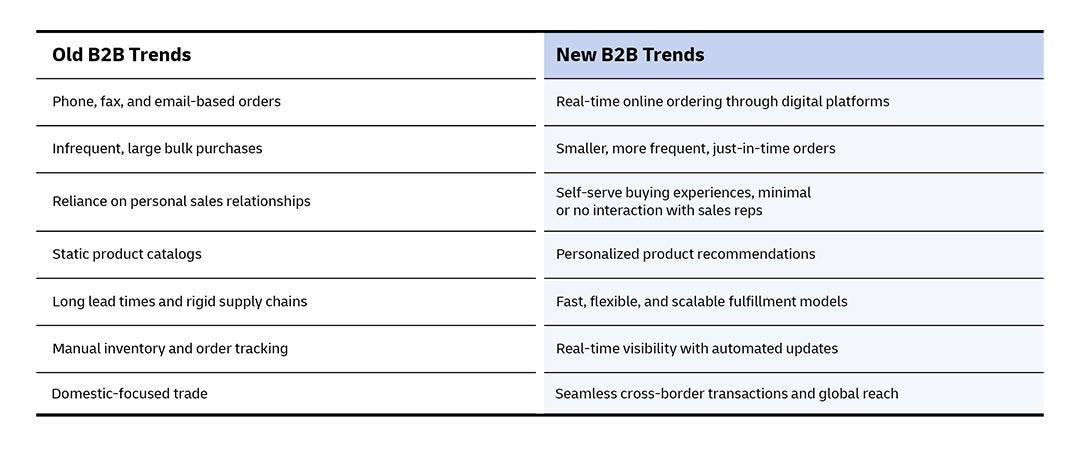
Here’s how some of the old norms compare to today’s emerging trends:
Where transactions take place
B2B transactions used to be built on face-to-face relationships. Deals were negotiated over meetings, phone calls, or trade shows, with trust developed slowly and personally. Orders were placed manually, processed on paper, and fulfilled through long, often rigid supply chains.
Today, those same transactions are happening online – instantly, and often without the involvement of a sales rep. Buyers research, compare, and purchase through digital platforms, expecting seamless, self-service experiences.
This shift to digital has redefined where and how business gets done, enabling B2B companies to operate around the clock, across borders, and at the speed of modern commerce.
A new target audience
Millennials and Gen Z now account for 71% of B2B buyers – up from 64% in 20221 – and they’re bringing new expectations shaped by years of B2C online shopping.
They’d rather research a product online than speak to a sales rep, and they expect to complete transactions as quickly and easily as they would on an e-commerce site. They’re more likely to switch suppliers if the digital experience doesn’t meet their standards – for B2B sellers, this means rethinking how they attract, engage, and retain these new buyers.
Changes in buyer expectations
Today’s B2B buyers expect the same seamless experiences they get when shopping as B2C consumers. They want to browse online, compare products easily, get personalized recommendations, and complete purchases in just a few clicks. Fast response times, real-time tracking, and flexible delivery options are expected, too.
This shift has fundamentally changed what it means to do business in B2B. Buyers now expect speed – they don’t want to wait days for quotes or chase down order updates. They’re drawn to suppliers who offer digital self-service, automated processes, and integrated systems that make buying easy. To stay competitive, B2B sellers must meet these new standards.

The value of investing in digital infrastructure
Research by Sana2 found that although 73% of B2B buyers prefer to buy online, 85% of them experience frustrations when doing so. This suggests there’s a significant gap between what buyers expect and what many businesses are currently offering. Whether it’s clunky websites, lack of real-time inventory, or limited payment options – these pain points can quickly drive potential customers elsewhere.
By investing in robust digital infrastructure – like integrated e-commerce platforms and automated fulfillment systems – B2B businesses can meet the expectations of today’s buyers. And with the right logistics partner, they can offer the kind of smooth customer experience that builds loyalty.
What is the future of B2B e-commerce?
AI integration
AI isn’t just the future – it’s the new foundation of B2B. Already, 67% of B2B e‑commerce firms are using AI and machine learning technologies, and 90% see AI as critical to their long-term strategy3.
In practice, this means:
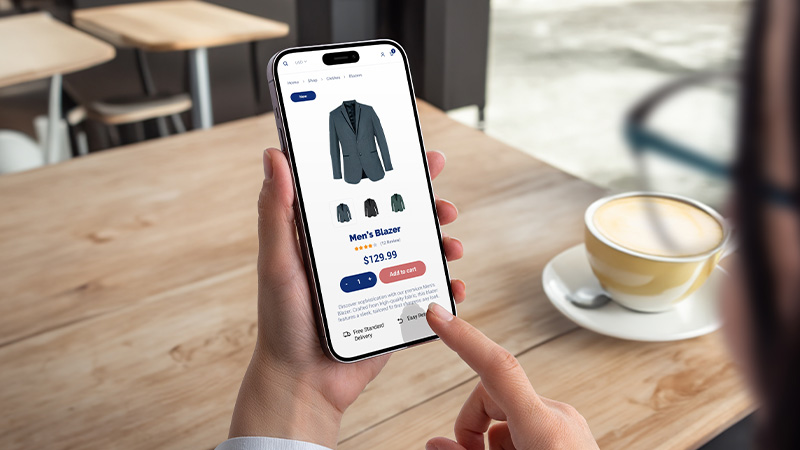
Personalization at scale: AI-driven recommendation engines can tailor product suggestions, pricing, and upsell/cross-sell offers based on buyer history, industry segment, real-time behavior, and market context.

Conversational agents & virtual assistants: These bots are now doing more than just answering FAQs – they can handle reorders, answer product questions, guide procurement, and even negotiate basic terms, 24/7.

Smart forecasting and demand planning: Predictive analytics will become more accurate and autonomous, enabling businesses to prevent stockouts, reduce excess inventory, and adjust supply in response to market signals.

Autonomous transactions: Over time, AI agents may be able to make purchasing decisions on behalf of departments or connected devices – e.g. a machine ordering replacement parts automatically when sensors detect wear.
Data & analytics
Success in B2B e-commerce will depend less on how much data you have, and more on how well you use it.
- Platforms will evolve from transaction engines into intelligence hubs, offering dashboards, benchmarking, predictive signals, and decision support as value‑adds to customers.
- Real-time data links across CRM, ERP, logistics, and supply chain will drive smarter, faster decisions across procurement, pricing, fulfillment, and inventory.
- The more integrated your systems, the less manual friction, and the more seamless the customer experience – especially for SMEs that compete on agility.
The rise of mega & vertical marketplaces
Traditional, horizontal marketplaces (think “everything for everyone”) are giving way to vertical, industry-specific platforms that can offer better curation, and value-added services.
- Vertical marketplaces are gaining momentum by focusing on specific sectors, with curated product assortments, specialist filters, and deeper domain knowledge.
- These platforms can layer in complementary services (e.g. financing, compliance, quality assurance, logistics) – creating ecosystems rather than just transactional flows.
- Over time, vertical players with strong traction may evolve into “mega platforms” that expand into adjacent niches, building network effects across related sectors.
At the same time, we may see marketplace-as-a-service models – where brands or suppliers build their own marketplace, using underlying platform infrastructure. The “platformification” of B2B will reduce barriers to entry and change how brands own their channels.
Other emerging B2B e-commerce trends
- Hyperautomation: More processes – from onboarding to returns – will become fully automated, reducing manual handoffs and errors.
- Ethical & transparent AI: As AI systems play larger roles, buyers and regulators will demand fairness and privacy safeguards.
- Sustainability & traceability: Buyers will expect visibility into environmental footprint, sourcing practices, and compliance – pushing platforms to embed ESG data into the transaction flow.
- Embedded commerce & IoT: Commerce will be embedded in workflows, devices, and systems. Orders might trigger from within business software, connected machinery, or supply chain signals – not just from a website.
How DHL can support your B2B e-commerce journey
B2B e-commerce is changing fast. Companies that invest in digital infrastructure, leverage data intelligently, and adapt to new buyer behaviors will be best positioned to grow.
By partnering with DHL, your business will benefit from:
- A global logistics network that ensures faster, more reliable shipping – no matter where your customers are.
- Digital tools that provide real-time visibility, tracking, and integration with your e-commerce systems.
- Flexible fulfillment and warehousing solutions to handle fluctuating demand and support smaller, more frequent orders.
- Deep expertise in cross-border trade, customs compliance, and omnichannel fulfillment.
With DHL, you’ll be in the best position to grow your e-commerce offering and keep up with future trends – whatever they may be.
For fast, international B2B shipping, open a DHL Express Business Account.


 Share
Share

Similar Stories