For Japanese small business owners and first-time exporters, the world is a market full of potential customers. The challenge, however, often lies in efficiently and affordably getting your products to them. Shipping is a critical business expense that, with the right knowledge, can be significantly optimised. One aspect of international shipping fees you might not be aware of is dimensional weight, sometimes also known as volumetric weight.
What is dimensional weight exactly? Let’s explore the definition, how to calculate it, and how it affects your shipping fees.
What is dimensional/volumetric weight?
What does dimensional weight mean? Put simply, it is a calculation that reflects the amount of space a package occupies when transported in relation to its actual weight.
Courier companies like DHL Express use this metric to ensure fair pricing for shipping fees.
Imagine an airplane cargo hold where space is a finite resource. A shipment of heavy, compact machine parts takes up very little room, while a box of pillows, though very light, occupies a large amount of space.
Dimensional weight ensures that shipping costs are balanced for both types of shipments, preventing a situation where a business shipping a small, heavy item might subsidize the cost for another business shipping a large, lightweight item that takes up far more space.
How to calculate dimensional/volumetric weight
The calculation itself is straightforward once you know the dimensions of your package. The standard dimensional weight formula is:
(Length x Width x Height in cm) / Dimensional Factor
To use this formula, you simply measure the longest point of each side of your box. Make sure to use centimeters for all three measurements.
What is the dimensional factor?
The "Dimensional Factor" (also known as the DIM factor or dimensional divisor) is a specific number used by carriers to convert the volume of your package into an equivalent weight. This number varies depending on the courier’s cost structure and mode of transport. For instance, shipping via air typically has a higher DIM factor than shipping via sea because space is at a much greater premium on an aircraft.
For DHL Express, the DIM factor for most international express shipments is 5000.
How dimensional weight affects your shipping costs
To illustrate the impact of dimensional weight on shipping fees, let's look at two examples that highlight how the billable weight is determined for your shipment.
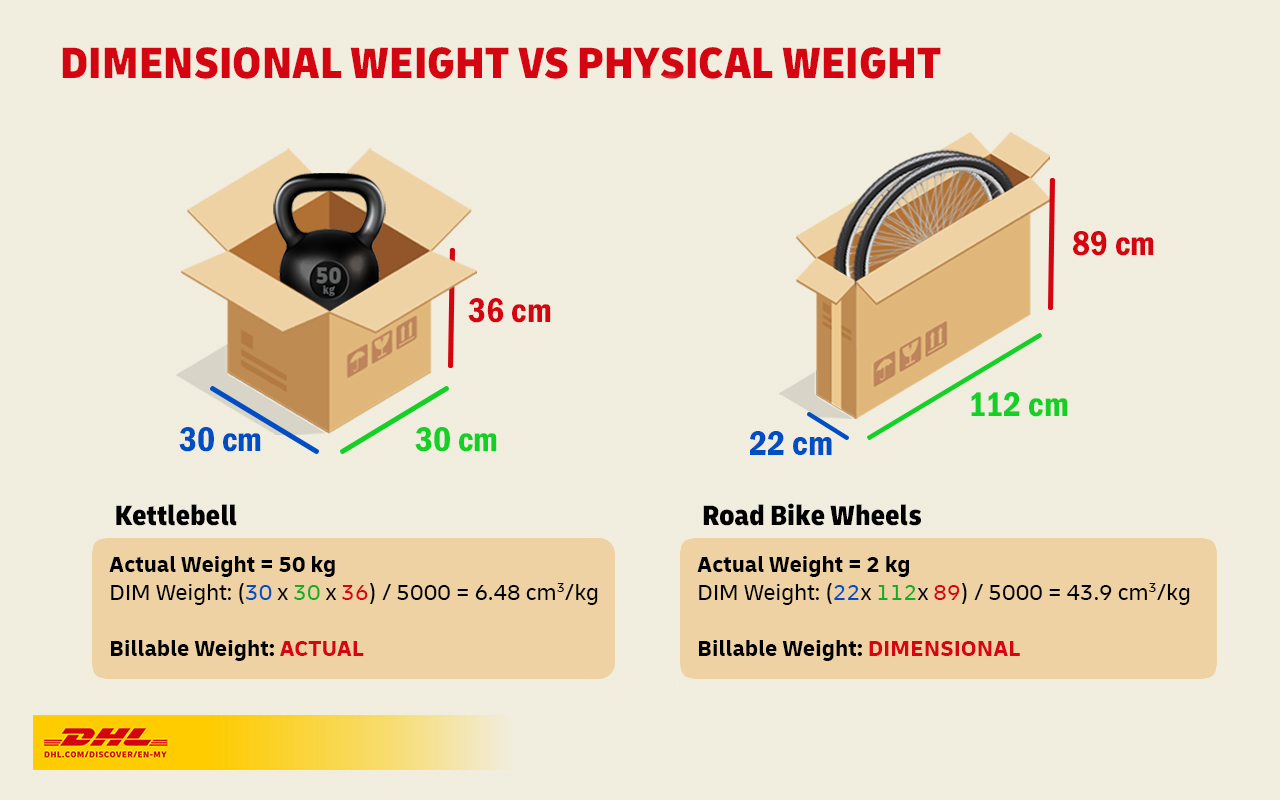
Example 1: Dimensional weight is lower than actual weight
Imagine you are shipping a heavy, compact Kettlebell.
- Dimensions of box: 30 cm (Length) x 30 cm (Width) x 36 cm (Height)
- Actual weight of item: 50 kg
Using the DHL Express DIM factor of 5000, we calculate the dimensional weight:
(30 x 30 x 36) / 5000 = 32,400 / 5000 = 6.48 kg
In this case, the dimensional weight (6.48 kg) is significantly less than the actual weight (50 kg). Therefore, the billable weight will be the actual weight of 50 kg.
Example 2: When dimensional weight is higher than actual weight
Now, let's consider a bulky but lightweight item, like a set of road bike wheels.
- Dimensions of box: 112 cm (Length) x 22 cm (Width) x 89 cm (Height)
- Actual weight of item: 2 kg
Using the same formula:
- (112 x 22 x 89) / 5000 = 219,376 / 5000 = 43.9 kg
Here, the calculated dimensional weight of 43.9 kg is much higher than the actual weight of 2 kg. The billable weight for this shipment would be 43.9 kg, leading to a much higher shipping cost than you might have expected based on the actual weight alone. This clearly demonstrates how to calculate dimensional/volumetric weight in shipping and why it's so important for controlling your expenses.
Smart packing optimisation for Japanese exporters to optimize shipping costs
Now that you understand what is dimensional weight, what can you do to ship more optimally? Here are some packaging optimisation tips you can follow to get more out of your shipping fees:
- Choose a smaller box: Always use the smallest possible box that can safely fit your product. Any empty space inside a large box is essentially air that you're paying to ship. By minimizing this empty space, you directly reduce your package's dimensions and, consequently, its dimensional weight.
- Use efficient packing materials: The materials you use to protect your items can affect its dimensional weight. Instead of bulky fillers like packing peanuts, you can opt for materials that take up less space like air pillows, bubble wrap, or even crinkled paper. These can provide excellent protection without adding excessive volume.
- Consider shipping in custom-sized boxes: If you regularly ship a product of a specific size, investing in custom-sized boxes that eliminate unnecessary volume can lower your dimensional weight.
- Ship your items disassembled: For items that can be safely taken apart, like certain furniture or electronics, disassembling them can dramatically reduce the box size required.
- Consider splitting shipments: If the dimensional weight of a single, large package will result in higher shipping costs, it may be more economical to ship the items in two smaller, separate parcels.
By adopting these practices, you can effectively manage your packaging and ensure that you're not paying to ship wasted space.
Ship smarter with DHL Express
For Japanese exporters, understanding how dimensional weight affects your shipping costs can help you optimize shipping fees and give you an edge in the global market. To help you ship smarter, DHL Express provides transparent, easy-to-use online tools to assist with every step of the process.
You can use the DHL Express MyGTS portal to find HS codes to assist with customs clearance and calculate your shipping costs before you even book a shipment, removing guesswork and giving you a clear estimation of your expenses upfront.
By leveraging DHL Express' efficient global network and adopting smart packaging optimization tips, you can ensure that your products not only reach your customers quickly and reliably but also cost-effectively.
Create a DHL Express business account today to start shipping internationally with confidence and clarity.


 Share
Share
Similar Stories