In-House or Third-Party?
If you’re a small business owner, there’s a good chance you founded your company on a “do it yourself” mentality. However, in B2B ecommerce, as the expectation of speed and efficiency rises, sometimes it makes sense to utilize third-party logistics (3PL) instead of in-house fulfillment.
Whether you're shipping pallets to distributors or handling high-volume orders for business customers, choosing between in-house operations and 3PL fulfillment services can significantly impact cost, speed, and scalability.
This guide breaks down the key differences, offers a practical cost comparison framework, and provides decision-making checklists to help you select the right logistics approach for your business.
Consider the Options
Let’s take a high-level look at 3PL vs. in-house fulfillment.
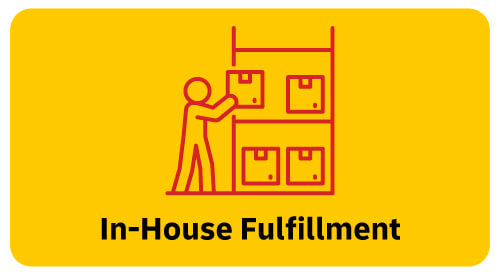
In-House Fulfillment
In-house fulfillment means managing your own warehousing, staffing, inventory, and shipping operations. This model offers full control over processes, branding, and customer experience.
Best for:
Businesses with stable order volumes
Companies requiring strict quality or compliance controls
Organizations with capital to invest in infrastructure
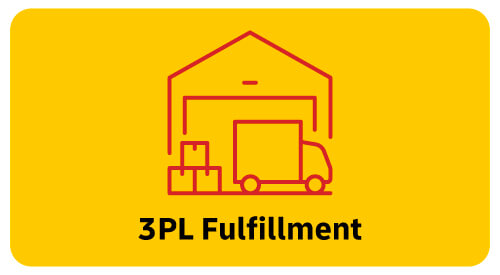
3PL Fulfillment Services
What is 3PL fulfillment? Third-party logistics fulfillment providers handle warehousing, picking, packing, and shipping on your behalf. 3PL fulfillment may also include value-added services such as returns management, kitting, and cross-border support.
Best for:
Fast-growing B2B e-commerce brands
Companies expanding into new markets
Businesses seeking operational flexibility and reduced overhead
Cost Comparison Framework
To accurately evaluate B2B fulfillment solutions, it’s essential to look beyond surface-level pricing. Use this framework to compare total cost of ownership (TCO):
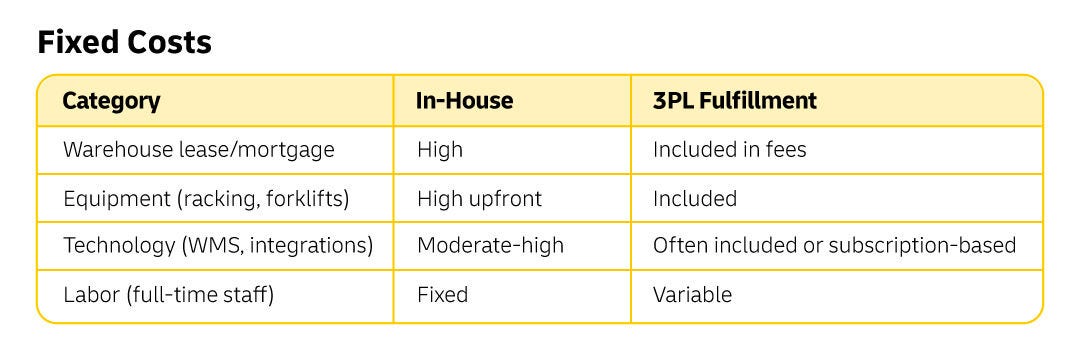
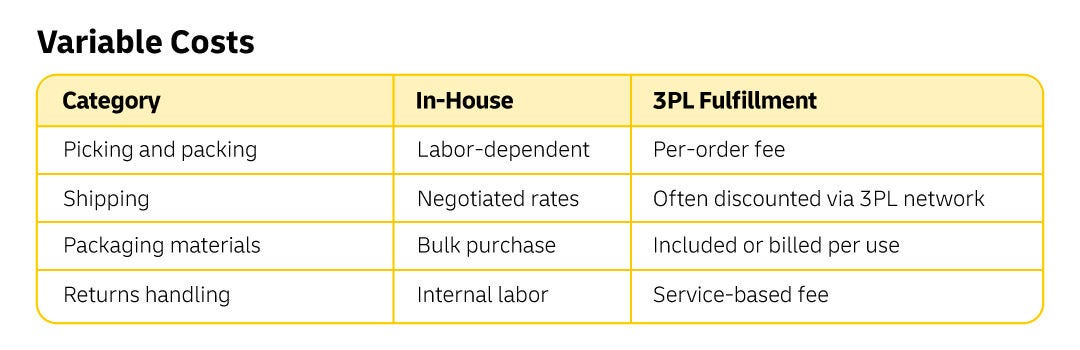
Hidden Costs to Consider
Seasonal labor spikes and overtime
Inventory shrinkage or errors
Technology upgrades and maintenance
Carrier contract negotiations
Opportunity cost of management focus
Cost Insight
While in-house fulfillment may seem cheaper at scale, 3PL fulfillment often reduces risk and makes cost more predictable, especially when demand is in flux.
Scalability Considerations
In-House Scalability Challenges
Limited warehouse capacity
Hiring and training delays
Capital expenditure for expansion
Slower entry into new geographic markets
3PL Fulfillment Advantages
Elastic storage and labor capacity
Established global distribution networks
Faster onboarding in new regions
Technology integrations for real-time visibility
3PL Checklist
How quickly can your fulfillment model adapt to 2x or 5x growth?
If the answer is unclear or resource-intensive, a 3PL fulfillment solution may offer a strategic advantage.
You can also use the following checklist to see if 3PL fulfillment is right for you. The more boxes you check, the stronger the case for 3PL.
Operational Complexity
Do you manage multiple SKUs, locations, or order types?
Are you handling bulk, palletized, or customized B2B orders?
Do you require specialized handling (e.g., temperature control, compliance)?
Growth Trajectory
Are you expecting rapid or seasonal growth?
Are you expanding into new markets or regions?
Do you need faster delivery SLAs to stay competitive?
Financial Considerations
Do you have capital for warehouse expansion?
Is cost predictability more important than cost minimization?
Are you prepared to invest in technology and automation?
Internal Resources
Consider the internal resources your team has available, and your capacity to handle growth internally. The most internal resources you have at your disposal, the more you might want to consider in-house fulfillment.
Do you have logistics expertise in-house?
Can your team manage carrier relationships and disruptions?
Are you able to maintain service levels during peak periods?
Customer Experience Goals
Is branded packaging or custom workflows critical?
If so, you might want to consider in-house fulfillment
Do your B2B customers expect fast, reliable delivery windows?
How important is real-time tracking and transparency?
A Choice for Now, a Choice for Your Future
There’s no one-size-fits-all solution when it comes to B2B fulfillment. The right choice depends on how complex your operations are, how much you plan to grow, and the resources you already have internally.
Choose in-house fulfillment if control and long-term cost optimization are your top priorities.
- Choose 3PL fulfillment services if scalability, speed, and flexibility are critical to your success.
- Some companies are adopting a hybrid model, keeping core operations in-house while outsourcing overflow, new markets, or specialized services to a 3PL fulfillment provider. A hybrid approach balances control with flexibility and can evolve as your business grows.
Craft your fulfillment strategy with your businesses’ future in mind so you can keep up with an ever-changing B2B e-commerce world.
5PL: New Dimensions with DHL
At DHL, we love helping small businesses grow. We’re in a unique position to offer 5PL—5th party logistics-fulfillment, meaning we support a full scope of logistics needs.
The most successful companies continuously reassess their fulfillment models. Whether you start in-house, move to 3PL fulfillment, adopt a hybrid approach, or want to explore 5PL fulfillment, it’s best to stay agile. Open a DHL business account today to get all the resources our partners enjoy!


 Share
Share
Similar Stories