Optimize for User Experience
For ecommerce businesses and small-to-medium-sized enterprises (SMEs), a website is more than a digital presence. It’s a sales channel, brand experience, and customer service platform combined. While many businesses excel at attracting traffic or building awareness, the real challenge is turning visitors and fans into customers.
That’s where UX design becomes essential.
So, what is UX? Today, UX, or user experience, refers to how easily and efficiently people can interact with your website. It includes everything from navigation and page layout to product presentation and checkout flows.
UX’s impact is immediate. Forbes reports that users form an opinion about a website in a fraction of a second, and 88% say they would not return after a single bad experience1. For ecommerce businesses, every effort to improve user experience can support stronger engagement and more confident buying decisions.
UX design offers businesses competing in high-volume online markets the opportunity to stand out by better showcasing their products and services and making it easier for customers to complete purchases. While it doesn’t solve everything, UX is a huge factor in supporting a company’s level of success.
Why UX Matters for Business Growth
Good UX shapes how customers move through your website and whether they complete a purchase. For ecommerce businesses, that makes UX a meaningful growth lever.
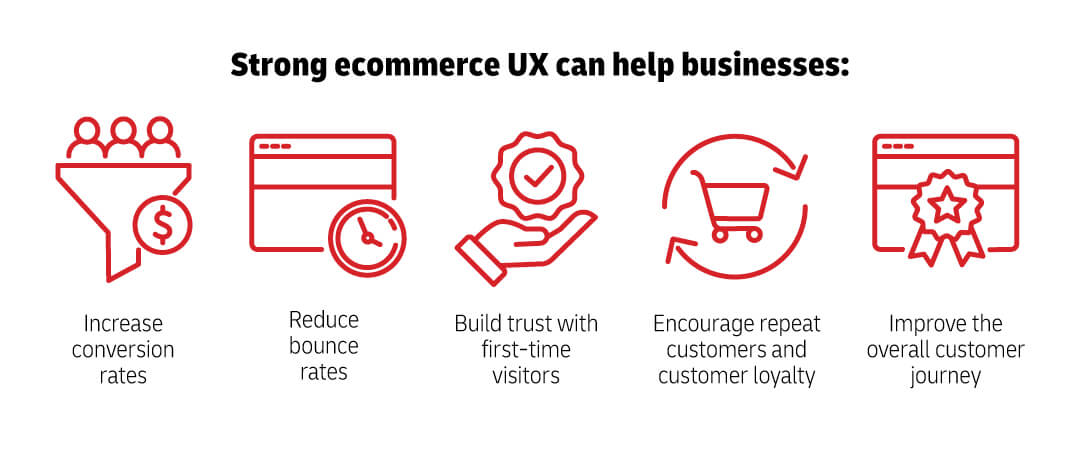
Strong ecommerce UX can help businesses:
- Increase conversion rates
- Reduce bounce rates
- Build trust with first-time visitors
- Encourage repeat customers and customer loyalty
- Improve the overall customer journey
Businesses should also recognize that UX is one part of a broader strategy. Search engines evaluate many factors, including content relevance, authority, site performance, and technical SEO.
UX works best when paired with strong content and conversion rate optimization strategies that guide users to complete purchases.
Understanding the Ecommerce Customer Journey
Improving UX requires looking beyond individual webpages and focusing on the full ecommerce customer journey.
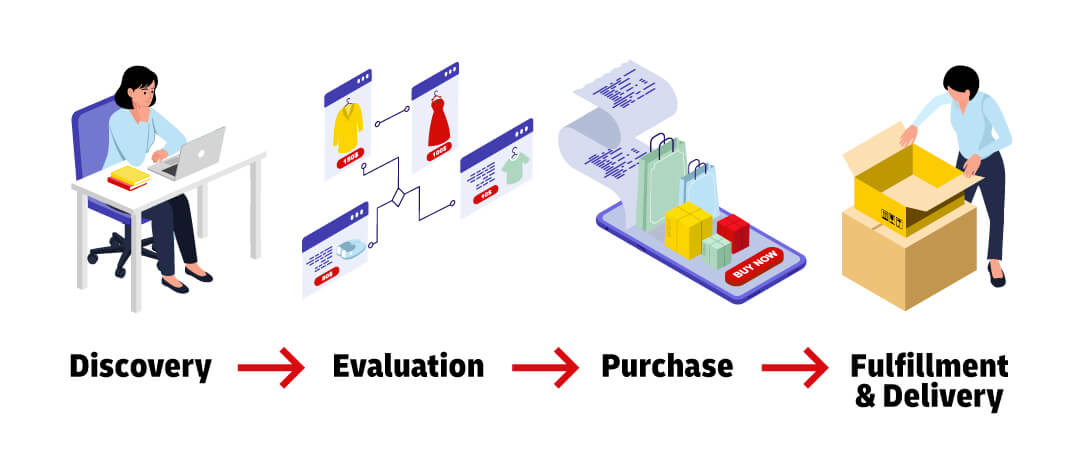
This journey typically includes four stages:
- Discovery: Customers find your website through search engines, advertising, or referrals.
- Evaluation: They compare products, read descriptions, and decide if they trust your brand.
- Purchase: Customers add items to their cart and move through checkout.
- Fulfillment and delivery: Shipping speed, reliability, and tracking play a major role in overall satisfaction.
Many businesses optimize the first three stages but ignore the last step. Delivery is a core part of the user experience2. Customers who receive clear delivery timelines and reliable shipping are more likely to return. Choosing a shipping and logistics partner like DHL takes your website’s strong experience all the way to the end of the journey.
UX Strategies to Showcase Products Effectively
One of the most important roles of UX is helping customers quickly understand your products and feel confident enough to buy.
1. Make Your Value Proposition Clear Right Away
Because users judge websites in a split second, your homepage should communicate value clearly.
Visitors should immediately understand:
- What you sell
- Who your products are for
- Why they should trust your business
Homepage UX checklist
- Clear headline describing your offering
- Visible product categories
- Simple, intuitive navigation
- Trust signals such as review highlights or certifications
- Clear calls to action
A strong homepage reduces confusion, encourages visitors to explore further, and supports the path to purchase.
2. Optimize Product Pages
Product pages are where customers decide to buy. Effective UX design gives them the information they need to buy with confidence.
Product page UX checklist
- High-quality product images from multiple angles
- Clear pricing and availability
- Detailed descriptions explaining benefits and features
- Customer reviews and ratings
- Prominent “Add to Cart” button
- Clear delivery and return information
When customers see a product’s value quickly, they’re more likely to buy.
3. Simplify Product Discovery
One of the best ways to improve user experience is to help customers find products quickly.
Navigation UX checklist
- Logical product categories
- Predictive search functionality
- Filtering options such as price, size, and color
- Breadcrumb navigation to help users move between categories
These features reduce frustration and improve the overall customer journey, particularly for stores with large product catalogs or high inventory volume.
4. Reduce Checkout Friction
Cart abandonment often happens when the checkout process feels too complex. A streamlined checkout experience can support a higher conversion rate.
Checkout UX checklist
- Guest checkout options
- Minimal form fields
- Transparent shipping costs
- Multiple payment methods
- Clear progress indicators
A simple checkout flow makes it easiest for customers to complete their purchase.
5. Integrate Delivery into the User Experience
Delivery is one of the most important factors shaping customer satisfaction. Because it often involves third-party providers, businesses need to choose shipping partners and platforms carefully.
Fulfillment and delivery UX checklist
- Clear delivery timelines
- Accurate shipping costs
- Tracking visibility
- Reliable domestic and international shipping options
Displaying this information prominently throughout the purchasing process can improve conversions and customer trust.
DHL helps growing ecommerce businesses provide fast shipping, global reach, and transparent tracking to ensure the customer has the same experience promised on the website after the order is placed.
Continuous UX Improvements for SMEs
UX optimization is an ongoing process. Successful online businesses continually refine their websites based on real user behavior.
Ways to continuously improve user experience include:
- Analyzing data to identify high drop-off pages
- Conducting A/B tests on product layouts and calls to action
- Monitoring mobile usability
- Gathering customer feedback after purchases
Even small UX improvements can add up over time and deliver measurable revenue gains.
UX as a Competitive Advantage for Ecommerce Businesses
In ecommerce, competitors are often chasing the same high-volume search traffic and working to convert site visitors into customers.
Investing in ecommerce UX and conversion rate optimization can help your business gain an edge by creating a digital storefront that guides users smoothly from discovery to delivery.
In today’s digital marketplace, businesses that improve user experience can build stronger, more resilient ecommerce operations.
DHL Delivers!
Need a reliable shipping and logistics partner to help take your UX optimized e-commerce business global? Open a business account to get started!


 Share
Share
Similar Stories