If your company depends on suppliers or manufacturers in China, you're not alone. For decades, China has served as the world's premier manufacturing hub, helping companies of all sizes secure cost-effective production and expand their operations.
However, recent global disruptions – from rising costs to geopolitical uncertainty, have highlighted the risks of relying too heavily on a single manufacturing market. As a result, many companies are exploring ways to diversify their supply chains while continuing to benefit from China's established strengths.
This approach is widely known as the China Plus One strategy. Rather than moving all production out of China, businesses expand their manufacturing or sourcing operations into additional countries to reduce risk, strengthen supply chain resilience, and unlock new growth opportunities.
In this article, we'll explore why the China Plus One framework is gaining momentum, which markets are emerging as attractive alternatives, and how businesses can successfully implement this approach.
Why are companies embracing a China Plus One Strategy?
China Plus One centers entirely on balance. It does not require abandoning China altogether – rather, it involves maintaining it as a vital component of your supply chain while incorporating at least one additional sourcing or manufacturing location.
For growing businesses, this is an effective way to reduce risk and build greater operational flexibility as they scale.
Multiple key drivers are prompting organizations to explore this approach:

Minimizing dependence on a single market
When an enterprise relies excessively on a single country, particular supplier, or logistics route, unforeseen disruptions can quickly impact inventory, delivery times, and overall customer satisfaction. Implementing a China Plus One strategy helps mitigate those risks.

Building a more resilient supply chain
The past few years have demonstrated how quickly delays; port congestion, political tensions, or extreme weather can disrupt global trade. Working with an experienced international logistics company to diversify your sourcing options gives your business greater agility to respond to disruption and maintain supply chain continuity.
Controlling Rising costs
While China continues to be a primary manufacturing hub, costs have increased significantly in certain regions. Evaluating alternative markets allows enterprises to compare production, labor, freight, and tax costs more efficiently.
Expanding into new global markets
Selecting a secondary manufacturing destination can likewise unlock valuable market opportunities. Establishing production or sourcing closer to target regions can shorten transit times and support faster international shipping, accelerating overall business expansion.
The benefits and considerations of the China Plus One strategy
As with every strategic logistics choice, China Plus One offers distinct advantages as well as potential challenges. The key is evaluating if this expansion strategy aligns with your product portfolio and commercial objectives.
Key advantages to consider
Mitigated operational risk
Diversifying supplier locations across multiple regions safeguards your business operations when unexpected disruptions strike a single market.
Diverse financial structures
Alternative markets frequently provide attractive production costs, specialized tariff relief, or favorable exchange conditions based on your industry.
Proximity to expanding target Markets
Establishing a secondary production or nearshoring hub positions closer to high-growth consumer bases, allowing for faster response to local demand.
Enhanced supply chain agility
Maintaining secondary manufacturing partnerships enables your company to adapt more effectively during delivery bottlenecks, sudden volume surges, or revised customs regulations.
Access to specialized regional expertise
Various global manufacturing hubs feature deep domain talent across targeted sectors, including automotive components, electronics, textiles, and medical devices.
Potential challenges to evaluate
Upfront investment and onboarding costs
Identifying, vetting, and integrating reliable manufacturing partners demands dedicated time and initial capital investment.
Quality assurance Requirements
Fresh vendor relationships require rigorous auditing and ongoing communication to preserve brand consistency and product excellence.
Regulatory and customs compliance
Every market has its own trade policies, documentation standards, and commercial practices. Partnering with an experienced international logistics company helps ensure that you understand and address these requirements early to eliminate delivery delays and unexpected fees.
Macroeconomic and geopolitical factors
While supply chain diversification minimizes vulnerability, it cannot completely eliminate global trade risks. Foreign exchange fluctuations, labor shifts, policy updates, and severe weather patterns still require proactive management.
Top regional markets for a China Plus One strategy
There is no one-size-fits-all destination. The ideal expansion hub relies on your specific products, primary buyer locations, cost structures, and required fast international shipping speeds.
Here are the prominent sourcing hubs leading global enterprises are exploring:
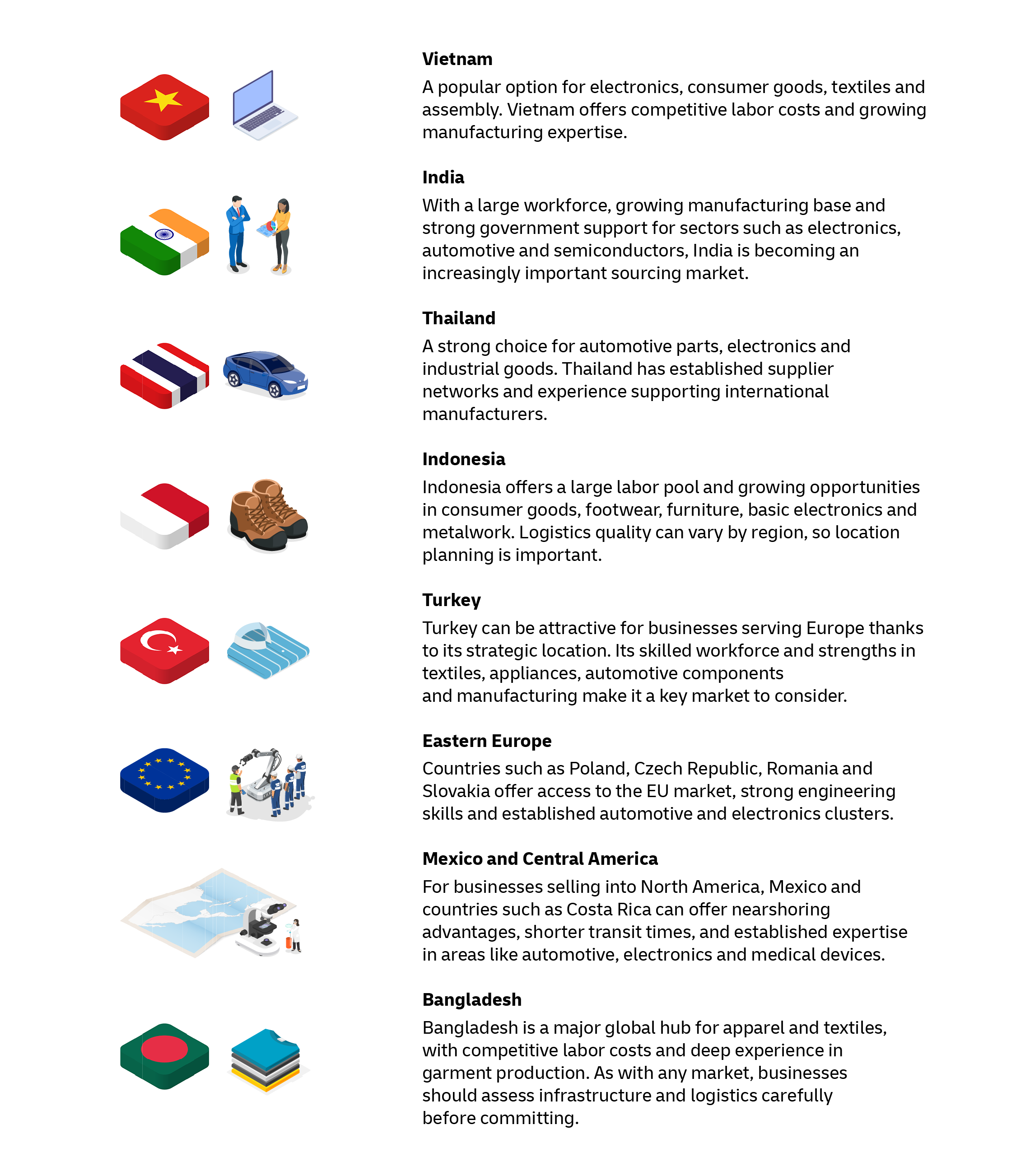
Which industries are adopting the China Plus One strategy?
Although companies across many industries are exploring supply chain diversification, certain industries have been faster at adopting the China Plus One strategy than others.

Electronics
Technology and electronics companies often rely on complex global supply chains and tightly controlled production schedules. To reduce risk and improve operational flexibility, many manufacturers have expanded their operations into countries such as Vietnam, India, and Mexico, supported by specialized nearshoring logistics solutions.

Apparel and textiles
With rising manufacturing expenses across key Chinese regions, numerous clothing brands have turned to countries such as Bangladesh, India, and Turkey for supply chain support. These destinations feature well-established manufacturing sectors alongside skilled workforces.

Automotive Industry
The vehicle manufacturing sector relies heavily on extensive networks of suppliers and producers operating seamlessly across multiple countries. Consequently, many automotive brands are diversifying their operations across locations such as Thailand, Indonesia, Mexico, and Eastern Europe to enhance supply chain resilience and improve access to key regional markets.

Life Sciences & Healthcare
Within the pharmaceutical, healthcare, and medical device sectors, regulatory compliance and operational reliability are paramount. Emerging production centers such as Singapore and Costa Rica allow companies to mitigate risk while preserving strict quality standards through specialized business logistics services.
Which global brands are actively implementing the China Plus One Strategy?
Apple historically manufactured around 90% of its hardware in China, but has significantly lowered its dependency by relocating device assembly to India, Vietnam, and Mexico. Evolving geopolitical dynamics, including U.S. trade policies, China’s countermeasures, and global supply chain disruptions, have driven Apple to diversify its manufacturing footprint. Apple’s China-based production dropped to around 75%, with approximately 20% of iPad assembly and 65% of AirPod assembly relocating to Vietnam. Furthermore, Apple’s key manufacturing partners, including Foxconn, Pegatron, Luxshare, and Wistron,have expanded manufacturing operations across Mexico and Vietnam to accommodate this transition (1).
California-headquartered MGA Entertainment, creators of the Bratz and L.O.L. Surprise! lines, historically concentrated production in China. In 2025, the company decided to shift 40% of its manufacturing operations to India, Vietnam, and Indonesia. CEO Isaac Larian explained that roughly 60% of production remains in China following this swift transition toward alternative Southeast Asian hubs. He emphasized that the company might need to increase wholesale prices on Chinese-manufactured goods to safeguard narrow profit margins. MGA’s strategy illustrates how consumer goods brands, heavily dependent on Chinese factories, are pivoting rapidly in response to shifting trade policies and tariff adjustments (2).
Selecting the optimal China Plus One destination
Before committing to an alternative manufacturing hub, companies must evaluate factors far beyond basic labor costs.
Key criteria to evaluate:
- Total operational and overhead expenditures: Will the target region meaningfully optimize operational costs without compromising product quality?
- Transport networks and infrastructure capability: Are there robust freight hubs, modern highways, and reliable business logistics services available to keep your supply chain moving efficiently?
- Labor talent and technical capabilities: Does the regional workforce possess the specialized skills required for your product category?
- Vendor compliance and quality control: Are prospective partners capable of adhering to international quality standards, safety requirements, and ethical practices?
- Geopolitical stability and operational risk: Assess macroeconomic conditions, political stability, and regional climate-related risks.
The ideal expansion destination varies significantly for each company. The objective is never simply to find the lowest cost option; it is to build a resilient foundation that supports sustainable international growth.
A strategic 5-step roadmap to implement a China Plus One framework
Transitioning a portion of your sourcing footprint outside China does not require an immediate, full-scale overhaul. Adopting a structured, phased roadmap allows your organization to reduce risk, manage capital outlay, and validate new operational models effectively.
1. Audit your existing supply chain network
Begin by identifying your most critical supply chain risk. Which core SKUs generate the most revenue? Which vendors pose severe operational risks if bottlenecks occur?
Document all critical supplier relationships and freight routes highlighting single-source dependencies that could jeopardize business continuity.
Strategic advice: Prioritize your high-demand products and those that require longer transit times.
2. Evaluate secondary manufacturing hubs
Investigate potential countries that complement your existing operations in China. Analyze manufacturing costs, workforce expertise, local infrastructure, trade agreements like USMCA, and proximity to key customer markets.
Rather than executing a large-scale relocation immediately, launch a controlled pilot with a selected product line to evaluate supplier performance, production costs , and fast international shipping lead times.
Strategic advice: Initiating a targeted pilot program can help identify potential challenges before significant investments are made.
3. Deploy advanced end-to-end tracking tools
Gaining real-time visibility across multi-country supplier networks is essential for operational success.
Leverage digital management platforms to monitor cargo movements and proactively identify potential transit delays. Enhanced visibility enables more agile decision making. Helping prevent stockouts and inventory bottlenecks.
Strategic advice: Integrating real-time tracking solutions provides actionable business insights as your international distribution network expands.
4. Cultivate resilient supplier partnerships
Identifying suppliers is only the first step. Thoroughly audit prospective manufacturing partners to confirm they possess the operational capacity to scale alongside your business.
Transparent communication, aligned KPIs, and clearly defined quality standards foster mutual trust while preventing costly mistakes in the future.
Strategic advice: Maintain secondary pre-approved suppliers for mission-critical inventory to strengthen overall business resilience.
5. Partner with an established international logistics company
As your global distribution model expands, supply chain coordination becomes increasingly complex. Collaborating with a trusted international logistics company that understands cross-border customs regulations, trade compliance requirements , and regional transportation infrastructure helps to ensure smooth end-to-end delivery.
Work with an industry-leading global carrier with extensive customs clearance expertise—such as DHL Express—to support reliable international shipping for small and medium-sized businesses and growing companies.
Strategic advice: Start with small-scale shipping pilots before expanding into new international markets or onboarding additional manufacturing facilities.
Essential action items prior to launching your operations
✓ Audit your key product lines and core supplier relationships.
✓ Identify a secondary sourcing hub to diversify risk.
✓ Run a pilot production order with a prospective manufacturing partner.
✓ Deploy real-time tracking and inventory management software.
✓ Verify the documentation required to export and streamline customs clearance.
✓ Develop risk mitigation strategies for potential supply chain disruptions.
✓ Select an international logistics company capable of supporting cross-border expansion.
How DHL Express supports your China Plus One supply chain strategy
As global distribution networks diversify, managing fast international shipping across borders becomes increasingly complex. Moving inventory across multiple sourcing locations, complying with customs requirements, and maintaining real – time shipment visibility all require strategic coordination.
DHL Express supports companies that require international shipping solutions for small and medium-sized businesses as well as growing enterprises through:




Whether you are evaluating an alternative supplier, expanding into a new market, or strengthening your distribution network, relying on expert business logistics services minimizes operational challenges and supports business continuity.
China Plus One does not aim to replace Chinese manufacturing altogether, it focuses on building more agile operations, greater resilience, and long-term growth opportunities. By combining a clear implementation plan with an experienced international logistics, your enterprise can successfully navigate the next phase of global trade.
Regardless of where your expansion journey leads, DHL Express delivers end-to-end support. With an unrivaled network spanning more than 220 countries and territories, DHL Express remains a trusted partner for fast and reliable international shipping.


 Share
Share

Similar Stories