If your business relies on suppliers or manufacturers in China, you're not alone. For years, China has been the world's manufacturing powerhouse, helping businesses of all sizes access cost-effective production and scale their operations.
But recent disruptions – from rising costs and geopolitical uncertainty – have highlighted the risks of relying too heavily on a single market. As a result, many businesses are exploring ways to diversify their supply chains while continuing to benefit from China's strengths.
This approach is known as the China Plus One strategy. Rather than moving production out of China altogether, businesses add manufacturing or sourcing operations in another country to spread risk, improve resilience and create new opportunities for growth.
In this article, we'll explore why the China Plus One strategy is gaining momentum, which markets are emerging as popular alternatives, and how businesses like yours can take steps to adopt it.
Why are businesses adopting a China Plus One strategy?
China Plus One is all about balance. It doesn’t mean leaving China behind – instead, it means keeping it as an important part of your supply chain while adding at least one other sourcing or manufacturing location.
For SMEs, that can be a smart way to reduce risk and build a more flexible operation as the business grows.
Several factors are encouraging businesses to explore this approach:
Reducing reliance on one market
If your business depends heavily on one country, one supplier or one route, disruption can quickly affect stock levels, delivery times and customer experience. A China Plus One strategy helps spread that risk.

Building a more resilient supply chain
Recent years have shown how quickly delays, port congestion, political tensions or extreme weather can affect international trade. Having more than one sourcing option can give your business more room to adapt.

Managing rising costs
China remains a major manufacturing hub, but costs have increased in some regions. Exploring other markets can help businesses compare production, labor, shipping and tax costs more effectively.
Reaching new markets
Choosing a “Plus One” location can also open doors to new customers. Manufacturing or sourcing closer to key markets can help reduce delivery times and thus support international growth.
The benefits and challenges of China Plus One
Like any supply chain decision, China Plus One comes with opportunities and trade-offs. The key is understanding whether the approach makes sense for your business and products.
The potential benefits
Lower risk
Using suppliers in more than one country can help protect your business if disruption affects one location.
More cost options
Alternative markets may offer competitive production costs, tax incentives or favorable exchange rates, depending on the country and sector.
Access to new customers
A new sourcing or manufacturing location can help you get closer to growing markets and better understand local demand.
Greater flexibility
With more than one supplier base, your business may be better placed to respond to delays, demand spikes or changes in trade rules.
Specialist skills and capabilities
Some countries have strong expertise in specific industries, from textiles and electronics to automotive parts and medical devices.
The challenges to consider
Set-up costs
Finding, testing and onboarding new suppliers takes time and investment.
Quality control
New suppliers may need careful checks and regular communication to ensure product quality remains consistent.
Regulations and compliance
Every market has its own rules, documentation requirements and business practices. Understanding these early can help avoid delays or unexpected costs.
Political and economic risk
Diversification reduces some risks, but it doesn’t remove them completely. Currency changes, labor issues, regulations and extreme weather can still affect operations.
Key China Plus One markets to consider
There is no single “best” China Plus One location. The right choice depends on what you sell, where your customers are, your cost priorities and how quickly you need goods to move.
Here are some of the markets businesses are exploring:
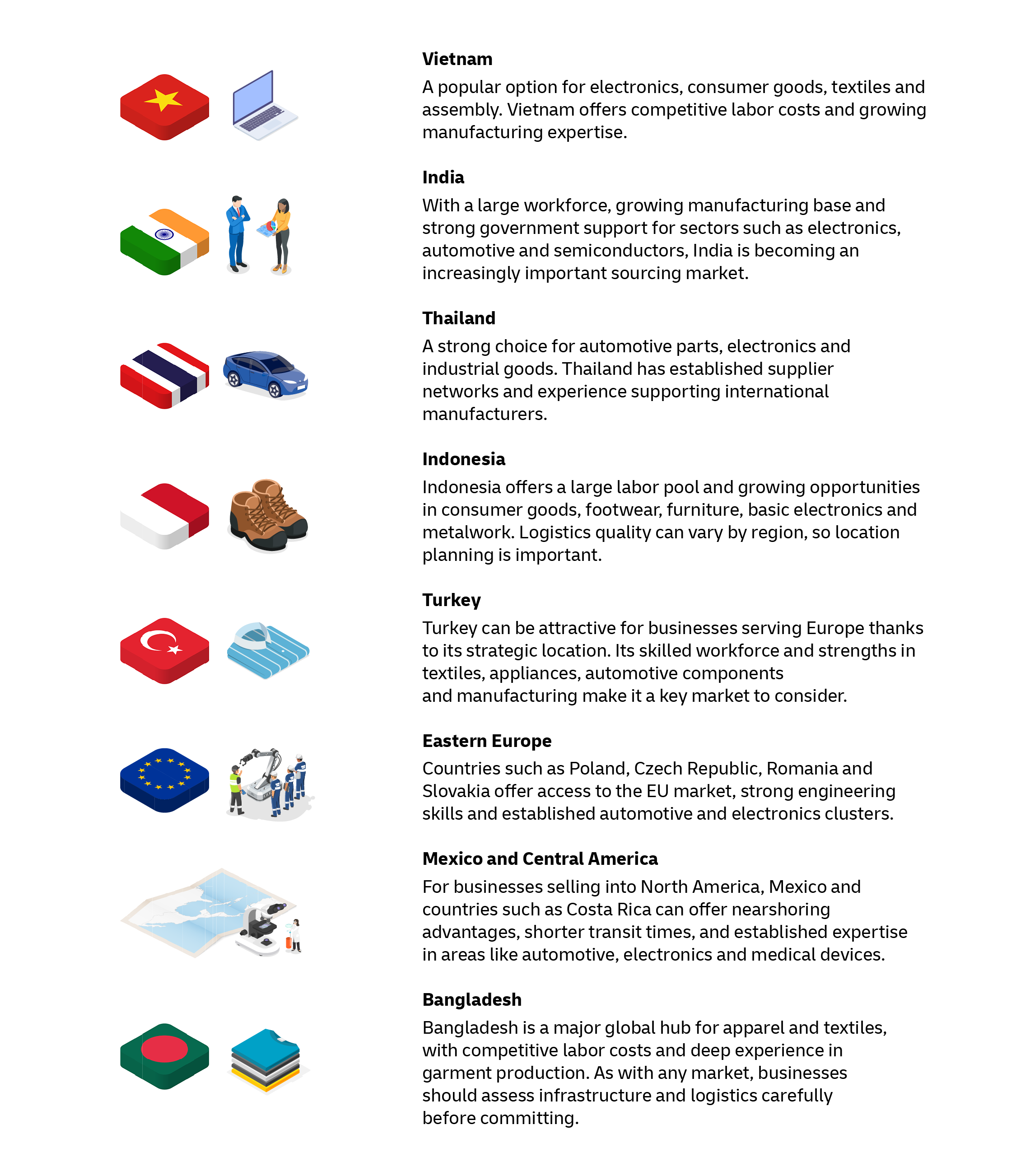
Which industries are embracing China Plus One?
While businesses across many sectors are exploring supply chain diversification, some industries have been quicker to adopt the China Plus One approach than others.

Electronics
Electronics businesses often rely on complex global supply chains and tightly managed production schedules. To reduce risk and increase flexibility, many manufacturers have expanded operations into countries such as Vietnam, India and Mexico.

Textiles and apparel
As production costs have increased in some parts of China, many fashion and apparel brands have looked to countries including Bangladesh, India and Turkey for manufacturing support. These markets offer established textile industries and experienced workforces.

Automotive
The automotive sector depends on large networks of suppliers and manufacturers working together across multiple countries. As a result, many companies are diversifying production across locations such as Thailand, Indonesia and Eastern Europe to strengthen resilience and improve access to regional markets.

Life sciences
For pharmaceutical, healthcare and medical device companies, compliance and reliability are critical. Countries including Singapore and Costa Rica have become important manufacturing hubs, helping businesses reduce risk while maintaining high quality standards.
Who is adopting the China Plus One model?
Apple produced around 90% of its tech in China, but has reduced its dependency by moving some device assembly to India, Vietnam and Mexico. Recent geopolitical shifts, such as US Trade policy, along with China’s counter measures and the pandemic’s impact, have encouraged Apple to diversify its supply chain. Apple’s China-based production has decreased to around 75% with 20% of iPad and 65% of AirPod production moving to Vietnam. And Apple’s contract manufacturers such as Foxconn, Pegatron, Luxshare and Wistron have expanded their production capacities into Mexico and Vietnam to support the shift.1
California-based MGA Entertainment, makers of the Bratz and L.O.L. Surprise! toy ranges primarily focused production in China. In 2025, the company took the decision to move 40% of its manufacturing to India, Vietnam and Indonesia. CEO Isaac Larian said roughly 60% of the company’s manufacturing will still be in China after the rapid shift to alternative SEA sources. He noted that the company may have to raise wholesale prices on China-made products to protect already-thin profit margins. MGA’s plans show how U.S. makers of everyday items, who rely heavily on Chinese factories for their products, are adjusting as quickly as possible in response to the trade and tariff realignment.2
How to choose the right China Plus One location
Before choosing a new sourcing or manufacturing location, it's important to look beyond labor costs alone.
Consider:
- Production and operating costs: Will the new location genuinely help reduce costs without affecting quality?
- Transport and logistics infrastructure: Are there reliable ports, airports and road networks that can support your shipping needs?
- Workforce and skills: Does the country have the expertise needed for your products and industry?
- Supplier quality and compliance: Can suppliers meet your standards for quality, safety and ethical practices?
- Stability and risk: Consider factors such as political stability, economic conditions and exposure to natural disasters.
The right location will look different for every business. The goal isn't to find the cheapest option – it's to find the best fit for your long-term growth strategy.
Five steps to get started with a China Plus One strategy
Moving part of your sourcing or manufacturing outside China doesn't have to happen overnight. A phased approach can help you reduce risk, control costs and test what works for your business.
1. Review your current supply chain
Start by understanding where you're most exposed. Which products are critical to your business? Which suppliers would cause the biggest disruption if they experienced delays?
Map your key suppliers and shipping routes, then identify any areas where you rely heavily on a single supplier or location.
Tip: Focus first on your best-selling products or those with the longest lead times.
2. Explore alternative sourcing locations
Research countries that could complement your existing operations in China. Consider factors such as manufacturing costs, workforce skills, infrastructure, trade agreements and proximity to your customers.
Rather than making a large-scale move immediately, test a small product range or production run in a new location to assess quality, costs and lead times.
Tip: Running a pilot project can help you identify potential challenges before scaling up.
3. Invest in supply chain visibility
The more visibility you have over your inventory and shipments, the easier it is to manage a multi-country supply chain.
Use digital tools to track orders and identify shipment delays early. Better visibility can help you make faster decisions and avoid costly stock shortages.
Tip: Even simple tracking and inventory management tools can provide valuable insights as your supply chain grows.
4. Build strong supplier relationships
Finding a supplier is only the first step. Take time to assess potential partners and ensure they can support your long-term growth plans.
Strong communication and clear expectations can help build trust and reduce the risk of problems later on.
Tip: Consider having more than one approved supplier for your most important products to improve resilience.
5. Partner with an experienced logistics provider
As your supply chain becomes more diverse, logistics can become more complex. Working with a logistics partner that understands international shipping, customs requirements and local market conditions can help keep goods moving efficiently.
Look for a provider with global reach and customs expertise (like DHL Express!) that can support your business as it grows.
Tip: Start with a small-scale shipping pilot before expanding to additional suppliers or markets.
Practical checklist before you go live
✓ Review your most important products and suppliers
✓ Identify at least one alternative sourcing location
✓ Test a new supplier or production run
✓ Put shipment and inventory tracking tools in place
✓ Confirm your logistics and customs processes
✓ Establish contingency plans for potential disruptions
✓ Choose a logistics partner that can support cross-border growth
How DHL Express can support your China Plus One strategy
As supply chains become more diverse, managing international shipping can become more complex. Moving goods between multiple sourcing locations, navigating customs requirements and maintaining visibility across shipments all require careful planning.
That's where an experienced logistics partner can help.
DHL Express supports businesses shipping internationally through:


Whether you're testing a new supplier, expanding into a new market or building a more resilient supply chain, the right logistics support can help reduce complexity and keep your business moving.
China Plus One isn't about replacing China. It's about creating greater flexibility, resilience and opportunity for growth. With the right strategy – and the right logistics partner – your business can confidently navigate the next chapter of global trade.
Wherever your China Plus One strategy takes you, DHL Express can get you there. With a presence in over 220 countries and territories, DHL Express is your go-to for fast international shipping.


 Share
Share

Similar Stories