Sitting at the heart of international trade, the Certificate of Origin (COO) is often referred to as the economic passport of a product. It formally certifies the country where goods were manufactured, produced, or substantially transformed, giving customs authorities the information they need to determine trade eligibility.
For a major exporting nation like Indonesia, where total exports were valued at US$ 266.33 billion in 20241, getting origin right is a critical pillar of international trade. Knowing what the certificate of origin is, and how it functions is essential, as it can influence tariffs, duties, and overall international shipping costs.
A COO document is especially important when exporting goods under trade deals like the ASEAN Free Trade Area (AFTA), where a preferential COO can mean lower taxes. On the other hand, a non-preferential certificate simply confirms the origin without influencing trade benefits, but remains necessary for global commerce. Whether you are new to exports or experienced in international trade logistics, understanding the purpose of a COO is crucial for smooth, compliant transactions.
Why Certificate of Origin is important in 2026
In today’s dynamic global trade environment, knowing the origin of your products is more important than ever. Origin determines not just tariffs but also a business’s vulnerability to regulatory scrutiny. Even minor misrepresentations can be interpreted as Customs Fraud in some jurisdictions, leading to heavy fines or blacklisting.
The principle of Substantial Transformation is at the core of origin determination. If an exporter imports raw materials into Indonesia and adds significant value through manufacturing or assembly, the “Origin” may legally change to Indonesia. However, if goods are merely repackaged or undergo minimal modification, the original country of production remains the official origin. This distinction has far-reaching consequences for duties, compliance, and reputation.
International courier service providers frequently flag COO documentation issues because mislabeling or incomplete forms can lead to shipment delays. For Indonesian exporters, maintaining clarity on product origin is essential, not only to avoid penalties but to ensure predictable landed costs and timely delivery.
Example: Exporting China-origin goods from Indonesia to the USA
Consider an Indonesian exporter shipping goods to the United States that were originally sourced from China. While the goods physically depart from Indonesia, US Customs and Border Protection (CBP) evaluates the Production Point, the country where the goods were actually manufactured.
This scenario highlights why Certificate of Origin is important. Even if products are temporarily stored or minimally modified in Indonesia, Section 301 duties on Chinese goods still apply unless the items are deemed Substantially Transformed into Indonesian products.
Misrepresenting the origin or failing to provide a necessary COO document can result in penalties, shipment delays, or seizure by customs authorities. In short, for any shipment, a COO is a required proof that underpins correct tariff application and compliance.
Landed cost simulation: The financial impact of COO
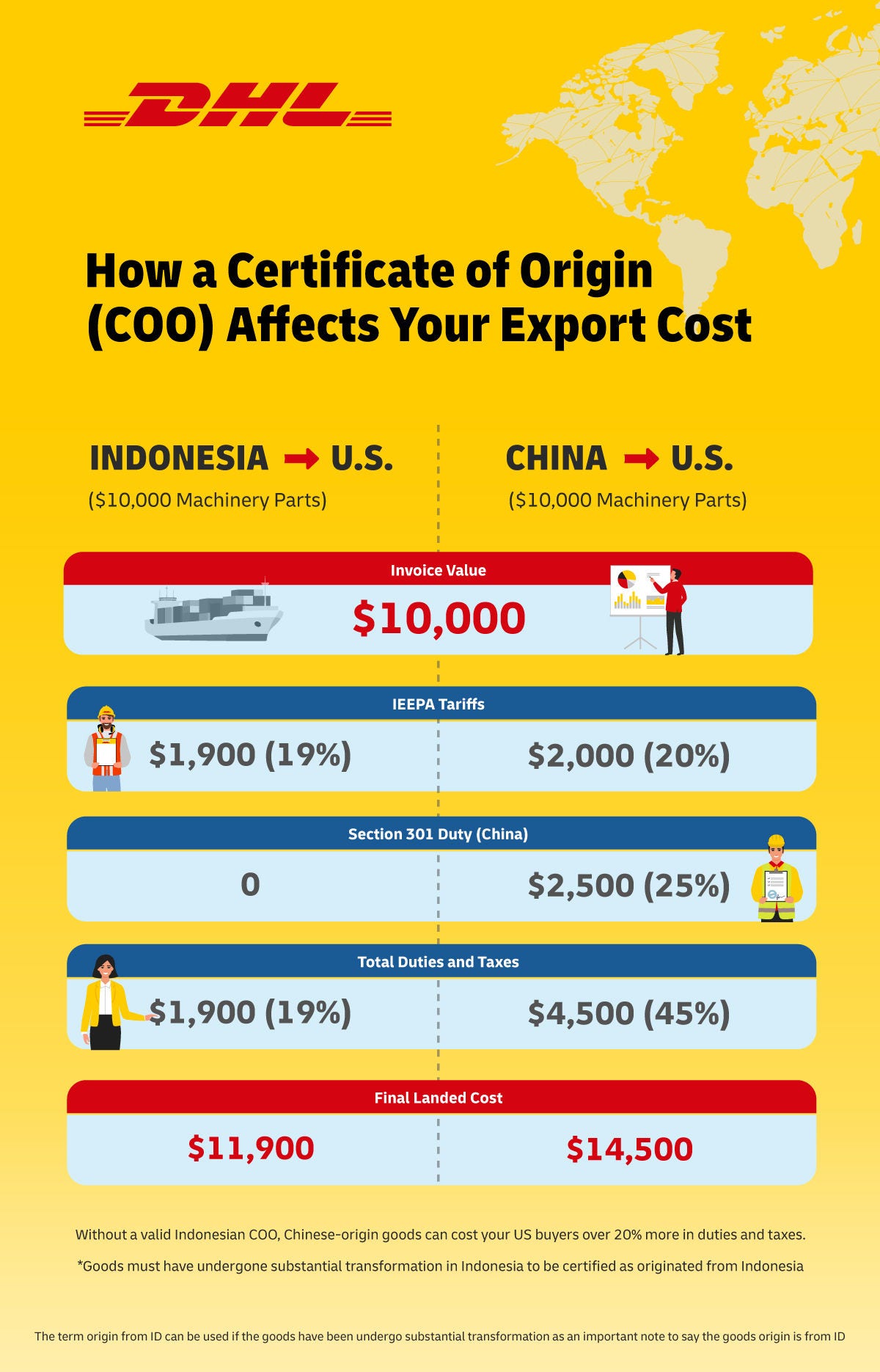
To put the financial implications into perspective, let’s have an example where a US$10,000 shipment of machinery parts or valves, classified under HS code 8481.90.90.20, is being exported to the United States.
Two scenarios illustrate the difference: one product is verified as Indonesian Origin, while the other, originally from China, is shipped from Indonesia without Substantial Transformation.
Cost Component | Product A: Indonesian Origin (US$) | Product B: Chinese Origin (US$) |
Invoice Value | 10,000 | 10,000 |
IEEPA Tariffs | 1,900 (19%) | 2,000 (20%) |
Section 301 Duty (China) | 0 | 2,500 (25%) |
Total Duties and Taxes | 1,900 (19%) | 4,500 (45%) |
Final Landed Cost | 11,900 | 14,500 |
This simple simulation shows that even when Chinese-origin goods are shipped from Indonesia, they can cost over 20% more for the buyer due to US tariffs.
How to manage COO as an Indonesian exporter
For exporters, managing a COO isn’t just about paperwork. It’s a risk mitigation and strategic tool.
Transparency is key: Always declare the true origin on the Commercial Invoice. Attempting shortcuts or inaccurate declarations can lead to fines or shipment seizure by customs.
Maintain a paper trail: When export products contain components from multiple countries, keeping detailed Bills of Materials (BOM) and production records proves the level of value added in Indonesia. This documentation is essential to justify a change in origin and supports audits or inquiries.
Types of Certificate of Origin: Exporters can choose between preferential COO documents for trade agreements, like AFTA, and non-preferential COO for general proof of origin. Both play distinct roles depending on tariffs, trade deals, and customer requirements.
Recognising the importance of Certificate of Origin helps businesses make informed decisions, avoid penalties, and strengthen their international reputation. Proper COO management ensures that Indonesian exporters meet compliance requirements while maintaining competitive pricing for their customers.
Turning Certificates of Origin into a strategic advantage
The Certificate of Origin is more than a formal requirement, it is a strategic tool for businesses engaged in international trade and shipping. For Indonesian exporters, understanding the difference between the country of export and the country of origin is crucial to navigating tariffs, trade agreements, and regulatory scrutiny.
From accurate declarations to careful record-keeping and strategic planning, managing COO effectively can prevent costly surprises and build credibility in global markets. It is one of the fundamental elements in international logistics that determines both compliance and competitiveness.
For Indonesian SMEs looking to streamline their export process, partnering with an experienced international courier service is essential. Open a DHL Express business account today to work with our customs specialist and secure your export path with confidence.


 Share
Share
Similar Stories