#LogisticsAdvice

Rules of Origin: How to Calculate Regional Value Content and Protect Your Trade Discounts

Key Takeaways

  • RVC Metrics: Calculate your regional value content to prove the origin of your goods.
  • Tariff Qualification: Shift your product classifications to unlock lower cross-border tariff rates.
  • Audit Protection: Keep detailed material logs to reduce the risk of retroactive penalty duties.
  • Digital Checks: Check regional thresholds before shipping to protect your global margins.

Every rupiah you pay in unnecessary customs duties is a direct hit to your operating margin. Often, these extra duties can be traced back to one small component: something unverified that disqualifies your entire production run from free trade agreement discounts, meaning you pay the full rate instead. DHL Express helps compliance teams across Indonesia check these calculations before a shipment ever leaves the warehouse. Here's how to calculate your regional value content and keep your trade discounts intact.


How do you calculate regional value content?

Regional value content, or RVC, is the percentage of a product's value that comes from inside a specific trade zone. The higher that percentage, the more likely your goods will qualify for lower tariffs. If you fall short of the threshold your trade agreement sets, customs will charge you the standard import duty instead.

Why small errors turn into big problems

When this check is overlooked, small slip-ups in your material records can add up quickly. If customs later audits your file, those same oversights can flip your product's origin status and wipe out the trade benefit you were counting on for your business.

This is precisely where a tool like My Global Trade Services (MyGTS) proves its value. Since every trade agreement sets its own RVC threshold, MyGTS lets you check the specific rule for your country and product combination before you ship, saving you the effort of working it out by hand.

Four ways to break down your material value

Whichever method you choose for your calculation, you need clear visibility into every input in your supply chain. If you're tracking material costs from a manufacturing base in an area like the Cikarang industrial estate, you'll want to check every input closely. Each approach below looks at cost from a different angle:

  • Transaction Value: Work out what share of the final sale price comes from materials that don't originate in the trade zone.
  • Net Cost: Break down your factory costs into materials, labour, and overhead to see what's genuinely local.
  • Origin Mapping: Get formal declarations from your vendors to check where every component comes from.
  • Currency Shifts: Monitor how exchange rates alter your regional value content metrics over time.

Even a small error here can add up to a significant amount. A cost variance of 825,000 IDR per unit might look trivial on its own, but when you multiply that across a year of production, it becomes very real money.


What is a tariff shift, and how does it affect your components?

A tariff shift is a simpler idea than it sounds: it just means your imported materials are processed enough in your factory to earn a new classification code. If a part goes in under one code and comes out under a different one, that change is what proves to customs that real manufacturing happened in your country.

Where this catches manufacturers out

Getting this wrong on complex industrial components can be costly, especially at manufacturing hubs like the Batam Free Trade Zone. If an imported part enters your factory and leaves under the exact same code, customs will treat it as non-originating, no matter how much processing actually took place.

MyGTS can help you work through the classification codes involved, though your team is still responsible for making the final call on classification and origin.

Four steps to confirm a valid tariff shift

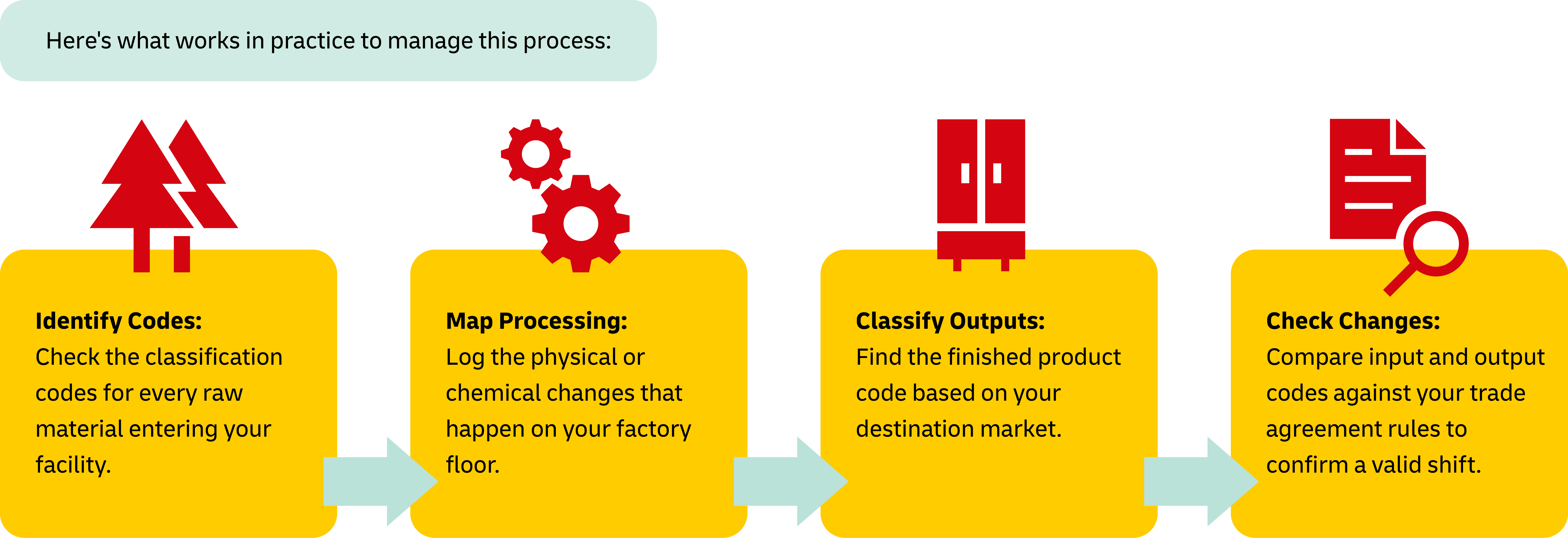
We recommend working through these four steps in order:

  • Identify Codes: Check the classification codes for every raw material entering your facility.
  • Map Processing: Log the physical or chemical changes that happen on your factory floor.
  • Classify Outputs: Find the finished product code based on your destination market.
  • Check Changes: Compare input and output codes against your trade agreement rules to confirm a valid shift.

What happens if you get an origin claim wrong?

Should you get an origin claim wrong, the consequences aren't small: you could lose your preferential trade status, be flagged by customs, and face fines applied retroactively. Under Indonesian customs law, agencies can audit your trade records and re-determine duties for up to two years after a shipment clears the border.

How one mistake snowballs

One clerical error can multiply across hundreds of past shipments, and a formal trade investigation can slow down shipping for all your goods, not just the one shipment in question.

MyDHL+'s pre-clearance features help by checking your documents line by line before you ship, catching missing data before it ever reaches the border.

Where most compliance gaps show up

It's a good practice to run through these common gaps before you file.

Origin Risk Area

Operational Threat

Recommended Action

Missing Records

High risk of preference denial

Use mandatory origin certificates in all supplier contracts

Outdated Codes

Medium risk of customs delays

Check your product catalogue against destination updates annually

Transit Routing

High risk of origin disqualification

Use Bonded Transit options where available to help protect cargo

Inadequate Archives

High risk of penalties for non-compliance

Keep secure manufacturing records for at least ten years.

Keeping a close eye on all of this helps protect your cash flow. We always advise making sure your documentation meets the standards set by the Directorate General of Customs and Excise (Bea Cukai) before you file your export declarations.


Protect your trade discounts today

Successfully managing rules of origin comes down to carefully checking your value calculations and classification shifts, every single time. DHL Express is here to support that process with tools like MyGTS for threshold and classification checks and MyDHL+ for pre-clearance document review, helping ensure fewer surprises reach the border.

Speak to a DHL specialist today to check your material logs and ship with confidence.


Frequently Asked Questions

RVC is simply the percentage of your product's value that comes from inside a trade zone, and it's what proves your goods qualify for a lower tariff. If you fall short of your trade agreement's threshold, customs will apply the standard duty instead, which can impact your profit margins.

A tariff shift focuses on your imported materials changing their classification code through local manufacturing. In contrast, an RVC calculation is about the monetary value you add through local materials, labour, and overhead. Customs can use either method to determine where your product truly originates.

Yes. If an audit finds errors in your origin claims, Indonesian customs authorities can re-assess your shipments and require you to pay any duties you underpaid. This can apply to shipments cleared up to two years previously, turning small past mistakes into significant current liabilities.

MyGTS shows you the specific origin thresholds and rules for your regional trade zone before you ever ship anything. This allows your team to spot available preferential rates and catch classification errors early, well before they turn into a problem at the border.

We're here to support your team with documentation readiness and compliance checks through tools like MyGTS and MyDHL+. Your internal compliance team is still the one responsible for verifying the final classification and origin numbers, so it's best to treat our tools as a helpful check in your process, not a replacement for it.